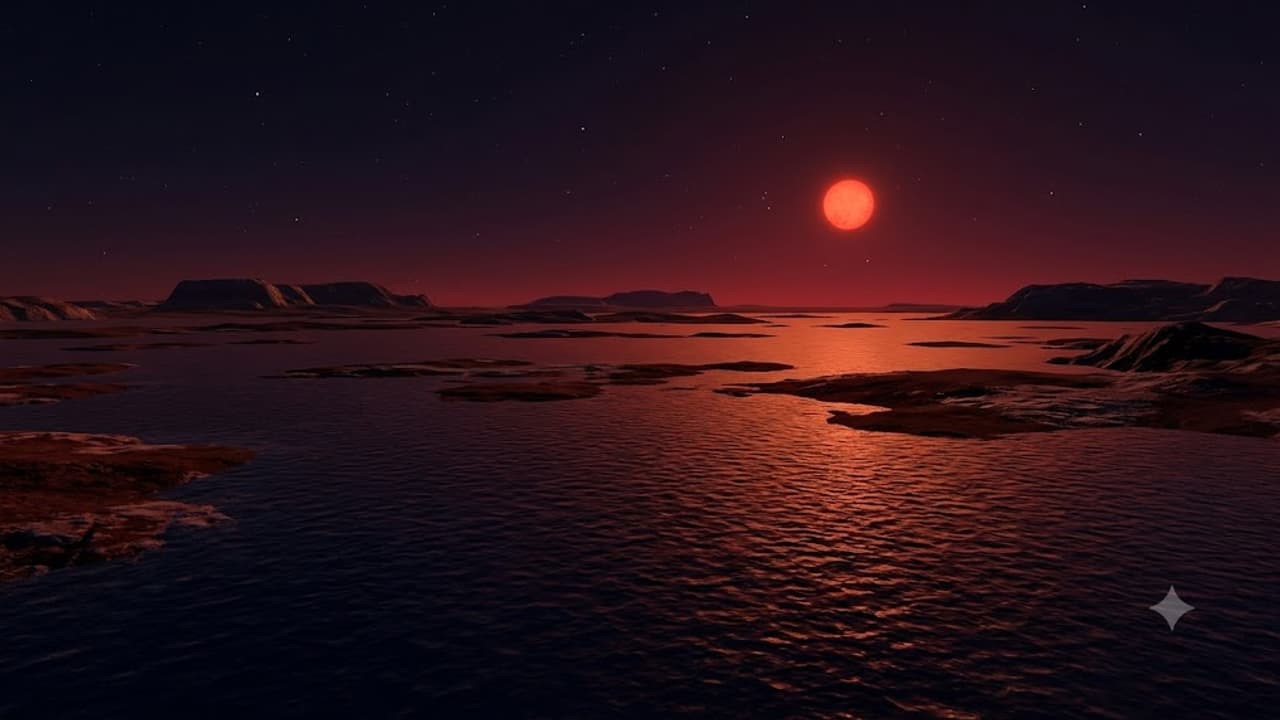
Scientists have confirmed two exoplanets orbiting the red dwarf star TOI-1752, around 337 light-years from Earth. TOI-1752 b is an extremely hot world that may have molten rock, while TOI-1752 c lies in an optimistic habitable zone. Future studies are needed to determine whether the larger world could support liquid water under suitable conditions.
Spanish scientists have confirmed two new exoplanets orbiting a red dwarf star around 337 light-years from Earth, including one extremely hot world that may have a surface of molten rock and another located in a region where liquid water could potentially exist.
The planetary system, named TOI-1752, was confirmed by an international research team led by Alberto Peláez Torres of the Institute of Astrophysics of Andalusia and Spain's National Research Council.
The findings were announced on August 31 and the research has been published in the journal Monthly Notices of the Royal Astronomical Society, India Today reported.
Related Articles

One planet may be a scorching lava world
The inner planet, TOI-1752 b, is very different from Earth.
It has a radius around 1.69 times that of Earth and completes one orbit around its star in less than a day. Scientists estimate its equilibrium temperature at more than 1,000 Kelvin, making it compatible with a possible lava-world scenario.
Because it orbits extremely close to its host star, the side facing the star could be hot enough to keep rock molten.
Researchers believe such extreme conditions may also help create a secondary atmosphere from gases released by the planet's surface. However, further observations will be needed to understand its actual atmospheric conditions.
TOI-1752 c lies in an optimistic habitable zone
The second planet, TOI-1752 c, has attracted greater attention because it lies in what scientists call the optimistic habitable zone.
The planet is larger than Earth, with a measured radius of around 2.29 times Earth's radius, and takes about 32.7 days to orbit its star. It is described in the scientific study as a sub-Neptune-sized world rather than a confirmed rocky super-Earth.
Scientists estimate its equilibrium temperature at around 291 Kelvin, or roughly 18 degrees Celsius. However, being located in a habitable zone does not automatically mean that the planet can support life or has liquid water. That would depend heavily on its atmosphere and other environmental conditions.
The significance of the ,discovery
Both planets orbit a red dwarf star, which is smaller and cooler than the Sun. Such stars are important targets in the search for small exoplanets because a passing planet causes a relatively noticeable dip in the star's brightness.
The team used observations from NASA's TESS mission along with ground-based telescopes, including the MuSCAT2 instrument at Teide Observatory and MuSCAT3 in Hawaii, to confirm the planets.
Future observations, potentially involving powerful telescopes such as the James Webb Space Telescope, could help scientists study the atmospheres of these distant worlds and better understand whether TOI-1752 c could truly support conditions suitable for liquid water.