
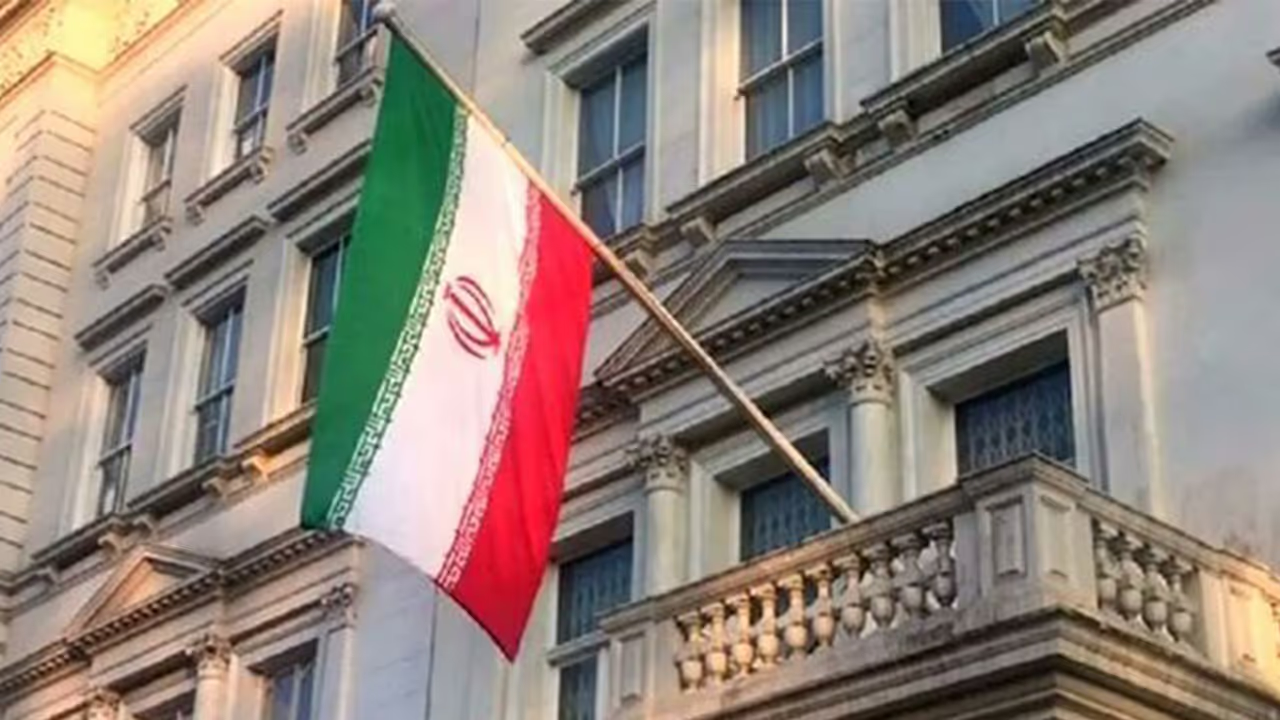
Iran remains undecided on an MoU to end conflict with the US and Israel, as a Qatari delegation visits Tehran for talks. The potential agreement has sparked domestic protests, while Tehran remains cautious despite Trump's claims of an imminent deal.
Diplomatic Efforts and Qatari Mediation
Iran has not yet taken a final decision on the Memorandum of Understanding (MoU) to end the conflict with the US and Israel, as reported by the Iranian news agency Fars. As per Fars news agency, the review of the political, legal, and technical dimensions of the proposed suggestions is still ongoing.
Meanwhile, a Qatari delegation travelled to Tehran on Sunday to examine the recent developments in diplomatic efforts involving Iran and the United States after last week's talks, according to local Iranian media. Iranian news agency Tasnim reported that the delegation is in the Iranian capital to examine the latest developments related to the diplomatic process and has held consultations with officials of Iran. According to ISNA, the delegation is headed by an adviser to Qatar's Prime Minister and Foreign Minister Sheikh Mohammed bin Abdulrahman bin Jassim Al Thani. The visit is aimed at continuing the exchange of messages between Tehran and Washington regarding a memorandum of understanding (MoU) intended to end the war.
Domestic Backlash in Iran
In Iran, dozens of people staged a demonstration outside a foreign ministry office in the north-eastern city of Mashhad, shouting slogans against top diplomat Abbas Araghchi following a televised interview concerning a potential peace agreement with the United States. This domestic outrage directly followed a broadcast on state television, where Araghchi stated that the proposed agreement includes provisions for dismantling the US naval blockade on Iranian ports, which Washington had instituted following Iran's own blockade in the Strait of Hormuz. Protesters were seen demanding political exits, chanting "Araghchi, resign" and "Ghalibaf, resign," directed at the foreign minister and parliament speaker Mohammad Bagher Ghalibaf, who is also serving as the chief negotiator.
Conflicting Timelines and Official Statements
While Trump and Pakistani officials stated that the deal aimed at concluding the conflict could be finalised as early as Sunday, authorities in Tehran remained highly cautious about the official timeline. Trump asserted that a framework agreement is anticipated to be signed on Sunday, with Islamabad stating that an electronic signing ceremony is being organised.
Trump's Stance on the Agreement
The Sunday on which Trump Trump, in a post on Truth Social, said that if the deal doesn't work out, the US has an ultimate alternative. "Barack Hussein Obama's Deal with Iran, the JCPOA, was an easy, beautiful, smooth road to a Nuclear Weapon, which Iran would have had six years ago, and would have used long before now. My Agreement with Iran is the exact opposite, A WALL TO NO NUCLEAR WEAPON! In fact, they no longer want a Nuclear Weapon, nor will they have one, either through purchase, development, or any other form of procurement. The Deal is scheduled to get signed tomorrow, and immediately after it is signed, the Hormuz Strait is OPEN TO ALL," he said.
Conversely, Iranian Foreign Ministry spokesperson Esmaeil Baghaei explicitly downplayed an immediate conclusion, stating, "It will not be tomorrow," though he acknowledged that an agreement might still be formalised in the subsequent days. (ANI)
(Except for the headline, this story has not been edited by Asianet Newsable English staff and is published from a syndicated feed.)