
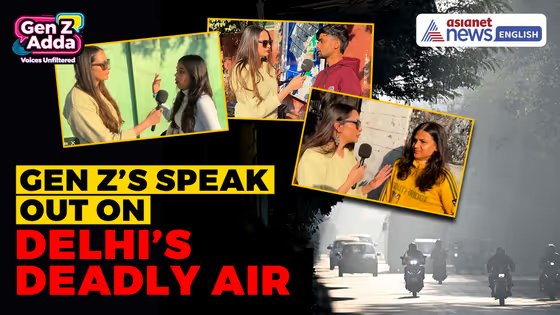
Delhi's AQI Nightmare: Toxic Air Has Gen Z Furious — Their Brutal Honesty Will Shake You
Gen Z in Delhi opens up about living through toxic air, calling out weak enforcement, civic lapses, stubble burning, and “false measures” as pollution chokes the city every winter.
Every winter, the National Capital Region slips under a suffocating blanket of toxic smog — a crisis Delhiites have now come to expect. Stubble burning, firecrackers, unchecked industrial emissions and vehicular congestion remain the biggest culprits. But what does Gen Z, the generation that will inherit this crisis, really think about Delhi’s air?

To find out, Asianet Newsable English's Heena Sharma visited Delhi NCR and spoke to young residents about solutions, long-term reforms and their lived experiences. “Like, you can't take deep breaths right now,” says one student, summing up the lived experience of millions.
A City Wrapped in Smog, Wrapped in Frustration
From unmonitored factories to booming firecrackers at late-night weddings, young voices point to a messy mix of forgotten rules and ignored warnings.
“I live in an area where I can see a lot of factories… which put out a lot of pollution, which is, I don't think it is monitored.”
“We get to see the firecrackers… many of those shahadis are happening on a single day… that sums up into huge pollution levels.”
Even legal orders go unheard: “Supreme Court said that you cannot burst firecrackers after 10pm, but we saw that happening everywhere post 10pm as well.”
The Enforcement–Civic Sense Gap
For many, the issue lies in a lack of discipline on both sides.
“Civic sense does play a role… if the government and the local policemen make sure that the civilians follow their rules… then civilians will follow.”
Public transport is widely seen as part of the solution — if only it reached the last mile.
“Delhi metro infrastructure also needs to expand to ensure that there is last mile connectivity.”
Stubble Burning: Sympathy, But Also Expectation
There is empathy for farmers — and a demand for structured solutions.
“We need to give monetary help to the farmers… and also create awareness… there is a season when they are supposed to burn those crops when the wind is not coming towards Delhi.”
“It's a mix of reform ideas… monetary incentive… but also an awareness, civic sense thing.”
‘Stop the False Measures’
Cosmetic measures trigger visible anger. Scenes of water sprinklers rolling down VIP stretches don’t impress this generation.
“They should stop those false measures of sparkling water everywhere… she is only sprinkling water where AQI metres are present.”
“If you spray water… that's just control measures. The idea is to stop it at its roots.”
Looking for Hope, But Not Finding Much
Cleaner cities like Indore are often cited as proof that solutions exist.
“They should see the policies of cities like Indore… AQI is below 100 normally… even after Diwali not more than 200.”
Yet optimism is running thin: “Next year, we will improve… but accordingly, the things have not been improving.”
Health and Home: The Crisis Enters the Living Room
The impact is not abstract — it’s in every breath, every cough, every bill.
“We had to dig into our savings… it was necessary… he was having difficulty in breathing.”
Some describe winters as a season of helplessness: “It was very pathetic at that point of time.”
Will Anyone Listen?
Young citizens say both government and public must change.
“They need to bring fundamental changes… China had an AQI around 700… they brought it down to less than 100.”
Campaigns are not enough: “Campaigns bring awareness, they don't really bring responsibility.”
From protests to influencer outreach, they believe pressure works. “If there are such protests, then the government will feel that people are also concerned.”
For now, Delhi’s youth waits — breathing shallow, hoping deep.
