
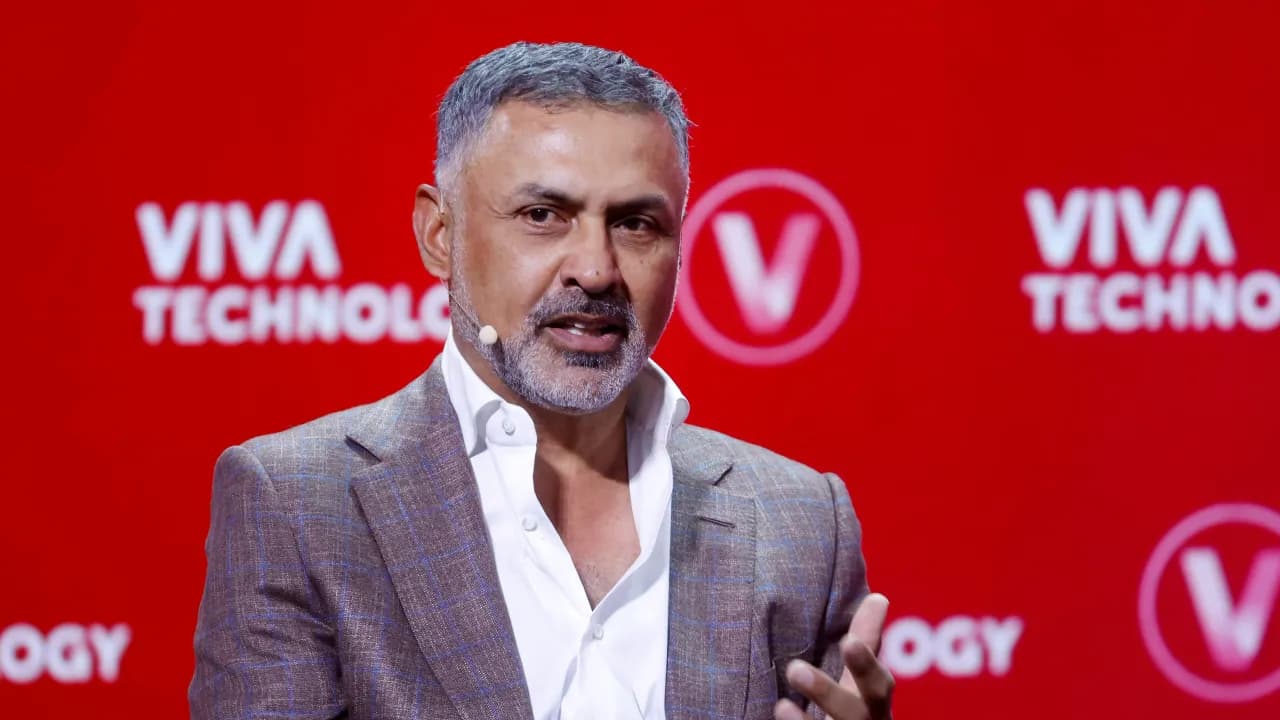
“All supply constraints over time have to equate, when excess profits are made in a category all innovators arrive,” Arora said.
- Arora said excess profits typically encourage innovation, cheaper manufacturing and efforts to reduce reliance on expensive components.
- The CEO’s comments add to potential long-term risk for Micron and SanDisk, whose stocks have benefited from soaring AI-driven memory demand and tight supply.
- MU and SNDK stocks have risen in August after a decline last month; they remain below the peaks achieved in June.
Palo Alto Networks CEO Nikesh Arora on Friday offered a fresh warning for investors betting that the AI boom has permanently transformed the memory-chip industry, arguing that even an unprecedented “supercycle” will eventually attract new supply and innovation – a potential risk for firms such as Micron and SanDisk.
“All supply constraints over time have to equate, when excess profits are made in a category all innovators arrive. Cheaper production, technological innovation etc,” Arora said in an X post, responding to a user’s question about his view on the memory sector.
“Also upstream innovation begins to focus on optimizing usage of expensive components. Memory and semis have been cyclical. It seems we are in a never before seen supercycle, super it might be, cycle it will be. When? Not smart enough to call,” said Arora, who was formerly the president and chief operating offering at Japan’s SoftBank.
Arora’s comments strike at one of the biggest assumptions underpinning the rally in memory stocks: that AI-driven demand has created a structurally different market in which shortages and elevated pricing could persist for years.
Memory Stocks Under Pressure Lately
Arora’s broader point is that the memory industry does not necessarily need supply to catch up with demand for the cycle to turn. Companies can also develop technologies that reduce the amount of expensive memory required per unit of computing, potentially easing demand growth.
Micron shares have gained about 14% this month, while SanDisk is up roughly 22%, recovering after both stocks fell in July. They are still below their peaks from late June as investors continue to assess risks, including overvaluations and the emergence of cheaper AI models, which could ultimately reduce memory demand.
MU and SNDK were down over 2% in overnight trading ahead of Thursday.
What’s Driving The Record Memory Demand?
With record buildout of AI data centers, the current environment is unusually favorable for memory makers.
AI data centers are consuming enormous amounts of high-bandwidth memory, while demand for conventional DRAM and NAND storage has also surged as hyperscalers expand infrastructure. Memory stocks have consequently soared as investors anticipate sustained pricing power.
For Micron, Arora’s warning is particularly relevant because its HBM business is at the center of the AI memory boom. The company stands to benefit from strong pricing and capacity constraints, but eventually higher profits could incentivize competitors to add capacity and accelerate technological improvements.
SanDisk mostly sells NAND flash and data-center storage, and the same dynamic could emerge if elevated prices persist long enough. Both suppliers, as well as South Korean giant SK Hynix, have committed massive investments in capacity expansion to meet soaring demand.
SanDisk and Kioxia on Thursday announced plans to invest more than $31 billion in Japan through 2032 to expand memory production and advance semiconductor technology.
Retail View On Memory Stocks
On Stocktwits, the retail sentiment was ‘neutral’ for MU and , with traders turning to Federal Chair Kevin Warsh’s Jackson Hole address later on Friday for macro cues that would determine the broader market move.
“$MU $AMD $QQQ risk assets might see quite a bit of volatility today with Jackson Hole and Warsh speaking at 10 AM EST. He has been soft on rates and if he doesn’t present language raising rates then I’d expect metals to spike and the dollar will drop, a trader said.
“If he does plan to hike, risk assets will drop. Risk here is higher and the AI trade might be a better purchase at lower valuations. 3 months of chop while indexes have gone to all time highs and the $VIX is under 15. This does not present a good setup,” the said.
Shares of Micron are up 228% year to date, while SanDisk shares are up 526%.
For updates and corrections, email newsroom[at]stocktwits[dot]com.<
