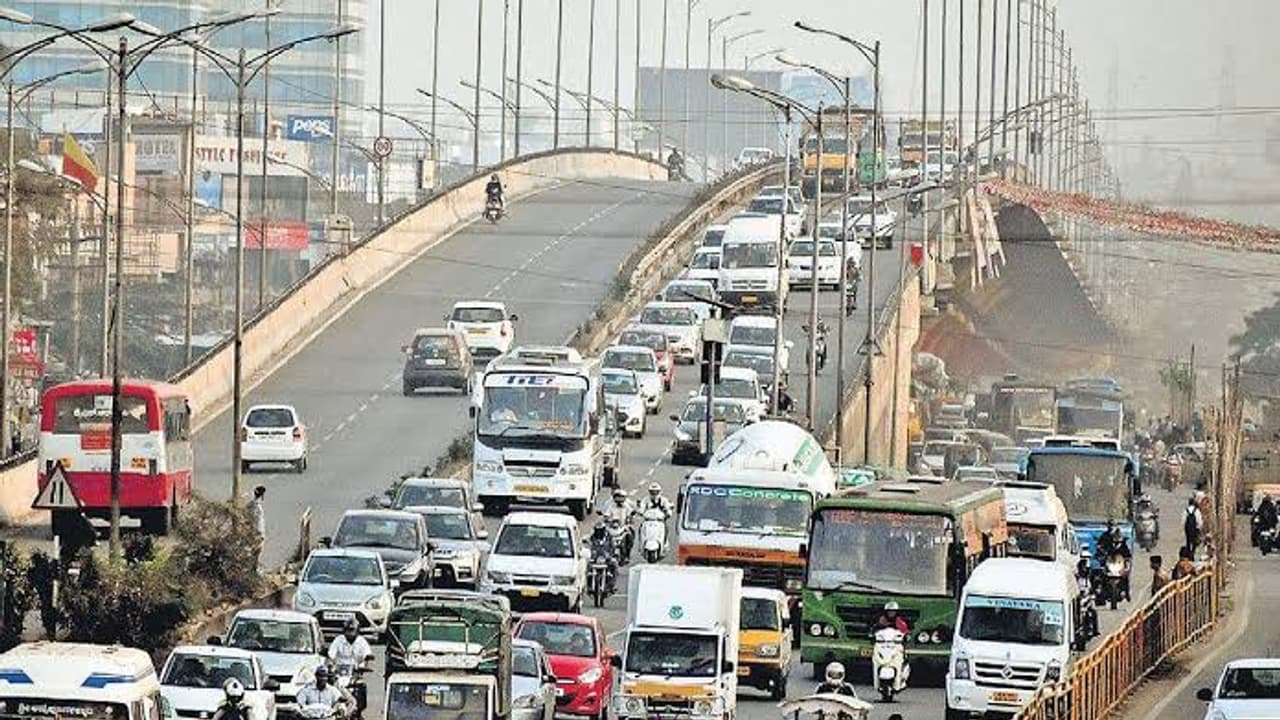
The contract for the Electronics City flyover and the Attibele toll plaza is ending on September 10. Now, the central government and NHAI are looking at several options, including whether to continue collecting the toll or scrap it altogether.
Bengaluru (Aug 28): Big news for commuters in Bengaluru. The concession agreement for the 9.9-kilometre-long flyover between Silk Board and Electronics City, and the Attibele toll plaza, is set to expire on September 10. This has put the ball in the court of the Ministry of Road Transport and Highways (MoRTH) and the National Highways Authority of India (NHAI) to take a major decision: should the toll stay or go?
This elevated road is a key part of the Bengaluru-Hosur corridor, connecting the busy Central Silk Board junction to the IT hub of Electronics City. Currently, the Centre and NHAI have four main options on the table.
- Completely stop toll collection at both the Electronics City and Attibele plazas.
- NHAI could take over toll collection itself, through an agency, to fund the road's maintenance.
- The stretch could be denotified as a national highway and handed over to the Karnataka Public Works Department (PWD).
- One of the toll plazas could be moved to another location to follow the minimum distance rule.
Proposal to move the toll plaza
According to NHAI rules, there must be a minimum gap of 60 kilometres between two toll plazas on the same highway, going in the same direction. The Electronics City and Attibele plazas are located very close to each other. Because of this, there's a proposal to close the Attibele toll plaza and collect the toll near Krishnagiri instead. The final call on this will be taken by MoRTH's toll committee.
Related Articles

Contractor firm wants compensation
Meanwhile, the contractor company has approached the Conciliation Committee of Independent Experts (CCIE). It is claiming it suffered losses during the COVID-19 lockdown and also because local commercial vehicle owners and residents refused to pay the toll. The company has asked for compensation from the state government. So, any extension of the toll period also depends on how these claims are settled.
The project was built on a BOT model
Initially, NHAI, the Karnataka government, and major E-City companies like Infosys and Wipro were supposed to invest ₹100 crore each. But that plan was scrapped. Instead, the project was built on a Build-Operate-Transfer (BOT) model. A consortium called 'Bengaluru Elevated Tollway Limited' (BETL), formed by Soma-NCC-Maytas, signed the deal in 2006. The flyover was built at a cost of about ₹990 crore and opened in January 2010. To recover the costs, even two-wheelers were charged a toll.
The Electronics City toll plaza is mostly used by people commuting to the IT hub daily. The Attibele plaza, on the other hand, serves commercial trucks moving goods between Bengaluru, Hosur, and Chennai. But residents are now demanding that the toll be scrapped, arguing that Electronics City has become a part of Bengaluru itself. If the road is handed over to the state PWD, there's a chance the toll might continue for maintenance, as per state policies.
Rates were revised recently
The toll rates for this route were revised, with the new prices set to take effect from July 1, 2026. For the flyover, a one-way trip for cars and jeeps costs ₹65, a return journey is ₹100, and a monthly pass is ₹1,960. The monthly pass for two-wheelers is ₹785. At the Attibele toll, a one-way trip for cars is ₹40, and a return trip is ₹60.