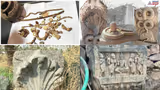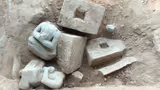
Five rare ancient Jain inscriptions have been discovered at the historic Kote Basadi in Mala, Karkala, Udupi, during renovation work. Researchers believe the inscriptions offer evidence of Jain religious activity dating back to the 14th century.
A significant historical discovery has been made at the historic Kote Basadi in Mala village of Karkala taluk, where five rare Jain inscriptions have been unearthed during ongoing renovation work. The inscriptions, found on Jain idols and the base of a shrutaskanda (a stand used for sacred texts), offer valuable clues about the history of the ancient Jain place of worship and its patrons over several centuries.
The Kote Basadi follows the Swasti Sri Lalitakirti Bhattaraka Rajaguru Peetha tradition and was undergoing renovation when the inscriptions were discovered. The restoration work was being carried out at the shrines of Adinatha Tirthankara, Neminatha Swami, Parshvanatha Swami, Chandranatha Swami and Padmavati Devi.
The discovery came to light after Ayurvedic doctor Dr P Satyanarayana Bhat alerted a team of experts. The team was led by Prof SA Krishnaiah, study director of Udupi’s Prachya Sanchaya Research Centre. Archaeological researcher Shrutesh Acharya Moodubelle subsequently conducted a detailed study of the inscriptions found on the Jain idols and the base of a shrutaskanda.
Related Articles

Inscriptions Believed To Span Several Centuries
One of the inscriptions was found on the base of a bronze Ganadhara Pada, representing the symbolic footprints of a Ganadhara. The three-line inscription records that a person named ‘Vigna’, the son of Hegade, had the object made for the basadi. Researchers estimate that the inscription dates to the 18th or 19th century.
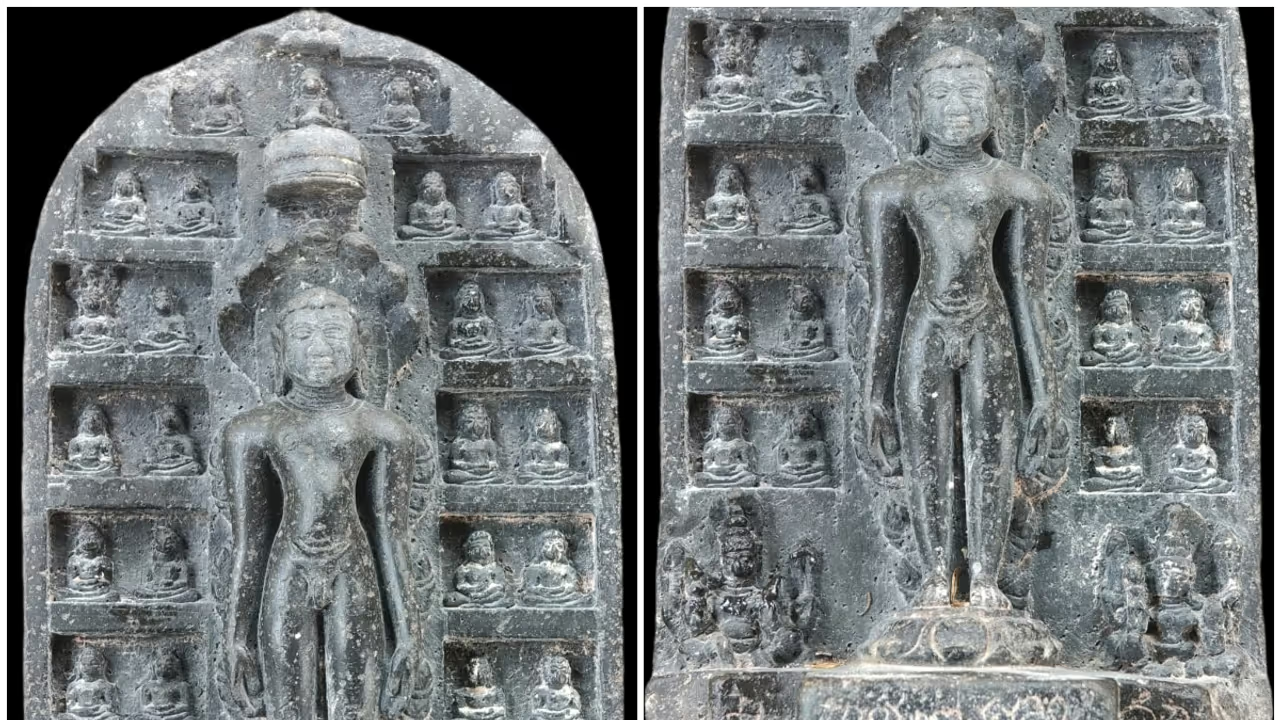
Another inscription, found on a stone statue of Parshvanatha Tirthankara, states that the statue was made by a person named ‘Payanna’. Researchers believe that this inscription dates back to the 14th century.
A third inscription, also found on a stone statue of Parshvanatha, provides a precise historical date. It mentions the Virodhikritu Samvatsara and Vaishakha Shuddha Trayodashi, corresponding to Monday, April 15, 1611.
The inscription records that Kotiladeva of Sirulala, now known as Shirlalu, belonging to Aithappa, donated three and a half mudi of rice for the daily offerings, or amritapadi, to the Chavvisateertha Parshvanatha statue he had installed.
Devanagari Inscription Found On Marble Statue
A fourth inscription was discovered on the pedestal of a marble Parshvanatha Tirthankara statue. Written in the Devanagari script, the inscription records that the statue was installed sometime during the 17th century CE.
Together, the inscriptions provide evidence of continued Jain religious activity at the site across different periods. Based on the historical evidence gathered so far, researchers have concluded that the Kote Basadi was likely an ancient Jain centre of worship dating back to the 14th or 15th century.
The fieldwork and documentation were supported by Sri Chandrakantha Indra of Kote Basadi, research scholar Shashanth Palli, and history enthusiasts Keshava Dongre and Yadugopan KR.