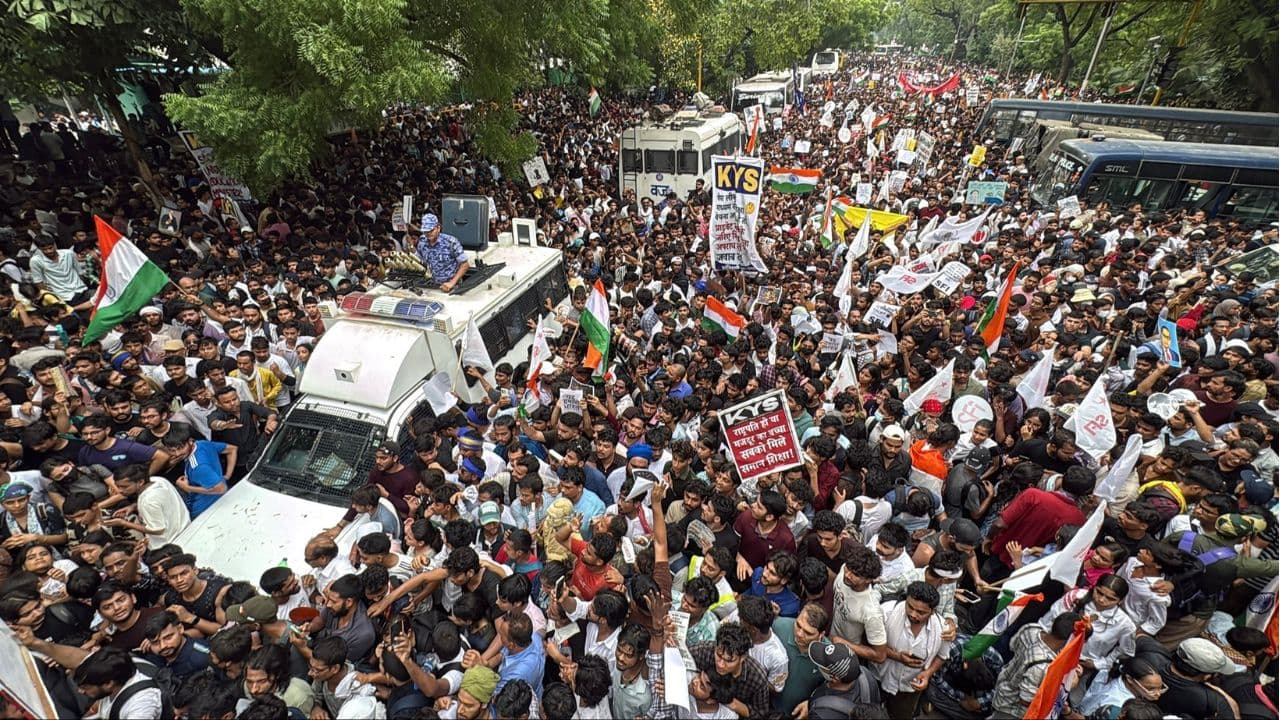
Delhi Metro Rail Corporation has temporarily closed 16 stations in central Delhi amid heightened security during Parliament’s Monsoon Session and ongoing protests over NEET-UG 2026 paper leak row. The affected stations are near Parliament and Jantar Mantar. Interchange facilities remain available at Rajiv Chowk, Mandi House and Central Secretariat.
The Delhi Metro Rail Corporation (DMRC) has temporarily closed 16 metro stations in central Delhi as security arrangements have been stepped up around Parliament and Jantar Mantar. The closures come as Parliament's Monsoon Session is under way and protests linked to the alleged NEET-UG 2026 paper leak continue at Jantar Mantar.
The move is likely to affect thousands of passengers who normally use stations in central Delhi. However, the DMRC has said that interchange facilities will continue to be available at three important stations, allowing passengers to change metro lines even as the stations remain closed for entry and exit. Here is a closer look at the closures, why they have been ordered and what commuters should know.
Thiruvananthapuram Zoo Tiger Babita Diagnosed With Rare Cancer, Begins Chemotherapy
Related Articles

Which 16 Delhi Metro stations are closed?
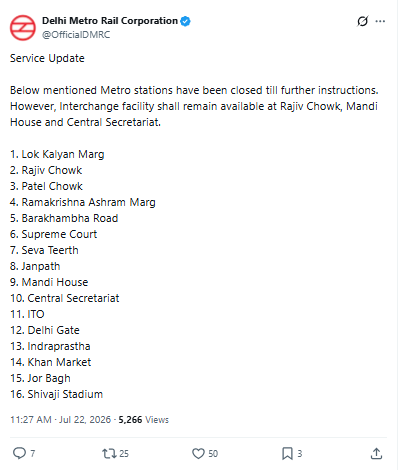
According to the DMRC, the following 16 stations have been closed until further instructions:
- Lok Kalyan Marg
- Rajiv Chowk
- Patel Chowk
- Ramakrishna Ashram Marg
- Barakhambha Road
- Supreme Court
- Seva Teerth
- Janpath
- Mandi House
- Central Secretariat
- ITO
- Delhi Gate
- Indraprastha
- Khan Market
- Jor Bagh
- Shivaji Stadium
He Painted Homes to Support His Family: Rajasthan Boy Scores 99.15 Percentile in NEET 2026
The closures cover several important stations in and around central Delhi. Many of them are used by people travelling to government offices, Parliament, major commercial areas and other important locations.
For passengers, this means that trains may continue to operate through the affected areas, but commuters will not be able to use the closed stations in the normal way until further instructions are issued.
The DMRC has not announced a fixed time for reopening the stations.
Interchange facilities remain available at three stations
- Although 16 stations have been closed, the DMRC has clarified that passengers can still use interchange facilities at three major metro stations. These are:
- Rajiv Chowk
- Mandi House
- Central Secretariat
Bengaluru Metro Pink Line Likely to Miss August 15 Deadline, Opening May Shift to September
This is an important arrangement for passengers who need to switch between metro lines.
For example, a passenger travelling through the central Delhi network may still be able to change trains at these stations, even though the stations are otherwise closed as part of the security measures.
The arrangement is aimed at keeping the wider metro network connected while restricting passenger movement at locations considered sensitive during the heightened security period.
Passengers travelling through central Delhi are advised to check the latest DMRC updates before starting their journey, as the situation may change depending on security requirements.
Why have the 16 stations been closed?
The closures are linked to increased security arrangements in central Delhi. All 16 stations are located in the wider vicinity of important government and public areas, including Parliament and Jantar Mantar.
The decision comes during the Monsoon Session of Parliament, when security around the Parliament complex is already high.
At the same time, a protest movement over the alleged NEET-UG 2026 paper leak has been taking place at Jantar Mantar.
The combination of the Parliament session and ongoing demonstrations has led authorities to increase security in the area.
The DMRC announced the latest closures through a post on X, explaining which stations were affected and where interchange facilities would continue to operate.
Cat Faces Striking Cobra, Dodges Every Attack In Viral Video, Internet Can't Believe It (WATCH)
What does this mean for Delhi Metro passengers?
For regular commuters, the biggest impact is likely to be on passengers travelling to or through central Delhi.
People planning to use any of the 16 affected stations should check the latest DMRC updates before leaving home. They may need to get off at another station and use road transport or walk to their destination.
Passengers changing metro lines should note that interchange facilities remain available at Rajiv Chowk, Mandi House and Central Secretariat.
However, the exact arrangements may depend on the security situation at the time of travel.
The closures also highlight how security restrictions around Parliament can affect public transport in central Delhi.
For now, the DMRC has said the 16 stations will remain closed until further instructions. With Parliament's Monsoon Session continuing and protests over the NEET issue still drawing attention, commuters may face further changes if security requirements increase.
The immediate priority for authorities is maintaining security around Parliament and other sensitive locations while keeping as much of the city's public transport network operational as possible. For passengers, checking official metro updates before travelling remains the safest way to avoid unexpected disruption.
Protests at Jantar Mantar add to security concerns
The security measures come against the backdrop of protests at Jantar Mantar over the alleged NEET-UG 2026 examination paper leak. The demonstrations began in June, with protesters demanding accountability over the alleged leak and calling for action against those responsible.
The protesters have also demanded the resignation of Union Education Minister Dharmendra Pradhan.
The issue gained further attention after activist Sonam Wangchuk joined the protest at Jantar Mantar in late June and began an indefinite hunger strike.
Wangchuk had said that he would end his hunger strike if the government accepted accountability for failures in the education system, including paper leaks. He also said he would consider ending the protest if MPs assured him that the issue of accountability in education would be taken up in Parliament.
The proposed protest movement also included a call for a march towards Parliament.
However, Delhi Police said no permission had been sought or granted for such a march.
Delhi Police warns against unauthorised marches
Delhi Police issued an advisory on Monday regarding the proposed march to Parliament.
The police said that prohibitory orders under Section 163 of the Bharatiya Nagarik Suraksha Sanhita (BNSS) remain in force in the New Delhi district.
The provision corresponds to the earlier Section 144 of the Code of Criminal Procedure.
Under the restrictions, protest marches, processions, demonstrations and gatherings of five or more people are prohibited in the area, except at designated protest locations such as Jantar Mantar and subject to prior permission.
Police warned that strict action would be taken against anyone violating the restrictions.
The security arrangements around central Delhi have therefore been tightened as authorities seek to prevent large gatherings or unauthorised movements towards Parliament.
'He Was Set To Marry Next April': Kerala Family Awaits Body of Sailor Killed in Ukraine ship attack
What is happening in Parliament over NEET?
The NEET paper leak issue has also become a major point of confrontation between the government and Opposition parties during the Monsoon Session.
Union Minister for Parliamentary Affairs Kiren Rijiju said in the Lok Sabha that the government was ready to discuss the alleged NEET paper leak issue.
He said discussions could take place according to parliamentary rules and that floor leaders of different parties should discuss how and when the matter should be taken up.
Lok Sabha Speaker Om Birla also said the government was ready for a discussion and invited Opposition parties to discuss the agenda.
However, the Opposition continued to press for a discussion under an adjournment motion and demanded accountability from the government.
Congress MP KC Venugopal said Opposition parties had repeatedly submitted adjournment motions seeking a discussion on the alleged NEET and CBSE examination paper leak issue. The Opposition has also demanded the resignation of Education Minister Dharmendra Pradhan.
The disagreement has contributed to repeated disruptions in Parliament.
Opposition MPs protest in black clothes
The NEET issue also spilled onto the Parliament premises, where Opposition MPs staged a protest wearing black clothes.
Congress leaders, including Rahul Gandhi and Priyanka Gandhi Vadra, and Samajwadi Party chief Akhilesh Yadav were among those present during the protest.
Priyanka Gandhi Vadra said students had genuine concerns and were demanding their rights. She criticised the government's handling of the issue and said repeated paper leaks were a serious concern.
Akhilesh Yadav also questioned why the Education Minister had not been removed and said the government should take stronger action.
The Opposition has said it will continue raising the concerns of students both inside and outside Parliament.
Leopard Enters Liquor Shop in Rajasthan's Tonk, Attacks Man; Video Goes Viral
Earlier protests also led to police action
The latest security restrictions follow a series of protests in central Delhi.
On Tuesday, Congress leaders Rahul Gandhi and Priyanka Gandhi, along with other party workers, were detained by Delhi Police during a protest near Lok Kalyan Marg. They were later released.
The action drew criticism from Opposition leaders, who accused the government and police of restricting peaceful protests.
The government, meanwhile, has maintained that security restrictions are necessary around sensitive areas, particularly during the Parliament session.
(With ANI inputs)