
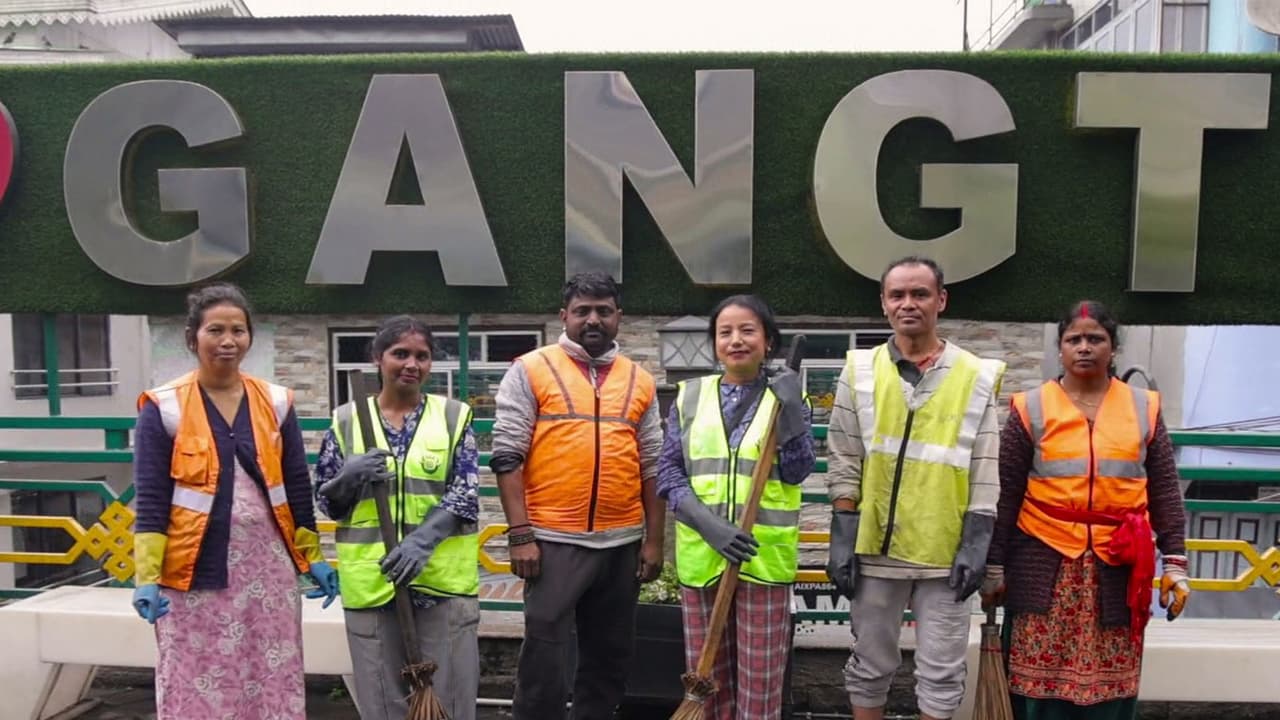
Gangtok's status as one of India's cleanest cities stems from a deep-rooted culture of cleanliness. Public participation, strict civic rules, and residents' ingrained habits, not just municipal efforts, are the cornerstones of its success.
Gangtok, the capital of Sikkim, is often counted among India's cleanest cities. But beyond its spotless streets and well-maintained public spaces lies a deeper story, one where cleanliness is not merely the result of municipal efforts, but a habit embedded in everyday life. At the heart of the city is MG Marg, a pedestrian-only, smoke-free and litter-free public space that reflects Gangtok's approach to urban cleanliness. Supported by systematic waste segregation, restrictions on plastic use and strict enforcement of civic regulations, the city has developed a model that combines effective governance with active public participation.
Public Participation: The Cornerstone of Success
For many residents, keeping the city clean begins at home. "Our government has good rules, but we are also taught by our families to keep our surroundings clean," said local resident Reena. "If someone throws garbage irresponsibly, we tell them not to do so. These values are learned from childhood."
Another resident, Alishba, believes the city's cleanliness is a reflection of its people. "Gangtok is clean because the people here care about cleanliness. Everyone likes to keep the city neat and tidy," she said.
According to MG Marg Ward Councillor Sandeep Malu, public participation remains the cornerstone of the city's success. "Rules and regulations are important, but their implementation is equally important," Malu said. "Public participation and awareness are the key factors. We regularly conduct awareness programmes to encourage citizens to keep their city clean."
The Daily Efforts of Sanitation Workers
The city's cleanliness efforts are also driven by sanitation workers who begin their work before dawn each day. Their efforts ensure that public spaces remain clean and welcoming for residents and visitors alike. "All sanitation workers enter the market area by around 4 or 4:30 in the morning, and some even begin at 3 a.m.," said sanitation worker Om Prakash. "By 8 a.m., we make sure the entire area is clean. Sikkim is known across India as a green state, and we work hard to maintain that reputation."
A Holistic Approach to Urban Living
Gangtok's approach extends beyond waste management. MG Marg is visually distinctive, with buildings following a uniform colour scheme and utility cables placed underground, creating a clean and organised urban landscape. The emphasis is not only on removing litter but also on maintaining an aesthetically pleasing environment.
Visitors often notice the difference immediately. "When we arrived, the first thing we noticed was the greenery," said tourist Arpita Mondal. "In many places, trees are cut down to build larger structures, but here there is abundant greenery. The city is very clean and well maintained."
Even outside MG Marg, civic discipline remains visible. Traffic moves in an orderly manner, with minimal honking and adherence to lane discipline. Such practices, though seemingly small, contribute significantly to the overall quality of urban life.
Gangtok's experience demonstrates that sustainable cleanliness cannot be achieved through regulations alone. It requires a collective commitment from citizens, effective governance and a culture of responsibility. In Gangtok, cleanliness has evolved beyond a campaign; it has become a way of life.
(Except for the headline, this story has not been edited by Asianet Newsable English staff and is published from a syndicated feed.)