- Home
- Entertainment
- Dilkashi, Mohabbat, Junoon, Maut: Decoding 7 Stages of Love in Sanjay Leela Bhansali’s Films
Dilkashi, Mohabbat, Junoon, Maut: Decoding 7 Stages of Love in Sanjay Leela Bhansali’s Films
The article explores the seven stages of love—Dilkashi, Uns, Mohabbat, Aqeedat, Ibadat, Junoon and Maut—and examines how these emotions unfold through the intense, dramatic romances associated with Sanjay Leela Bhansali’s cinema.
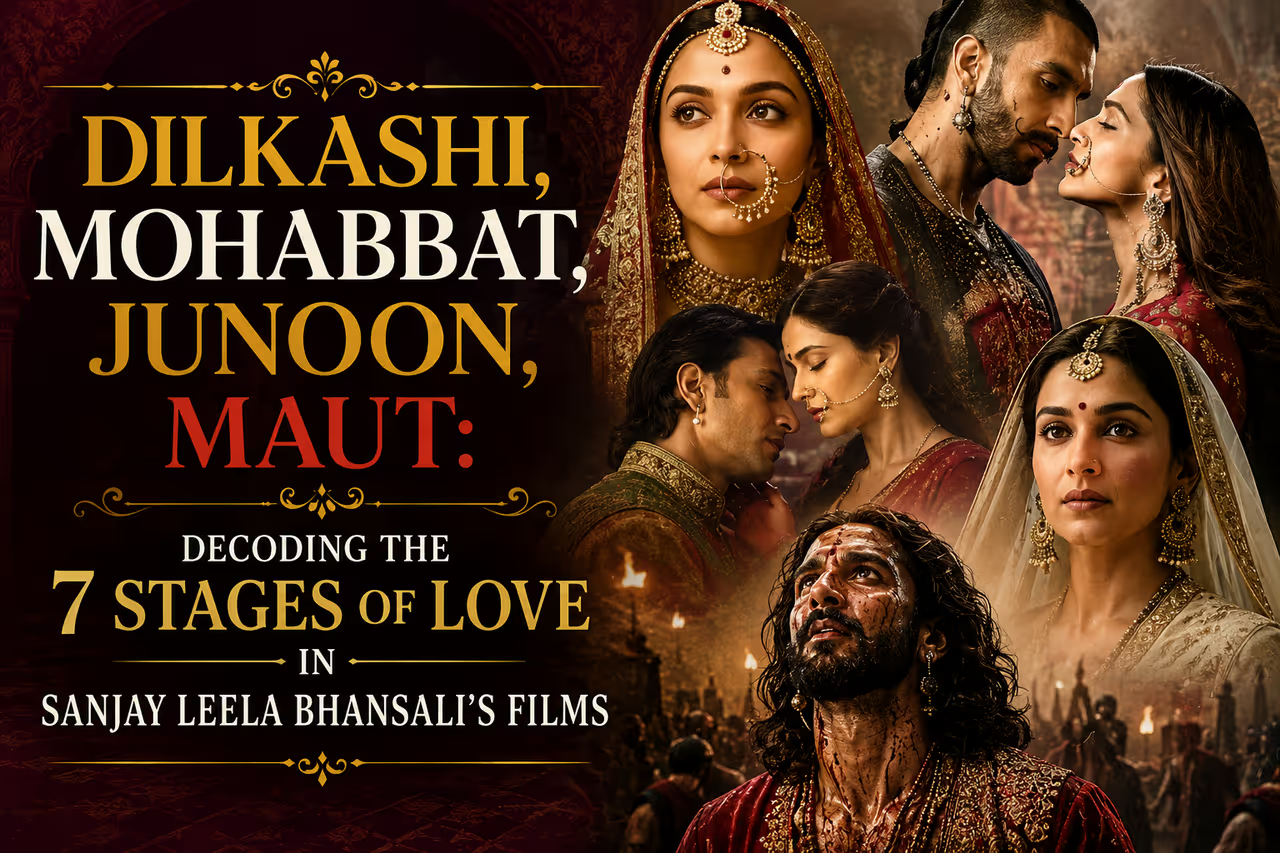
The Seven Stages of Love Through Sanjay Leela Bhansali’s Cinema
Regarded as a filmmaker worthy of being mentioned in the same breath as legends like Raj Kapoor, K. Asif, and Guru Dutt, Sanjay Leela Bhansali has carved a distinct place for himself in the history of Indian cinema with his enviable filmography that has love at its very core. For Bhansali, love has never been just a feeling. It is a journey, one that begins with a glance, grows into attachment, deepens into devotion and, at its most intense, demands complete surrender. Across his films, Bhansali has explored the many shades of love, from innocent attraction to consuming obsession and the ultimate sacrifice. Here are the seven stages of love, as seen through the world of Sanjay Leela Bhansali:


1. Dilkashi — Attraction
The first spark. The moment everything begins.
Every great love story begins with a glance, a pull or an inexplicable feeling that draws two people towards each other. In Saawariya, Bhansali captures this almost dreamlike quality of attraction and the excitement of encountering someone who suddenly makes an ordinary world feel magical. It is the stage where love is still unnamed, but the heart has already begun to notice.
2. Uns — Attachment
When you begin wanting their presence in your everyday life.
From attraction comes attachment that growing desire to be around the person who has started occupying your thoughts. Hum Dil De Chuke Sanam captures this beautifully through Nandini and Sameer, whose playful chemistry slowly evolves into something deeper. What begins as youthful attraction soon becomes an emotional bond neither can easily walk away from.
3. Mohabbat — Love
When affection becomes something deeper, warmer and undeniable.
This is the stage where love is no longer just a feeling but a part of who you are. In Goliyon Ki Raasleela Ram-Leela, Ram and Leela’s fiery chemistry evolves into an all-consuming love that refuses to be defined by the hatred surrounding them. Their love is passionate, fearless and willing to challenge everything standing in its way.
4. Akidat — Trust & Reverence
When love becomes faith.
True love is built not just on passion, but on an unwavering belief in another person. Bajirao Mastani explores this stage through Bajirao and Mastani, whose bond survives social opposition, personal conflict and immense pressure. Their love becomes an act of faith a belief in each other even when the world refuses to accept them.
5. Ibadat — Worship
When the beloved’s happiness begins to matter more than your own.
At this stage, love becomes devotion. Devdas presents one of Bhansali’s most poignant interpretations of this emotion, where love remains deeply rooted despite everything that separates the lovers. Love here exists beyond possession it becomes an almost sacred feeling, one that continues even when togetherness is no longer possible.
6. Junoon — Madness
When love consumes every thought, every choice, every breath.
There is a point where love stops being rational and becomes an obsession. In Heeramandi: The Diamond Bazaar, Richa Chadha’s Lajjo embodies this intense and consuming side of love. Her longing for Wali Mohammed becomes a force that shapes her choices and her destiny, capturing how love can blur the line between devotion and obsession.
7. Maut — Surrender
The death of the ego. The ultimate surrender to love.
The final stage isn't necessarily physical death it is the surrender of the self. Goliyon Ki Raasleela Ram-Leela embodies this idea through Ram and Leela, whose love ultimately demands the greatest sacrifice. Their journey becomes a testament to a love so absolute that they choose to surrender everything, including their lives, to remain united in the only way they can.
Bottom line
From Dilkashi to Maut, Bhansali’s cinema shows that love is never linear. It attracts, attaches, deepens, becomes faith, turns into devotion, consumes and finally asks us to surrender. Perhaps that is the enduring magic of his storytelling he doesn't simply portray people falling in love; he portrays how love transforms them. Looking ahead, Bhansali’s upcoming film Love & War already promises to be another ambitious chapter in his illustrious career, adding yet another dimension to the filmmaker’s remarkable exploration of love, relationships and human emotion.
Catch all the latest Entertainment News from movies, OTT Release updates, television highlights, and celebrity gossip to exclusive interviews and detailed Movie Reviews. Stay updated with trending stories, viral moments, and Bigg Boss highlights, along with the latest Box Office Collection reports. Download the Asianet News Official App from the Android Play Store and iPhone App Store for nonstop entertainment buzz anytime, anywhere.