

ARCT stock was most recently buoyed by positive late-stage results from Merck and Moderna on their personalized mRNA cancer vaccine combined with Keytruda in high-risk melanoma patients.
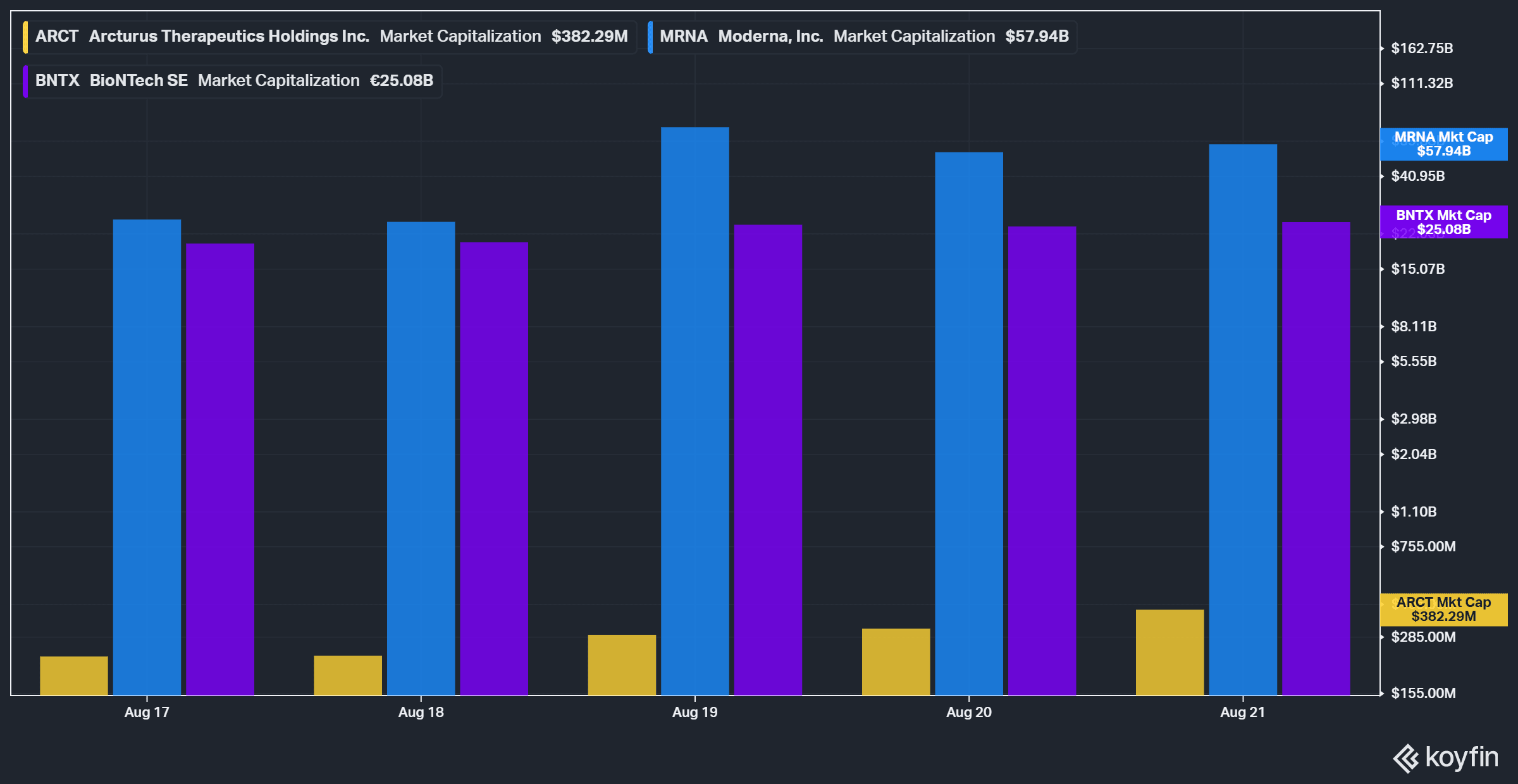
- It is important to note that Arcturus remains a smaller player in the mRNA space compared to Moderna and BioNTech, which have larger market capitalizations.
- Both Arcturus’s lead messenger RNA-based experimental medicines target rare diseases.
- Arcturus recently regained full global rights to its approved mRNA COVID vaccine KOSTAIVE.
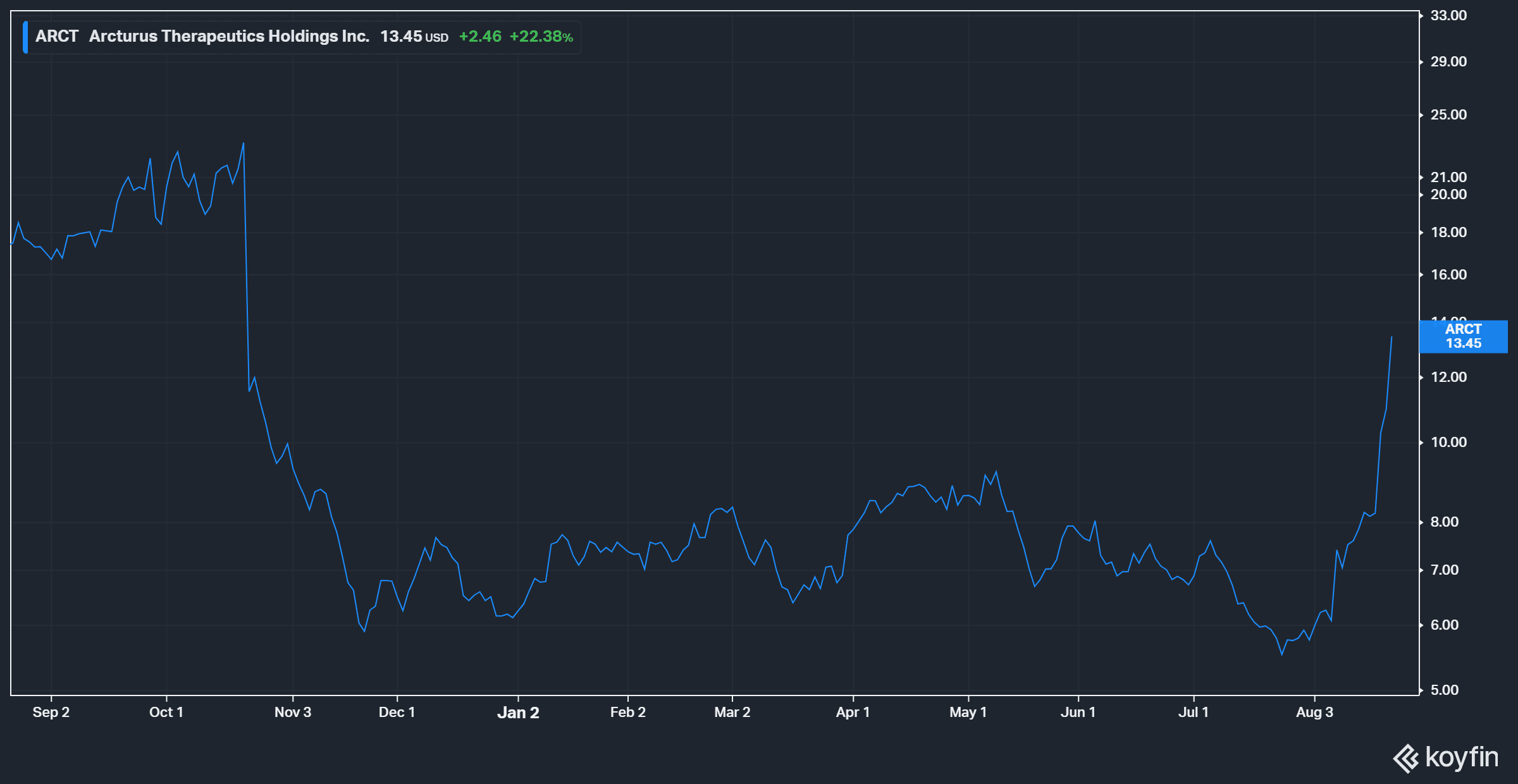
Shares of Arcturus Therapeutics (ARCT) delivered a powerful rally this week, climbing more than 60% from last Friday’s close and positioning the stock for its strongest weekly performance in a year after successive gains, driven by sector-wide enthusiasm for messenger RNA technology and company-specific progress.
Wednesday’s Breakout Ignites The Move
The surge began on Wednesday when ARCT jumped more than 25% to close at $10.28. The catalyst was positive late-stage results from Merck (MRK) and Moderna (MRNA) on their personalized mRNA cancer vaccine combined with Keytruda in high-risk melanoma patients. The trial met its main goals of reducing cancer recurrence and spread—the first successful late-stage readout for an mRNA cancer vaccine. Moderna shares soared nearly 177%, BioNTech (BNTX) rose about 22%, and the broader mRNA sector lifted in sympathy.
Rally Continues As Peers Pull Back
ARCT’s momentum carried into Thursday. While profit-taking hit larger peers—Moderna dropped more than 20%, and BioNTech fell roughly 2% to 4%—Arcturus advanced about 7%. Residual sector interest combined with Arcturus’s own recent developments helped the shares hold firm and extend higher. On Friday, the stock added another 22%, closing the week strongly.
It is important to note that Arcturus remains a smaller player in the mRNA space compared to Moderna or BioNTech, which have larger market capitalizations and broader commercial bases.
Company’s mRNA Pipeline Focuses On Rare Diseases
Arcturus develops messenger RNA medicines using its LUNAR delivery system, which packages mRNA to reach specific cells. Its two lead programs target rare diseases with high unmet need.
ARCT-032 is an inhaled mRNA treatment for cystic fibrosis, a genetic disease that makes thick, sticky mucus build up in the body. It helps the lungs produce the key protein they lack, especially for patients with certain genetic mutations who get no benefit from today’s drugs. The medicine is in an ongoing mid-stage trial. A fourth group of patients is now taking daily doses for 12 weeks. Enrollment is still open in the United States, Israel and Turkey. By the end of 2026, the company expects to decide whether to move into larger late-stage tests. If it does, Thermo Fisher Scientific will handle manufacturing and clinical support.
ARCT-810 targets a rare liver disease called OTC deficiency, in which the body cannot properly clear waste. The mid-stage trial has finished enrolling and dosing patients. Results and a plan for the next regulatory steps are due in the third quarter of 2026.
In addition, Arcturus recently regained full global rights to its approved mRNA COVID vaccine, KOSTAIVE, and its broader earlier-stage infectious-disease programs (influenza, RSV, EBV) after ending a collaboration. The company received $12 million in cash and relief from about $16 million in liabilities, strengthening its balance sheet.
Key upcoming events include ARCT-810 mid-stage trial data and a regulatory update in the third quarter of 2026, followed by the ARCT-032 late-stage go/no-go decision in the fourth quarter.
Recent Challenges
Arcturus Therapeutics has encountered several hurdles of late. In the second quarter of 2026, its revenue tumbled to $3 million from $28.3 million in the same period a year earlier, largely because collaboration payments shrank while the company prepared to exit and then formally ended its multiyear alliance with CSL Seqirus. That shift widened the quarterly net loss to $23.8 million, or 8 cents per share, from $9.2 million previously.
Adding to the pressure, interim mid-stage data released in October for the cystic fibrosis candidate ARCT-032 failed to show any meaningful improvement in a primary lung-function measure, sending the shares down by roughly half at the time.
Despite these setbacks, the company’s balance sheet remains solid. Cash stood at $191.5 million on June 30, down from $230.9 million at the close of 2025, and management expects the current reserves to last through the end of 2028.
How Did ARCT Retail Traders React?
On Stocktwits, retail sentiment around ARCT stock rose from ‘bullish’ to ‘extremely bullish’ over the past week, while message volume increased from ‘high’ to ‘extremely high’ levels.
A Stocktwits user opined that ARCT stock is “getting harder to dismiss.”
View this Stocktwits post
Another user highlighted that there is “no near-term risk of dilutive financing” with the stock, adding that it still “has a lot of room to run.”
View this Stocktwits post
A third user highlighted the multiple near-term catalysts for the stock. “I wouldn’t be surprised if we hit $50 this year,” they added.
View this Stocktwits post
ARCT stock has more than doubled year-to-date.
For updates and corrections, email newsroom[at]stocktwits[dot]com.
