
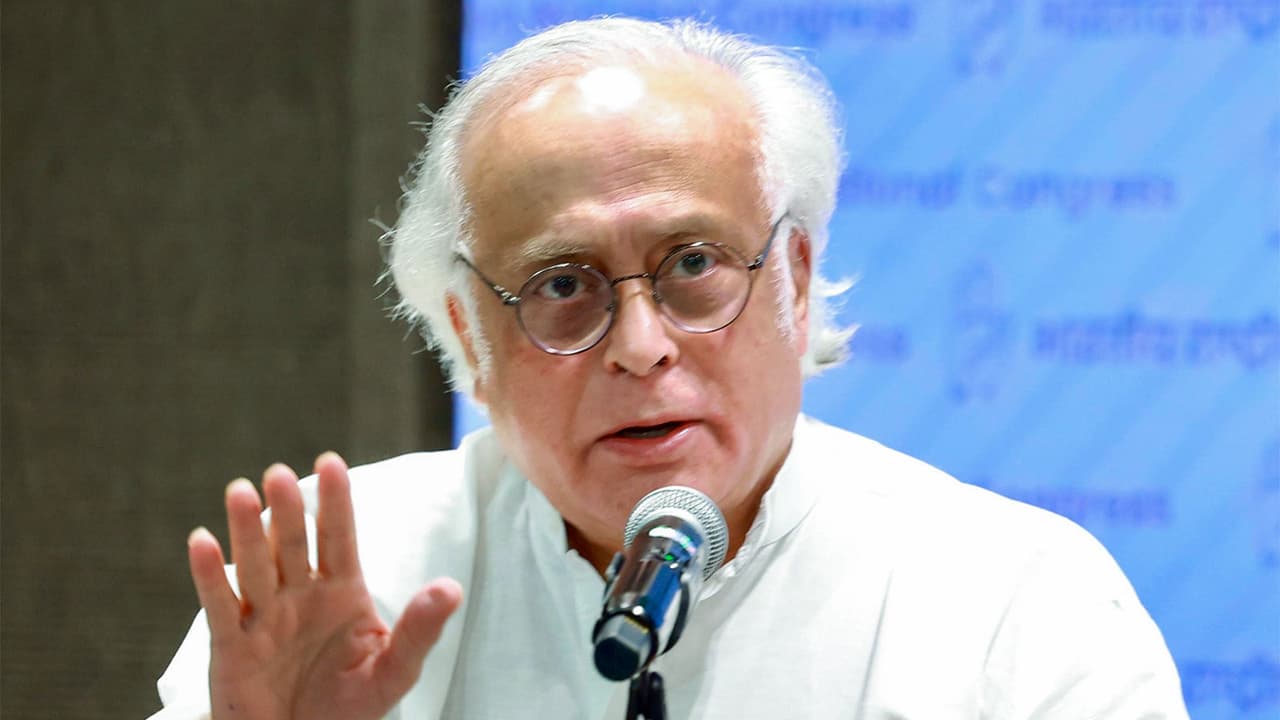
Congress's Jairam Ramesh attacked the Modi govt's E20 policy, alleging it made food and travel expensive. He said diverting sugarcane for ethanol raised prices and hurt vehicle mileage, a claim the govt refuted, citing other factors for mileage.
New Delhi [India], August 21 (ANI): Congress leader Jairam Ramesh on Friday launched a scathing attack on the Central Government over the implementation of 20 per cent ethanol-blended petrol E20 and alleged that the Modi government's decisions had made both food and travel more expensive for the public.
Ramesh Slams E20 Policy, Cites Price Rise and Vehicle Issues
In a post on X, Ramesh said, "Due to the wrong decisions of the arrogant Modi government, the public is paying the price for both expensive food and expensive travel." मोदी सरकार की अदूरदर्शी और जनविरोधी E20 नीति के कारण एक तरफ महंगाई बढ़ती जा रही है और दूसरी तरफ वाहन मालिक कम माईलेज और खराब होते वाहनों के रूप में मार झेलने पर मजबूर हैं। इसका खामियाज़ा जनता सड़क पर और रसोई में, दोनों तरफ से भुगत रही है। स्वाभाविक था कि गन्ने और अनाज को एथेनॉल… pic.twitter.com/mbaiIYMTgL — Jairam Ramesh (@Jairam_Ramesh) August 21, 2026
Ramesh also criticised the Centre's E20 policy, under which 20 per cent ethanol is blended with petrol, claiming that the policy has contributed to rising prices of food items while also affecting vehicle mileage and performance. He said, "Due to the Modi government's shortsighted and anti-people E20 policy, inflation is rising on one hand, while on the other, vehicle owners are forced to bear the brunt in the form of lower mileage and deteriorating vehicles. The public is paying the price for this both on the roads and in the kitchen, from both sides."
Explaining his concerns over the policy, the Congress leader said the diversion of sugarcane and grains towards ethanol production could affect the availability and prices of food products, while vehicles not designed for E20 could see reduced mileage. "It was only natural that when sugarcane and grains are turned into ethanol and blended at 20% in petrol, there would be a shortage of products derived from sugarcane and grains on the one hand, while vehicles not designed for 20 percent ethanol would face the risk of damage. Without proper testing, mileage in vehicles would decrease," he said.
Alleges Hike in Sugar, Jaggery, and Grain Prices
Ramesh further claimed that the diversion of sugarcane towards ethanol production has contributed to a rise in sugar and jaggery prices. Citing figures, he said, "It is now clear that 25 lakh tons of sugar-equivalent sugarcane has gone into ethanol, as a result of which, in just the last three months, sugar prices have risen from ₹48 to ₹67 per kg and jaggery from ₹50 to ₹65 per kg. Rice and corn flour have also become 16% and 11% more expensive, respectively. Animal feed has increased by 10.34%."
Questions Unchanged Petrol Prices
The Congress leader also questioned why petrol prices had not fallen despite a decline in international crude oil prices, and savings claimed from ethanol blending. "Without thinking it through, to give maximum benefits to their friends producing ethanol, the options for petrol alternatives have been limited for vehicle owners, but serious questions remain about the mileage and compatibility of vehicles with E20. It is surprising that despite a decline in international crude oil prices and the cost reduction from blending 20% ethanol, there has been no reduction in petrol prices," Ramesh said.
Congress's Stance and Demands
Ramesh said Leader of Opposition in the Lok Sabha Rahul Gandhi had repeatedly raised concerns over the E20 policy and alleged corruption linked to it. He stated, "Leader of the Opposition in the Lok Sabha, Rahul Gandhi, has been consistently highlighting the corruption happening in the name of E20. The Congress Working Committee had expressed its concerns on August 19 itself regarding the lower mileage due to E20, the risks related to vehicle compatibility, the limited options for consumers, and the questions of environmental damage."
"Our demand is that the E20 policy should be immediately reviewed and the public should be provided with options without ethanol. Such an anti-people fuel policy, where both the car and the kitchen become expensive, cannot be acceptable to the country," he added.
Government Responds to Mileage Concerns
The Congress leader's remarks come amid the ongoing political debate over the impact of ethanol blending on vehicle owners, fuel prices and the prices of agricultural commodities.
Meanwhile, on August 15, the government said E20 petrol alone cannot be held responsible for changes in vehicle mileage, stressing that real-world fuel economy depends on several factors, including driving habits, traffic conditions, vehicle maintenance, tyre pressure and use of air conditioning.
In a post on X, the Ministry of Petroleum and Natural Gas said E20 has undergone extensive testing and validation, while highlighting multiple factors that determine the mileage delivered by a vehicle.
"Mileage depends on more than fuel alone. Driving habits, traffic, vehicle maintenance, tyre pressure and AC usage all play a role," the ministry said.
"E20 has undergone extensive testing and validation, while real-world mileage depends on the overall driving and vehicle conditions," it added.
The government's latest clarification comes amid continuing concerns among motorists over the impact of 20 per cent ethanol-blended petrol on mileage, vehicle performance and compatibility. (ANI)
(Except for the headline, this story has not been edited by Asianet Newsable English staff and is published from a syndicated feed.)