
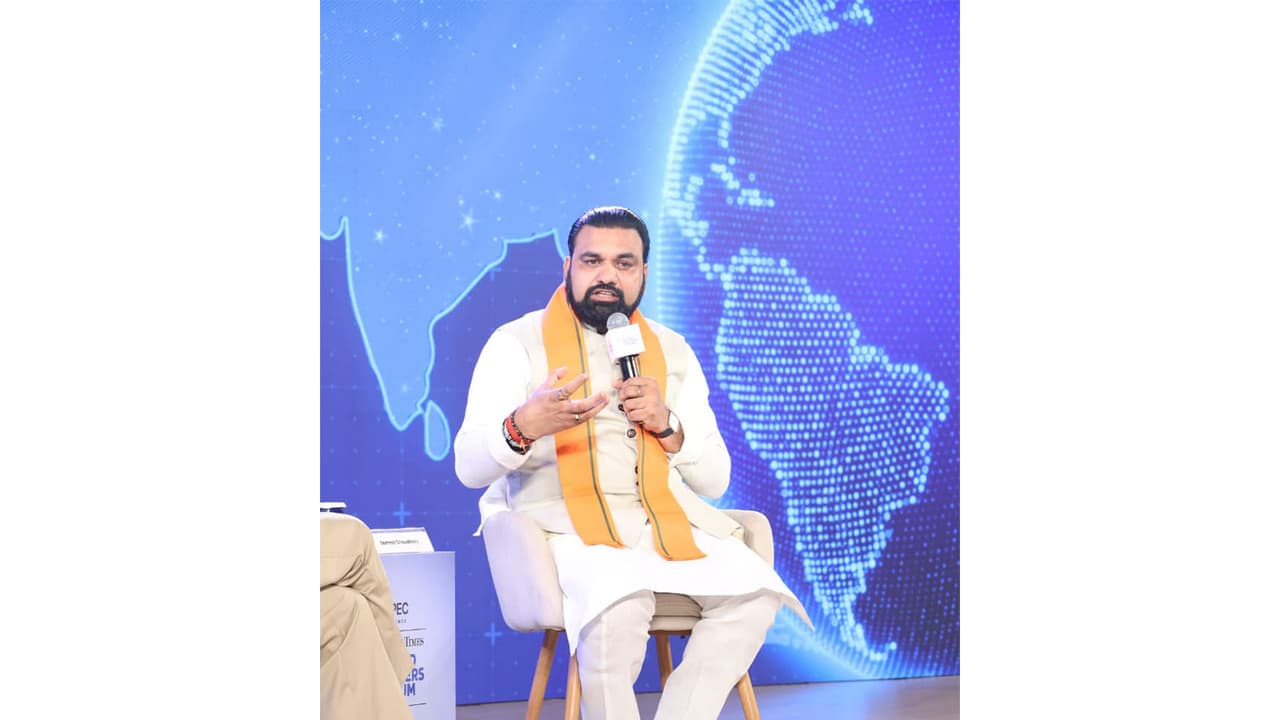
Bihar is rapidly progressing and stands on the threshold of transformation, said CM Samrat Choudhary. He highlighted the state's focus on industry, investment, and employment, supported by new policies to create a business-friendly environment.
Driven by the concept of 'Build Bihar, Believe in Bihar', the state is progressing rapidly today, Chief Minister Samrat Choudhary said at an event here on Friday. He stated that Bihar stands on the threshold of transformation.
Bihar Chief Minister spoke at length on a wide range of subjects--including the future direction of Bihar's development, investment potential, infrastructure, water management, employment, education, and women's empowerment--during The Economic Times 'World Leaders Forum' event.
From Infrastructure to Industry: Bihar's New Focus
For a long time, Bihar lagged in the development race due to various reasons, but basic infrastructure needs--road, electricity, and water--have now been largely fulfilled. The government's core focus is now on industry, investment, and employment, supported by several new policies designed to create a business-friendly environment for domestic and global investors, he said.
Good Governance and Grievance Redressal
He noted that prioritizing good governance led to the launch of the Sahyog (Cooperation) program. During his initial days as Chief Minister, numerous citizens submitted grievances. Consequently, an effective system was established to ensure time-bound resolution for every application. Out of 6,42,000 applications received so far, 96% have been resolved within a mandatory maximum timeline of 30 days. Strict action and automatic suspension provisions have been instituted against officials showing negligence or failing to meet deadlines.
Creating a Pro-Investment Climate
The Chief Minister highlighted that a conducive climate for industry and investment is actively being cultivated. Dedicated policies for Semiconductors and Global Capability Centers (GCC) were introduced in 2026. The state is continuously working to provide land, power, and essential amenities to industries. He added that Bihar is a densely populated state with quick technology adoption and a large pool of skilled human resources, offering investors both a massive market and a qualified labor force.
Infrastructure and Resource Management
Power Sector Overhaul
Power availability in Bihar has increased from around 350 MW to over 10,000 MW, with the state government extending approximately ₹23,000 crore in power subsidies to consumers.
Water Management and River Linking
Water management plays a crucial role in Bihar's growth trajectory. Rivers originating in Nepal cause severe annual flooding across nearly 16 northern districts during the monsoon, whereas several southern districts face drought conditions. Irrigated land in Bihar has expanded from 2.1 million hectares to 4.4 million hectares. Sustainable solutions to flood and drought challenges are being actively pursued by better managing the waters of the Kosi, Gandak, Ganga, and other rivers.
The Chief Minister stated, "Today, I met Union Finance Minister Nirmala Sitharaman and requested an action plan for irrigation projects--including the Kosi-Mechi link--and the management of river waters entering from Nepal."
Referring to the Farakka Barrage, he asserted that Bihar must get year-round access to Ganga river waters for drinking and irrigation purposes. Work is also underway on a project connecting the Sone and Falgu rivers to alleviate water shortages in Southern Bihar.
Economic Diversification and Urban Development
The government aims to transform the Kosi river from a curse into a boon. Integrated four-lane roads and industrial corridors are envisioned along both banks of the Ganga, Gandak, and Kosi rivers. Industrial corridors, educational hubs, institutional hubs, and large modern townships will be developed alongside the Ganga and Gandak.
Bihar is pivoting from a purely agrarian economy toward an ecosystem integrated with manufacturing, education, tourism, transport, and inland waterways. Possibilities are also being explored to develop water transport connectivity from Haldia to Bhimnagar/Virpur across the Indo-Nepal border region.
Modern Townships on the Anvil
The Chief Minister observed that Bihar is densely populated, noting that Patna historically hosted one of Asia's largest residential colonies. The government is working on a master plan to develop 12 modern, fully equipped townships across nearly 350,000 acres of land.
Employment and Women's Empowerment
Regarding employment, he recalled that prior to the previous assembly elections, a target of 1 million government jobs and 1 million employment opportunities was set. By 2025, over 5.3 million people were provided with government jobs and employment opportunities. A new target has now been established to provide jobs and employment to 10 million people over the next five years.
Furthermore, under Prime Minister Narendra Modi's Lakhpati Didi initiative, over 4.3 million women in Bihar have achieved Lakhpati Didi status. Women's financial independence and security have improved significantly, backed by over 40,000 female police personnel--the highest in the country. Women hold a 50% reservation in Panchayati Raj institutions and urban local bodies, resulting in 59% female representation in elected leadership roles.
Tapping into Agro-Industry Potential
The Chief Minister added that Bihar holds immense potential for food processing and agro-industries. Maize is cultivated at scale in regions like Motihari and Khagaria, while linking banana and other agricultural produce to food processing units can boost farmer incomes and create employment.
Reviving Cultural and Historical Heritage
Highlighting the state's heritage, he noted that Bihar boasts a glorious history associated with ancient Nalanda and Vikramshila Universities, Lord Buddha, Lord Mahavira, Guru Gobind Singh Ji Maharaj, and other eminent icons. World-class arrangements were hosted in Patna for the 350th birth anniversary of Guru Gobind Singh Ji Maharaj, and commemorative events are currently being organized for the 650th birth anniversary of Sant Ravidas Ji. Work is progressing on developing the Baba Hariharnath Corridor, Bodhgaya Corridor, and Vishnupad Temple Corridor. The ancient Nalanda University has been restored, and its historic ruins preserved so global visitors can appreciate Bihar's legacy as an ancient global seat of learning and wisdom.
A Call to Invest in a Prosperous Bihar
In conclusion, the Chief Minister stated that the aspirations of Bihar's citizens remain the government's paramount priority. The state is moving forward with a target to quadruple its economy over the next four years. While Prime Minister Narendra Modi works continuously toward a developed India, former Chief Minister Nitish Kumar initiated crucial foundational work for Bihar's growth. The present government is committed to advancing those initiatives to take Bihar to new heights.
Inviting national and international investors and industrial leaders to invest in the state, the Chief Minister urged: "Trust the government and contribute toward unlocking Bihar's prosperity. A prosperous Bihar will pave the way for a developed India."
He remarked that while political figures come and go, the commitment to transform Bihar must remain unbroken. Bihar occupies the heart's position on the map of India; the soil that gave India its golden age will once again play a pivotal role in opening the nation's path to future prosperity. Bihar will continue to march steadily along the road to transformation. (ANI)
(Except for the headline, this story has not been edited by Asianet Newsable English staff and is published from a syndicated feed.)