

The slower-growing Iridium business is expected to initially dilute Rocket Lab’s nearly 100% annual growth rate.
- Iridium adds constellation operations, applications and ground infrastructure to Rocket Lab’s launch and spacecraft businesses.
- Rocket Lab has “aggressive plans” to accelerate Iridium through greater investment and a growth-focused strategy.
- CFO Adam Spice called capital a competitive “weapon” that helped Rocket Lab pursue a similarly sized business.
Rocket Lab (RKLB) expects its proposed acquisition of Iridium Communications (IRDM) to double its size overnight, as the space company prepares to use the deal as a springboard for a broader expansion across orbital applications and constellations.
RKLB stock fell nearly 1% on Monday to close at $62.55 and slipped another 0.4% overnight heading into Tuesday.
Iridium Completes Rocket Lab’s Space Stack
Speaking at World Space Business Week, Rocket Lab CFO Adam Spice said Iridium would supply the missing piece in the company’s evolution from a launch provider into a fully integrated space operator.
Rocket Lab is widely known for its launch business, having flown nearly 100 missions while developing its larger Neutron rocket. But the company has also built a space-systems operation spanning satellite components, subsystems and complete spacecraft. What it lacked, Spice said, was the applications layer: operating a constellation in orbit and managing the associated ground infrastructure.
Iridium would fill that gap by extending Rocket Lab’s reach from launch and spacecraft manufacturing into constellation operations and services. “It’s incredibly transformational and really closes the whole loop for us,” Spice said, saying Rocket Lab’s goal is of becoming a “next-generation end-to-end space company.”
Rocket Lab Plans Post-Merger Growth
Spice said Rocket Lab has grown nearly 100% annually over the past several years, while the more mature Iridium has expanded at a single-digit rate. That means acquiring Iridium will initially weigh on Rocket Lab’s consolidated growth rate.
“When you double your company overnight, which will be the case when we combine the companies, you’ll naturally have some dilution in that growth,” Spice said. However, Rocket Lab believes Iridium has “interesting growth vectors” that could drive the next leg of expansion. Spice said greater access to capital and a more “forward-leaning,” growth-oriented strategy could help unlock those opportunities. “We’ve got a lot of aggressive plans” to move the combined company’s growth toward the level investors expect, he added.
Rocket Lab Eyes More Space Deals
Spice also touted Rocket Lab’s market valuation as an advantage that could fund additional expansion. “Capital is as much of a weapon as product and management team,” he said. Rocket Lab’s “very healthy market capitalization” helped it pursue a company nearly its own size, Spice said. Continued execution, in turn, should preserve its access to funding for both internal investments and future deals.
“As we continue to execute, the markets will continue to give us capital, and we’ll continue to kind of grow the business both organically and inorganically,” he said. Spice called the Iridium deal “the first step into many steps into the broader space market,” particularly across applications and constellations.
Rocket Lab-Iridium Merger Terms
Iridium last month filed its definitive proxy statement and Rocket Lab prospectus, formally sending the proposed transaction to an Iridium shareholder vote on Sept.24.
Under the deal, each Iridium share would convert into $27 in cash and a variable number of Rocket Lab shares based on Rocket Lab’s 10-day volume-weighted average price shortly before closing. Iridium shareholders would receive 0.4 Rocket Lab shares if the specified price is $67.50 or lower. Between $67.50 and $112.50, the exchange ratio would adjust to keep the stock component near $27. At $112.50 or higher, the ratio would be capped at 0.24 shares.
The transaction initially implied a $6 billion equity value and an $8.1 billion enterprise value for Iridium. Rocket Lab has secured a committed $3.6 billion bridge facility, which it may replace with longer-term debt, equity financing or both. Former Iridium shareholders are expected to own about 5% of the combined business.
How Do Retail Traders Feel About RKLB?
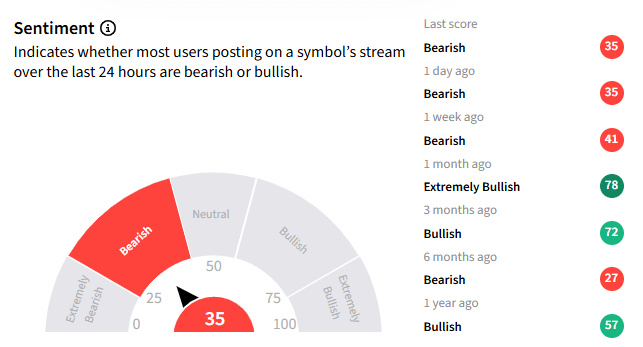
On Stocktwits, retail sentiment for RKLB has been ‘bearish’ over the past week amid a 247% jump in 24-hour message volumes.
One user said, “Although Rocket Lab is not fully net profitable overall, its core operations already approach break-even or positive adjusted cash flow when heavy Neutron rocket spending is removed.”
View this Stocktwits post
Another user said, “$RKLB tomorrow under 60 pre market Low 50 at open, market will be bloody red, easy short, unprofitable overvalued diluting company with delayed main product neutron into 2028”
View this Stocktwits post
RKLB stock has risen 17% over the past year.
For updates and corrections, email newsroom[at]stocktwits[dot]com.<
