
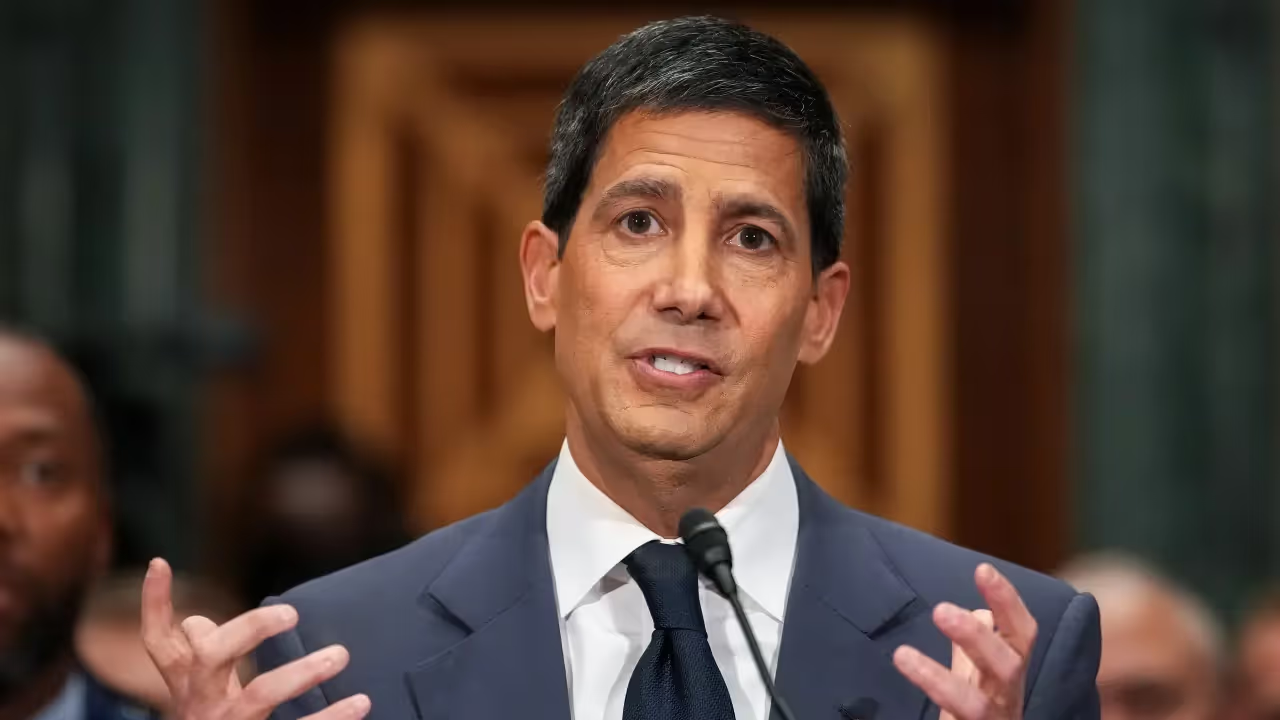
Warsh stated that the “Hall of Mirrors” problem could occur when markets rely on the Fed and the Fed relies on markets.
Federal Reserve Chair Kevin Warsh, in his debut keynote at the Jackson Hole Symposium on Friday, made a case for a less predictable, more data-dependent approach to monetary policy, stating that the Fed’s use of forward guidance has “outstayed its welcome.”
“You might know about my long-time discomfort with early pronouncements of future policy decisions,” Warsh said. “I much prefer another path.”
He stated that forward guidance was introduced during the global financial crisis and was “essential at the time,” but added that its continued use in normal economic conditions can create more problems than it solves. “I believe the practice has outstayed its welcome,” Warsh said.
The Fed chair added that excessive guidance can create “ambiguity in the name of clarity” and potentially lead markets, businesses and households “astray.”
He also said quasi-commitments on interest rates can limit the Fed’s ability to respond appropriately when conditions change.
‘Hall Of Mirrors’ Could Lead To Policy Errors
Warsh stated that there may be a “Hall of Mirrors” problem in play, in which markets rely on Fed guidance while the Fed simultaneously relies on market prices.
“If markets rely materially on the Fed’s guidance and the Fed relies on market prices, we’re more likely to be blinded to new developments,” he said, adding that policymakers could be “caught unprepared” and make policy errors.
“In my view, the Fed should be humble and never naive,” Warsh said.
Financial Conditions Aren’t ‘Restrictive’
According to Warsh, the economy “appears to have strengthened.” He pointed to resilient consumer spending, strong business investments and stable labor markets to support his view.
He added that more than half of that capital spending growth can likely be attributed to the buildout tied to artificial intelligence (AI).
“I would be hard pressed to describe broad financial conditions as restrictive,” Warsh said, noting that corporate credit spreads and leveraged-loan spreads are near the low-end of their historical ranges, while corporate issuance has remained strong. “Credit and loan markets are showing few signs of policy restraint,” he stated.
Warsh Says Inflation Still Needs To Improve
Warsh said recent inflation readings have not yet convinced him that underlying price pressures are firmly moving toward the Fed’s 2% objective. “While this summer’s PCE and CPI readings were better than expected, they do not tell me that underlying trends have meaningfully improved,” he said.
The Fed chair said policymakers need to be confident that underlying inflation is moving toward the target “clearly and at sufficient speed.”
“I stand here today committed to a discipline, not to a decision,” Warsh said.
Markets were little changed after his keynote. The SPDR S&P 500 ETF (SPY) gained 0.20%, the SPDR Dow Jones Industrial Average ETF (DIA) moved 0.11% higher, and the Nasdaq-100 tracking Invesco QQQ Trust (QQQ) remained flat.
The SPDR Gold Shares ETF (GLD) edged 0.8% lower, while Bitcoin (BTC) fell around 1% and the U.S. Dollar Index (DXY) moved 0.3% higher. The yield on the 10-year Treasury note was flat while the 20-year and 30-year yields were down by about two basis points as of this writing.
Read also: Mohamed El-Erian Says Kevin Warsh Faces Jackson Hole Balancing Act Between ‘Reaction Function’ And ‘Original Secular Spirit’
For updates and corrections, email newsroom[at]stocktwits[dot]com.<
