
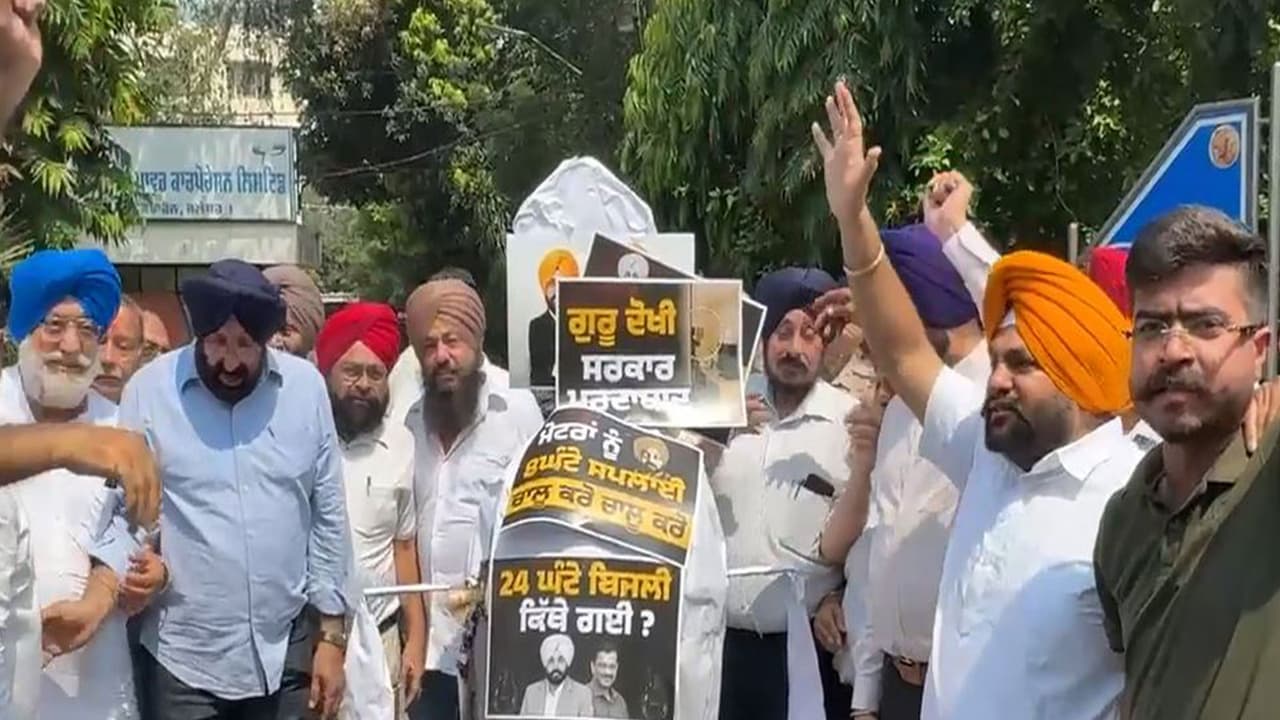
The Shiromani Akali Dal held a protest in Jalandhar against the AAP government over severe power cuts in Punjab, burning effigies of CM Bhagwant Mann and Arvind Kejriwal and demanding a 24-hour uninterrupted power supply.
Akali Dal leaders and workers launched an agitation against the scheduled and unscheduled power cuts in Punjab by staging a massive protest outside the Chief Engineer's office (Shakti Sadan) in Jalandhar against the Punjab government's power policy and submitted a memorandum of demands to the officials.
Angered by the unscheduled power cuts being imposed across the state by the Punjab government, the Jalandhar Urban unit of the Shiromani Akali Dal, led by District President Iqbal Singh Dhindsa, held a protest demonstration outside the Chief Engineer's office.
During the protest, Akali workers also burnt effigies of Punjab Chief Minister Bhagwant Mann and Aam Aadmi Party (AAP) convener Arvind Kejriwal.
At the conclusion of the protest, a memorandum outlining their demands was handed over to Chief Engineer Sarabjit Singh.
Akali Dal Blames AAP Government's Mismanagement
Addressing the protest, Akali Dal District President Iqbal Singh Dhindsa stated that the current power crisis in Punjab has arisen solely due to the mismanagement and poor planning of the Aam Aadmi Party government. He noted that towns and cities are facing power cuts lasting several hours, which have not only disrupted domestic life but also severely impacted businesses, industries, and the farming community. The general public in the state is deeply distressed today.
Dhindsa alleged that this power crisis is not a sudden issue but the result of the lax policies of the Punjab government and the electricity department. The AAP government has completely failed to devise alternative arrangements or plans to meet the electricity deficit.
AAP leaders, who had promised 24-hour electricity before the elections, are now proving incapable of ensuring a steady power supply.
The Akali leaders demanded that the Bhagwant Mann government immediately resolve this serious power crisis and ensure an uninterrupted 24-hour electricity supply across the state. They warned that if the power issue is not resolved soon, the Akali Dal would be compelled to launch a massive and intense agitation, for which the Punjab government would bear full responsibility.
Several prominent Akali leaders and workers—including Maninderpal Singh Gumbar (General Secretary), Amrit Bir Singh, Advocate Vinod Kaul, Surjit Singh, Ravinder Singh Sweety, Sahib Singh Dhillon, Manish Gill, Bibi Rita Kaur, and Jaswinder Kaur Kamboj—were present during this protest demonstration.
Industrialists Note Improvement in Power Supply
Meanwhile, President of the Federation of Industrial & Commercial Organisation (FICO), Gurmeet Singh Kular, highlighted the critical nature of reliable electricity for local manufacturing, adding that power supply conditions improved substantially over the past three days. "As far as the recent power cuts are concerned, there was a major problem. Industries were facing outages of up to 10 hours. However, over the past three days, the industry has received complete relief, and there is now an uninterrupted power supply. At present, there are no power cuts affecting industrial operations. We are grateful to the State Power Minister, whom we approached to seek a solution, because electricity is a critical input for industry. Night-time outages have also stopped," he said.
Kular expressed appreciation toward state power authorities for responding to industry representations and resolving both daytime and night-time disruptions. "We appreciate the efforts of the Punjab Power Minister in resolving the issue. Industry requires a reliable 24/7 power supply to function efficiently. Many sectors, such as heat treatment and electroplating, depend on continuous processes. If the power supply is interrupted, the material being processed can be damaged or ruined," he said.
General Secretary of the Chamber of Industrial & Commercial Undertakings (CICU), Honey Sethi, echoed a similar sentiment, "For the past two or three days, there have been no power cuts at all. The Punjab Government has certainly taken steps to improve the situation."
Industrialist Ashwini Kumar noted that while manufacturing units experienced operational hiccups over the past few days, supply conditions have since returned to normal without immediate major alerts. "The power crisis was not this severe earlier, although there was some disruption over the last two or three days. However, since yesterday, the situation has been completely normal, with no issues. There was a problem on Sunday, but as of today, we have not received any alerts, and the situation is fine. I would not describe it as a major crisis at the moment," he said.
Underlying Challenges for Manufacturing Sector
Despite the recent improvement, Kumar highlighted the underlying operational challenges that unannounced power cuts pose to export-oriented manufacturing units. Key industrial operations, such as heating furnaces and chrome-plating plants, require consistent lead time and continuous power to run safely and efficiently. "A reduced power supply certainly affects us. We export our products, and several of our manufacturing processes, such as operating heating furnaces, require advance planning. If we are not informed about outages in a timely manner, we need at least two hours to safely manage and shut down the equipment. We also have a chrome-plating plant, which requires time to process and unload material. So, there are operational difficulties. We do use generators as a backup, but the cost of running them is very high, around Rs 15,000 to Rs 20,000 per hour. That is definitely a challenge. There were no issues yesterday, and there have been no issues today either," he said.
Industrialist Sumit Sharma also noted that despite operational challenges during the initial phase of the disruption, the power supply has seen a swift recovery. "We did face some challenges over the last week or two. However, fortunately, the situation has now stabilised, and I hope it remains stable going forward. There were certainly some difficulties, but at present things appear to be under control. We were concerned, and our operations were affected during the initial phase when the issue emerged last week. We did not expect such a quick resolution, but fortunately the situation improved, and I believe things will return to normal now," he said.
"I am optimistic about the situation and hope that no such problems arise in the future, but as things stand today, there is no concern of that nature," he added.
(Except for the headline, this story has not been edited by Asianet Newsable English staff and is published from a syndicated feed.)