
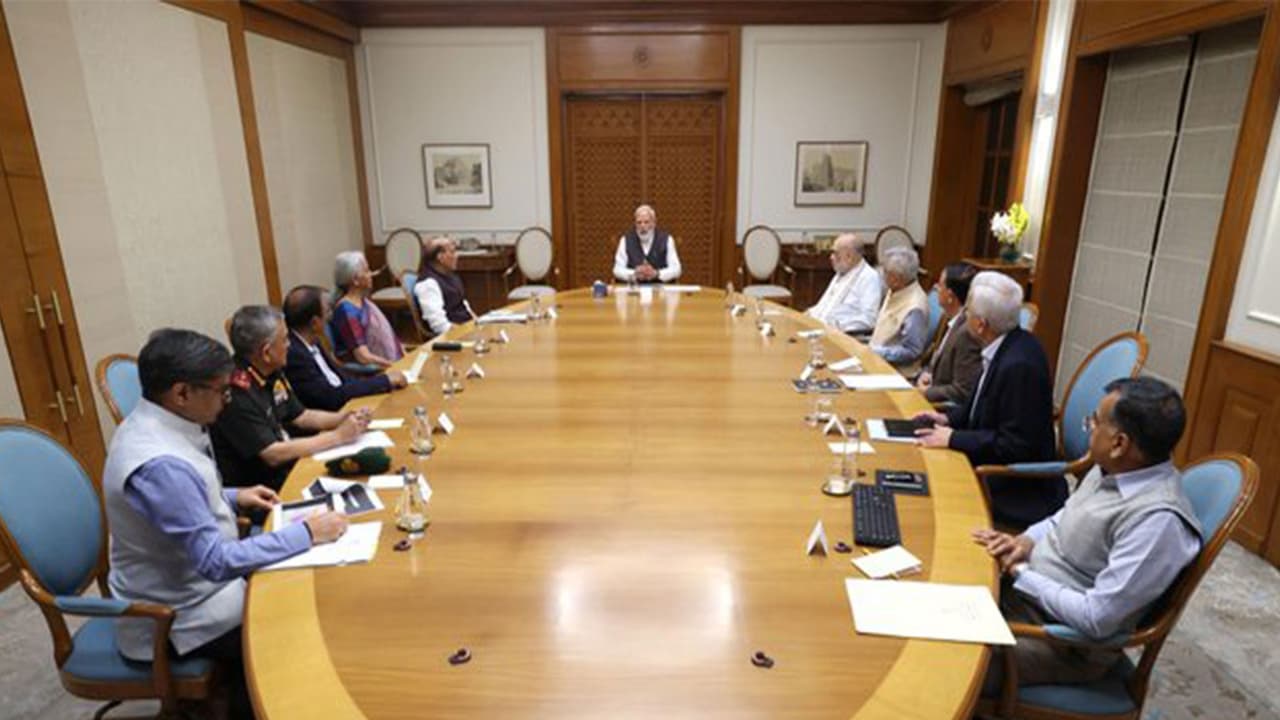
PM Modi chaired a CCS meeting to review the West Asia crisis after US-Israel airstrikes in Iran. The committee expressed concern for the safety of Indian expatriates and directed departments to assist affected nationals amid the escalating conflict.
The Cabinet Committee on Security (CCS) met under the chairmanship of Prime Minister Narendra Modi to review the evolving situation in West Asia. The meeting was held on Sunday in the national capital at 7, Lok Kalyan Marg, the official residence of the Prime Minister.
CCS Reviews Regional Security, Indian Nationals' Safety
According to a release, the Committee was briefed on the air strikes in Iran on 28 February and the subsequent escalation, including attacks in several Gulf countries. It expressed serious concern over the safety and security of the large Indian expatriate community in the region. The CCS also reviewed the difficulties faced by Indian travellers transiting the region and students appearing for scheduled examinations, as well as the broader implications for regional security and economic and commercial activities. The CCS directed all concerned departments to take necessary and feasible measures to assist Indian nationals affected by the developments. It underscored the importance of an early cessation of hostilities and a return to dialogue and diplomacy.
Prime Minister Modi returned to Delhi after his two-day visit to Puducherry and Madurai, where he participated in National Democratic Alliance (NDA) election campaign events ahead of the upcoming Tamil Nadu Assembly elections. During his tour, he inaugurated key central government infrastructure projects in Tamil Nadu, focusing on national highways and railways, aimed at improving connectivity and boosting economic development in the region.
Background of the Escalation: US-Israel Airstrikes
The CCS meeting came in the aftermath of Israel and the US' coordinated airstrikes across multiple Iranian cities, targeting Iranian military command centres, air-defence systems, missile sites, and key regime infrastructure. The strikes resulted in the death of Iranian Supreme Leader Ayatollah Khamenei and four senior military and security officials. Large explosions were reported in Tehran and other major cities. US President Donald Trump said that the strikes were done to "ensure that Iran does not obtain a nuclear weapon".
Iran's Retaliation
Iran retaliated by firing ballistic missiles and drones at US assets and allies across the region, targeting Israel, Bahrain, Kuwait, Qatar, the United Arab Emirates and Jordan, thus triggering conflict in the Middle East. (ANI)
(Except for the headline, this story has not been edited by Asianet Newsable English staff and is published from a syndicated feed.)