
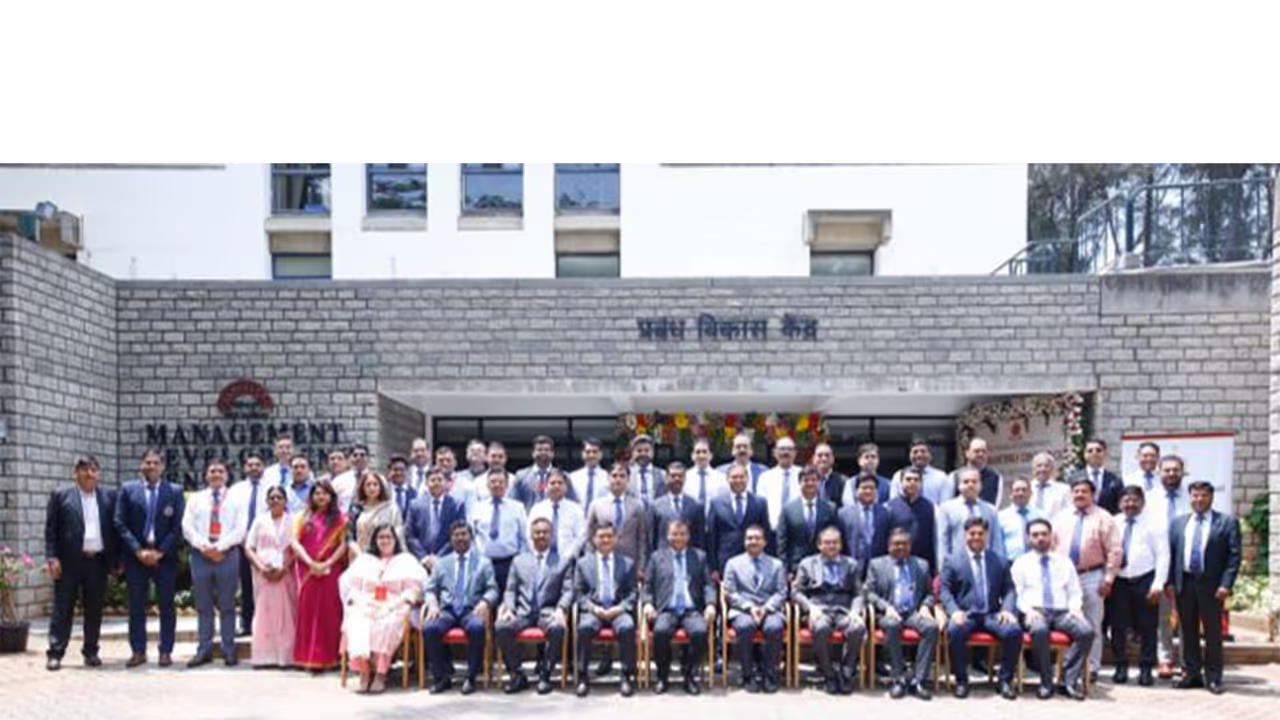
The Enforcement Directorate held its 36th QCZO at IIM-B, announcing a 60% expansion of its cadre strength. The conference focused on using AI in investigations, fast-tracking trials, and strengthening inter-agency cooperation to combat economic crime.
As per the official release, the three-day conference was chaired by the Director, ED, and attended by all Special Directors, Additional Directors, Joint Directors, Deputy and Assistant Legal Advisors, and other senior officers from Headquarters and field formations.
The workshop commenced at the IIMB campus with ceremonial lamp lighting and invocation. The Special Director (Southern Region) welcomed the academic dignitaries, and in his opening remarks, the Director, ED, conveyed the Directorate’s gratitude to IIMB and announced that the Government of India had formally approved the long-pending cadre restructuring of the Directorate, expanding its sanctioned strength by sixty per cent. He also emphasised the value of institutional bonds within the organisation and of longer-term academic collaboration with IIMB.
The Dean (Administration), IIMB encouraged participants to approach the sessions with an open mind and to engage in two-way learning with the faculty.
Leadership and Technology Workshop
The sessions of the workshop were conducted by faculty of IIMB and by international experts. They covered the future of financial investigation in the context of India’s digital public infrastructure, the use of Artificial Intelligence and data analytics in economic crime investigation and the attendant risks of deepfakes and AI-enabled fraud, cyber threats and international cooperation in a session by a Special Agent of the Federal Bureau of Investigation attached to the United States Embassy in New Delhi.
The recurring theme across the sessions was the need to move from a case-centred to an ecosystem-centred approach to investigation, to harness technology and data analytics while remaining alive to the risks they carry, and to strengthen institutional capacity, leadership and public projection of the Directorate’s work. The day concluded with cultural programmes at the IIMB auditorium.
Inaugural Day and Director's Address
The inaugural day of the 36th QCZO on 14th September also coincided with Hindi Divas, with the occasion being marked through a traditional lamp-lighting ceremony and the release of the Western Region's Hindi magazine ‘Pravartan Pravaah’ with articles from officers and staff of the region. The Conference also acknowledged the contribution of officers towards promoting Hindi in official work and highlighted the constitutional significance of Hindi as the official language.
In his keynote inaugural address, the Director, ED set out the operational, structural and ethical priorities of the Directorate. Noting that the Conference followed immediately upon the approval of cadre restructuring, he directed all Zonal Heads to conduct formal cascade briefings in their respective zones down to the level of Assistant Enforcement Officers and to record the proceedings. He called for quick and decisive decision-making in place of over-deliberation that delays search and enforcement action.
On technology, he cautioned that even offline deployments of Artificial Intelligence carry risks of data leakage and that confidential case material must be handled with the utmost care, while underlining the shift in intelligence culture from a ‘need to know’ basis to a ‘duty to share’ among law enforcement agencies. He further directed that the achievements of the Directorate, including action in bank frauds, builder-buyer frauds, insolvency-related frauds and cybercrime, be projected through regular press releases and media engagement, and reaffirmed an uncompromising policy of zero tolerance towards corruption within the organisation. He also emphasised the usefulness of general management principles in the day-to-day working of the Directorate, and called upon every officer and member of staff to update themselves on new developments in the areas of criminal investigation, legal principles, international practices and management principles, including through the use of social media and artificial intelligence tools.
Core Operational Thrust Areas
The Director, ED identified the following core operational thrust areas for the Zones: Unearthing frauds under the Insolvency and Bankruptcy Code and the PMLA, including re-examination of collusive resolution cases involving disproportionately large haircuts through which promoters re-acquire assets; Closer coordination with the State Police and other law enforcement agencies, including recourse to the attachment and bail provisions of the PMLA against organised criminal elements; Fast-tracking of trials, with identification of at least ten high-profile cases in each region for conclusion of trial and conviction within six to eight months; Aggressive pursuit of restitution of attached and confiscated assets to legitimate victims; and Mandatory valuation of all confirmed attached properties by government-approved valuers, with geo-tagging, within six months, along with the taking of constructive possession.
Cadre Restructuring and Infrastructure Roadmap
The first working session dealt with implementation of the approved cadre restructuring and the related infrastructure roadmap. The restructuring raises the sanctioned strength of the Directorate from 2,029 to 3,256 posts, expands the field structure to fifty PMLA Zones along with five dedicated FEMA Zones at Delhi, Chandigarh, Mumbai, Kolkata and Chennai, and increases the number of functional units from 131 to 241, with rollout targeted from 1st January, 2027. The objective is to compress the lifecycle of investigations from the present four to five years to about one and a half years.
On infrastructure, the session set the goal of owned office premises across all thirty-nine cities in the Directorate’s footprint by 31st March, 2029 under the ‘Project Pravartan Bhavan’, and reviewed the status of land acquisition and construction across several locations, along with deployment of security cover at the remaining offices.
Working Sessions Review
Investigation Tools and Intelligence
The second session reviewed the tools and techniques available for investigation and intelligence. Usage trends on the NATGRID platforms were examined, and Zones were directed to maintain strict controls on official use. The session also covered access to the Inter-Operable Criminal Justice System, corporate filings and immigration databases, and platforms for obtaining virtual digital asset transaction records, besides the analytical products of FIU-IND, including suspicious transaction reports, cash transaction reports, cross-border wire transfer reports and operational and tactical analyses, with a proposal for real-time coordination protocols with FIU-IND.
Insolvency Code and PMLA Interplay
The third session examined the interplay between the Insolvency and Bankruptcy Code and the PMLA. The session analysed the legal tension between the moratorium under Section 14 and the immunity under Section 32A of the Code on the one hand and attachment powers under the PMLA on the other, and identified recurring malpractices including circumvention of Section 29A, inflation of related-party claims, manipulation of the Committee of Creditors, asset stripping and artificially large haircuts through which promoters regain control of assets.
Cooperation with Other Law Enforcement Agencies
The fourth session addressed cooperation with other law enforcement agencies. The session emphasised seamless flow of information from the State Police, CBI, Customs, DRI, NCB and SEBI, and proposed migration of ML-I and ML-II reporting from manual returns to an automated online portal integrated with CCTNS and NATGRID with threshold-based alerts. The gap in registration of first information reports on references made by the Directorate under Section 66(2) of the PMLA was discussed, and recourse to joint special investigation teams, attachment provisions available to the police under the Bharatiya Nagarik Suraksha Sanhita and under special statutes, was recommended.
International Cooperation and Fugitive Management
The fifth session reviewed international cooperation, extradition and fugitive management. Stress was laid on the quality of drafting and treaty compliance in Letters Rogatory and mutual legal assistance requests, and a drive was announced to review and withdraw obsolete or non-essential requests pending for more than five years.
Special Session on Crypto Ecosystem
A special session on emerging trends in the crypto ecosystem highlighted the use of decentralised finance protocols and tokenisation of real-world assets without intermediaries, and the operation of hawala networks that convert rupee funds through domestic brokers into dollar-pegged stablecoins for seamless cross-border transfer of value.
Concluding Day: Trials, Prosecution and Restitution
On the concluding day, September 15, the Conference took up a detailed session on fast-tracking of trials and securing convictions under the PMLA, led by the Special Director (Southern Region). The session mapped the statutory lifecycle of a PMLA trial from filing of the prosecution complaint to judgment and sentencing, and aligned investigative and prosecutorial workflows with the new criminal codes, namely the BNSS, the BSA and the BNS, read with binding precedents of the Supreme Court.
On trial conduct, the session stressed adherence to the sixty-day window for framing of charges, the statutory cap on adjournments, uninterrupted cross-examination and full use of the modern evidentiary framework, including audio-video deposition of official witnesses and time-bound admission and denial of documents. Cases pending beyond ten years are to be placed in a dedicated monitoring register for monthly review by the Head of Zone, with plea bargaining and non-conviction based confiscation considered in eligible cases. The session also underscored the need for close coordination with the predicate agency, both at the level of the Investigating Officer and of the Public Prosecutor, as the outcome of a trial under the PMLA is dependent on the conclusion and outcome of the trial in the predicate offence. It was further directed that, other than in certain exceptional circumstances, committal applications under Section 44(1)(c) of the PMLA should be filed.
The Conference thereafter took up the topic of Prosecution Progress Report (PPR), which reviewed region-wise data on prosecution complaints across the country and drew attention to recurring reporting deficiencies across Zones. A session on the Directorate’s case management database reviewed the quality and timeliness of data reported by Zonal Offices on the EDOTS portal and emphasised the sanctity of data as the foundation of sound policy-making, risk management and institutional performance measurement.
The Conference finally took up a session on restitution, which reaffirmed the Directorate’s victim-centric approach of completing the justice cycle by restoring illicit wealth to those defrauded. Restitution effected so far has crossed Rs 73,800 crore across seventy-six cases, and the session traced the statutory scheme of confiscation and restoration under Section 8 of the PMLA, including restoration to legitimate claimants during the pendency of trial.
The 36th QCZO concluded with a clear road map for the coming quarter, time-bound implementation of the cadre restructuring, fuller use of technology and forensic capability, fast-tracking of trials and convictions, and sustained pursuit of restitution to the victims of economic crime. The Directorate of Enforcement reaffirmed its commitment to the firm and fair enforcement of the laws entrusted to it and to protecting the integrity of India’s financial system. (ANI)
(Except for the headline, this story has not been edited by Asianetnews Editorial staff and is published from a syndicated feed.)