
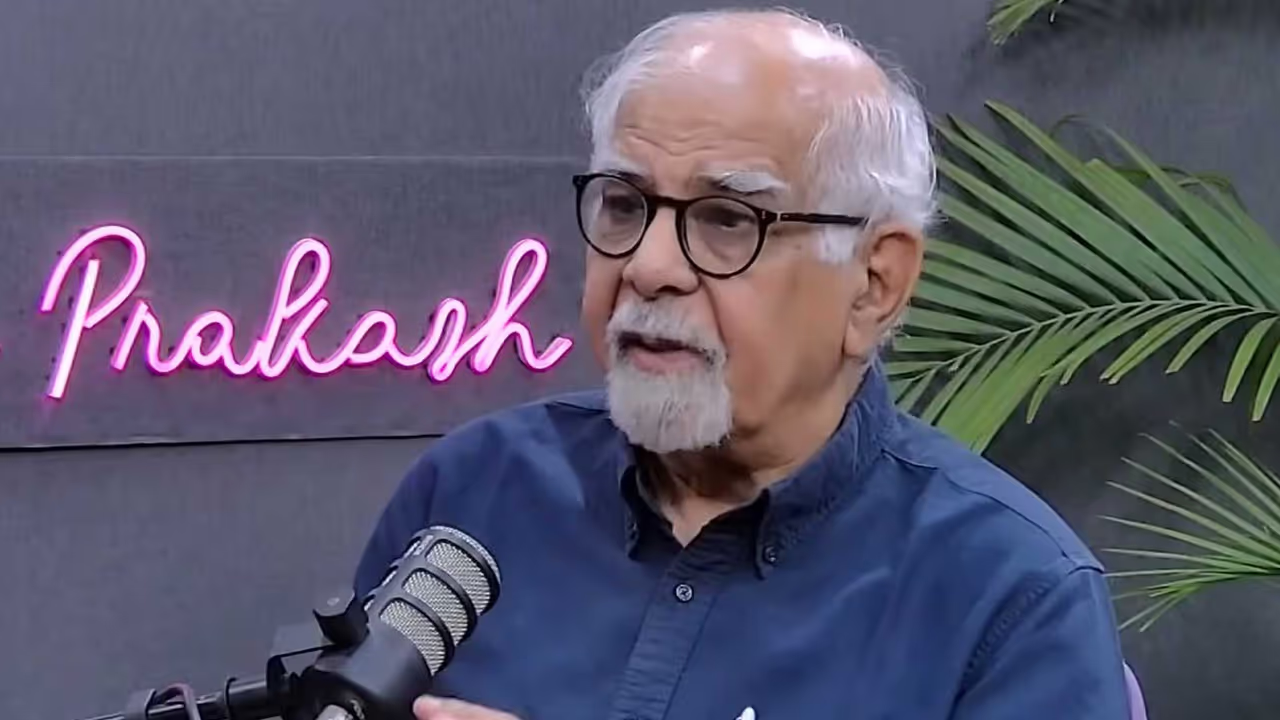
Economist Surjit Bhalla warns that despite 6% growth, India's economy is at a 'standstill' in ambition. He claims government protectionism is stalling the manufacturing sector, preventing firms from taking risks to compete globally.
Economist and author Surjit Bhalla has said that despite maintaining a robust growth rate of 6 per cent, the Indian economy is suffering from a "standstill" in ambition.
Speaking exclusively with ANI, Bhalla, a former part-time member of Prime Minister Narendra Modi's Economic Advisory Council, stated that India's manufacturing sector remains trapped in a cycle of stagnation because government protectionism has disincentivised corporations from taking the risks necessary to compete globally.
Bhalla highlighted a paradox in the current economic landscape: while Indian firms possess healthy balance sheets, they remain reluctant to commit to large-scale manufacturing investments. He argued that this hesitation is a rational response to a policy environment that shields companies from competitive pressures.
"The key element about the Indian system is why it is at a standstill. A standstill with a 6 per cent growth. We are doing well, but we are all very comfortable with what we have achieved. There is no ambition. There is no drive to go forward," he said.
Protectionism vs Export-Oriented Growth
Questioning existing tariff structures, such as a 25 per cent duty on polyester, Bhalla argued that these measures reduce the urgency for domestic manufacturers to become globally competitive. "Why are industrialists not taking risks? Look at the protection we provide them. So why should they take risks?" he asked.
Comparing India's approach to the "East Asian miracle" model, Bhalla pointed to South Korea's historical success, which he attributed to a government-industry compact that demanded competitiveness in exchange for support. "The government said, 'Go forth and export.' If you are competitive, we will back you with subsidies. If you are not competitive, you are out," he explained. By contrast, he felt India failed to demand similar export-oriented performance from its own industrialists.
Losing the 'China Plus One' Race
Bhalla noted that while many expected India to emerge as the primary beneficiary of the "China plus one" strategy, the country was effectively outpaced by its neighbours. "Vietnam and Bangladesh had our breakfast," he remarked, citing Vietnam's aggressive pursuit of foreign investment through tax incentives and swift integration into global supply chains.
Complacency a Barrier to 'Viksit Bharat'
Reflecting on the manufacturing sector's long-term share of GDP, which has hovered between 13 and 15 per cent for decades, Bhalla warned that complacency is the primary barrier to India's vision of becoming a Viksit Bharat (developed India).
While he acknowledged the country's current 6 per cent growth as "remarkable," he insisted that hitting higher potential growth targets will require a fundamental shift in policy. For Bhalla, the path forward is clear: move away from protective blanket policies and towards a system that rewards competitive efficiency, encourages exports, and compels industry to embrace the risks inherent in a globalised economy.
(Except for the headline, this story has not been edited by Asianet Newsable English staff and is published from a syndicated feed.)
