
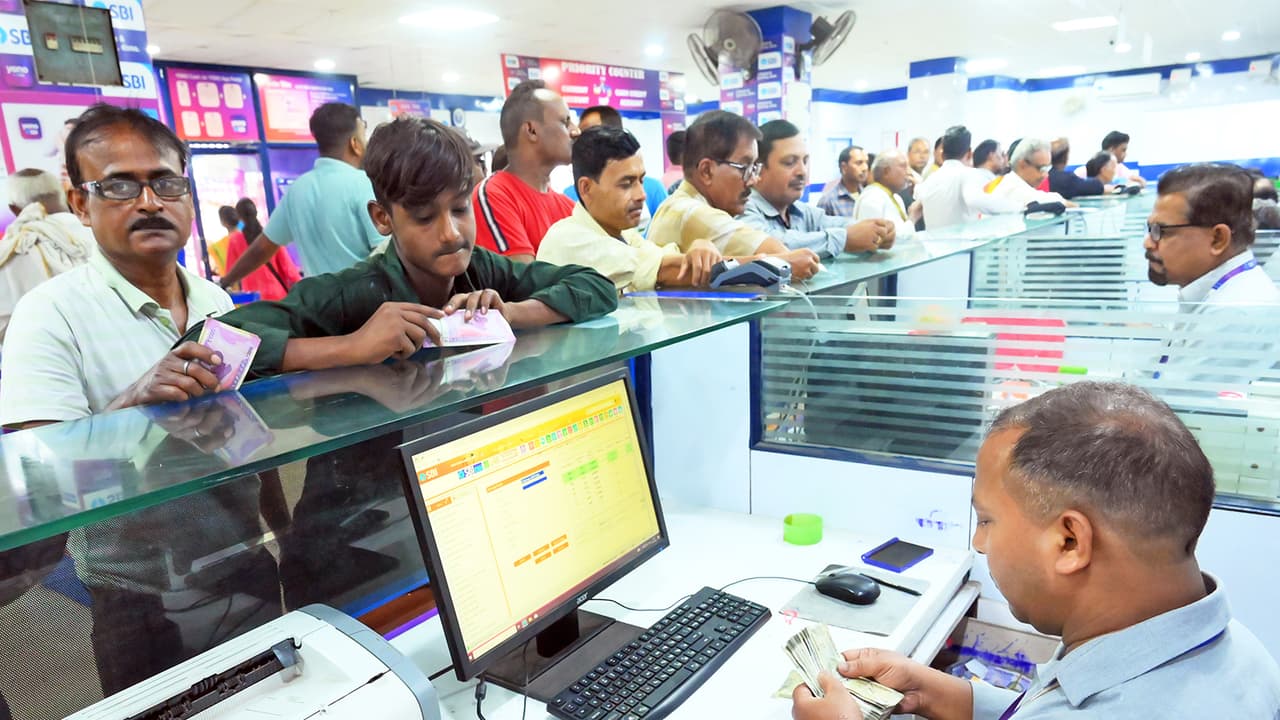
Asset quality at major Indian banks is set to improve despite economic challenges, an S&P analysis shows. Lenders are likely to see a decline in bad-loan ratios, offering a buffer against softer earnings growth and market volatility.
Asset quality at India's leading banks is expected to improve further in the current fiscal year despite global and domestic economic headwinds, according to an analysis by S&P Global Market Intelligence.
The report, titled "Lower bad loans at Indian banks offer respite amid economic uncertainty", said that major lenders are likely to witness a further decline in bad-loan ratios even as they navigate challenges arising from the ongoing conflict in the Middle East and the prospect of weak rainfall.
Stronger Balance Sheets, Lower NPAs
Data compiled by S&P Global Market Intelligence showed that nonperforming loans at India's largest public and private sector banks have continued to trend lower, reflecting stronger balance sheets and improved recovery mechanisms.
According to the analysis, the nonperforming assets (NPA) ratio of State Bank of India is projected to decline to 0.92 per cent in the fiscal year ending March 31, 2027, from 0.96 per cent as of March 31, 2026. Similarly, HDFC Bank Ltd. is expected to report a two-basis-point reduction in its bad-loan ratio to 0.76 per cent by March 31, 2027.
The analysis noted that "asset quality at major Indian banks is expected to improve further, despite economic challenges from the war in the Middle East and anticipated weak rainfall."
Profitability and Stock Performance Face Hurdles
However, the report highlighted pressure on profitability indicators, particularly net interest margins (NIMs), across the banking sector.
Net Interest Margins Decline
"Net interest margins (NIMs) at all major Indian banks declined in the quarter ended March 31," the analysis said.
Axis Bank reported a 15-basis-point quarter-on-quarter decline in its NIM to 3.39 per cent, while State Bank of India posted a 14-basis-point decline to 2.71 per cent during the same period.
Despite the margin compression, some lenders maintained their outlook. State Bank of India retained its full-year margin guidance at 3 per cent. Bank of Baroda, which reported a net interest margin of 2.79 per cent in the quarter ended March 2026, projected its full-year NIM in the range of 2.75 per cent to 2.95 per cent.
Banking Stocks Weaken
The report also pointed to weakness in banking stocks amid broader market volatility.
"Eighteen of the 20 largest listed banks in India also saw their market capitalizations drop in the quarter, driven primarily by a broad-based sell-off across sectors amid geopolitical tensions," the analysis said.
According to S&P Global Market Intelligence, the improvement in asset quality could provide some relief to lenders as they contend with external uncertainties and softer earnings growth pressures.
(Except for the headline, this story has not been edited by Asianet Newsable English staff and is published from a syndicated feed.)