

The BitMEX co-founder is returning to a leadership role after a six year hiatus as CEO of Flop Labs.
- Arthur Hayes suggested the real AI bubble was not in tech, but in the debt financing of data centers and loss-making AI firms.
- He added that excess compute capacity might eventually benefit crypto-AI projects, like Flop Labs.
- Hayes will be leading Flop Labs and its proposed FLOP token, which runs on a “proof-of-useful-inference” network.
BitMEX co-founder Arthur Hayes said that the AI bubble was not in the technology itself but in the debt being used to build it, and that the fallout could end up powering his newest project.
"The bubble is debt issued to build data centers and stocks of unprofitable hyperscalers and frontier labs," Hayes wrote on X Tuesday. He added that he "100% believe[s] in the agentic economy" and that "the compute overcapacity built with borrowed money bolsters my thesis" for Flop Labs, his new AI-crypto venture.

What Flop Is Building
Flop Labs is developing the Flop Network, a proof-of-useful-inference protocol with a native token, FLOP, that Hayes described as "food for your AI agent." The proposed design involved miners that provided compute to run AI inference tasks and would get paid in FLOP, validators that would verify the work and store agent memories, and AI agents that would consume FLOP to access those resources.
Hayes said the token will launch with no presale, no venture-capital allocation, and would be a "100% fair launch." He said the project planned a "massive airdrop,” with the genesis block targeted for the first quarter of 2027.
No Whitepaper Yet
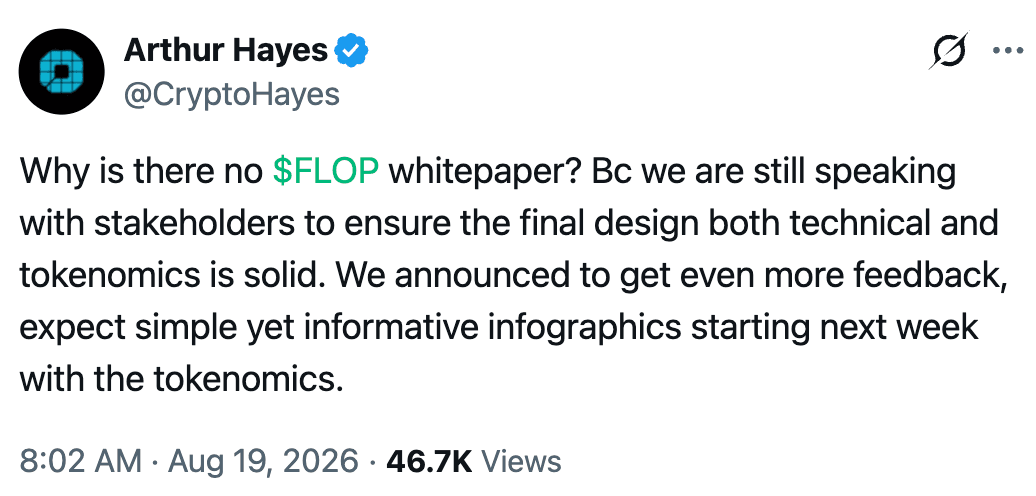
Hayes also addressed why the project had not published a whitepaper, adding the team was “still speaking with interested parties to ensure the final design, both technical and tokenomics, is solid.”
“We announced the project early to get feedback,” he said, “and we’ll be releasing informative infographics starting next week, beginning with tokenomics.”
The opposing logic behind Hayes' bet was that even if the AI infrastructure bubble burst, the resulting surplus of cheap compute could become an asset for the agentic economy rather than a liability. If debt-financed data centers produce more capacity than hyperscalers can profitably use, that excess could lower the cost of inference, the core resource Flop Network is designed to price and distribute.
Hayes Returns To Operating Role
He announced on Tuesday that he was returning to a hands-on leadership role for the first time in nearly six years, serving as CEO of Flop Labs. He had stepped down as CEO of BitMEX in October 2020 after the US Department of Justice and CFTC indicted the exchange.

He later pled guilty to violating the Bank Secrecy Act and was sentenced to six months of home detention, two years of probation, and a $10 million fine. He has continued to stay active as chief investment officer of Maelstrom, his family office.
The company announced it was officially shutting down in July and is set to wrap up its functions by September.
From AI Bear To Builder
Hayes has been warning about the AI bubble for months. In June, he estimated that roughly $1.5 trillion in debt had been issued to fund AI infrastructure since November 2022, arguing that it had absorbed nearly all new dollar creation and starved Bitcoin of the liquidity that would normally buoy it.
Read also: Bitcoin Mega-Whale Wallets Surge To 6-Month High As Big Buyers Hold $64K Support
For updates and corrections, email newsroom[at]stocktwits[dot]com<
