
Karnataka govt announced a plan to build ring roads in 172 talukas to ease traffic. The roadmap also includes a 'Tree Patta' revenue-sharing scheme for farmers and the 'Chief Minister’s Negila Yogi Scheme' for free mechanised cultivation.
In a bid to ease urban congestion while bolstering rural agriculture, the Karnataka government has announced a comprehensive development roadmap that includes a 'Network Grid Plan' with ring roads across 172 taluka headquarters, a revenue-sharing 'Tree Patta' scheme for roadside farmers, and the launch of the 'Chief Minister’s Negila Yogi Scheme' offering free mechanised cultivation for marginal farmers.
Karnataka's 'Network Grid Plan' for Urban Decongestion
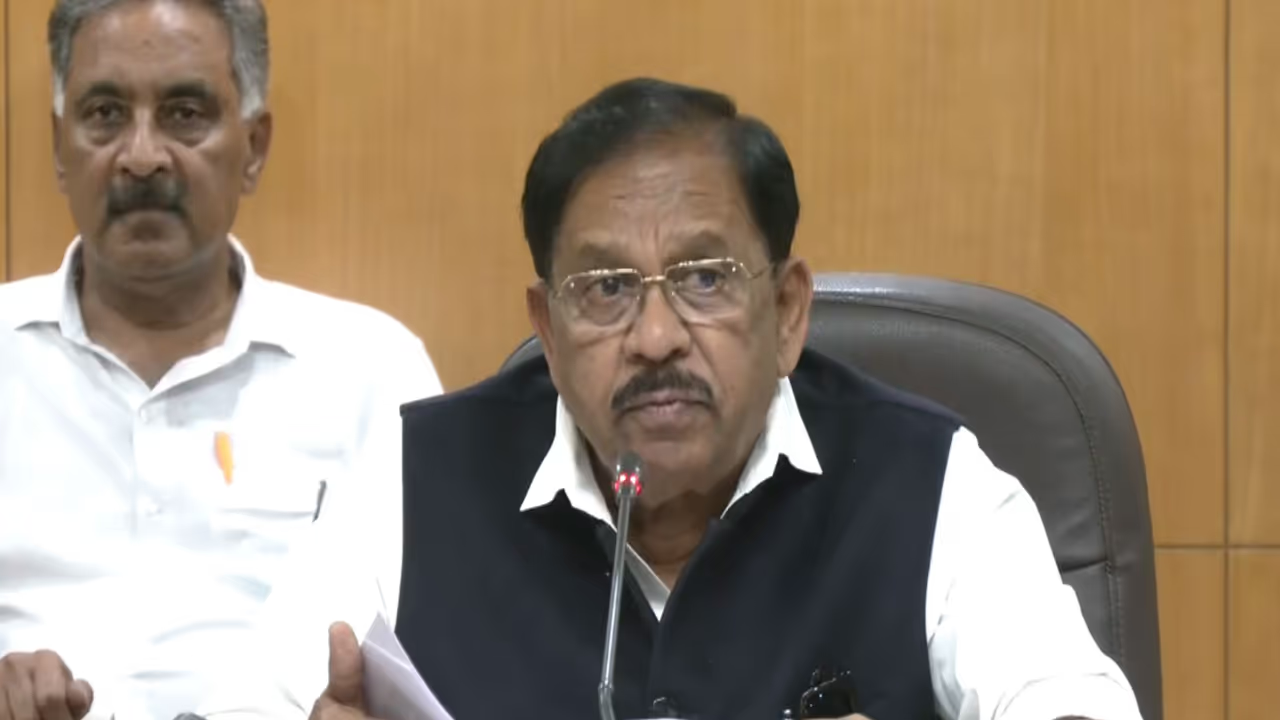
Addressing reporters, Karnataka Deputy Chief Minister G Parameshwara detailed the state's upcoming infrastructure initiatives aimed at easing traffic congestion not just in Bengaluru, but across expanding secondary urban hubs. "There are taluka headquarters, and today there is heavy vehicular traffic even around these taluka headquarters. There is also a lot of traffic in Bengaluru city. So, we have planned a network grid plan, which needs to be implemented in every taluka. If people need to go inside the town, they will continue to travel through it, which has resulted in increased traffic, particularly in district headquarters and taluka headquarters, with the roads becoming congested within the towns themselves. Therefore, in each of these talukas, covering 172 local planning areas, we need to develop ring roads. This is what we are proposing under the network grid plan for two-tier and three-tier towns," Parameshwara said.
Emphasising sustainable urbanisation—noting that the state’s urbanisation rate stands around 46 per cent—he underscored the need to keep developing towns liveable through regulated construction. "Wherever roads are being developed, we should also plan the surrounding areas properly. Along the roads, we should create an impact zone of one to two kilometres. This is because if houses are allowed to come up immediately alongside the roads, the same congestion will develop again. In Hyderabad, they have implemented something similar. If you travel about one kilometre along some roads, there are no houses being constructed there. Instead, they have developed greenery and landscaping, which has been done by the respective departments. It creates a good environment, attracts birds and also looks aesthetically pleasing. In the same way, our vision is to create a buffer or impact zone along these roads. There are 172 taluka-level local planning areas. Once this is properly implemented, the entire network will be streamlined," he explained.
'Tree Patta' Scheme for Farmers
To safeguard roadside land and boost green cover, the government will engage farmers in avenue plantation under a commercial incentive model titled the "Tree Patta" system. "We will approach farmers and ask them to take care of the trees planted along the road. If the tree grows and becomes large, the farmer will get the benefit from it. As the trees grow, we will provide a “Tree Patta” — a tree ownership document. The road will also look good, and the trees will be maintained. If the road comes through and the farmer’s land is taken along the roadside, we are not taking it away from them. Instead, for tree planting on the main roads, we will give the responsibility of protecting and maintaining those trees to the farmers. They will take care of the trees and, in return, they will get 70 per cent of the profit, with the remaining 30 per cent going to the other party," Parameshwara added.
Chief Minister’s Negila Yogi Scheme
Turning to the agrarian sector, the Deputy Chief Minister also announced the 'Chief Minister’s Negila Yogi Scheme', designed to eliminate fallow land and provide mechanised tilling support to smallholders lacking livestock or machinery. Under the initiative, the state will provide free cultivation services to small and marginal farmers owning three acres of land or less.
Explaining the scheme, Parameshwara said, "Under this scheme, suppose there are five people in a village who own tractors. They use those tractors to cultivate their own land. Once they have finished cultivating their own fields, we will rent those tractors from them and use them to cultivate other farmers’ lands. Suppose a farmer does not have a tractor; we will supplement the requirement from elsewhere. If there is a greater requirement and, say, five more people need to purchase tractors, we will purchase those tractors for them. There could be 500 or 1,000 tractors. We will purchase the tractors for small and marginal farmers who own three acres or less.”
“For farmers with three acres or less, we will undertake the cultivation work free of cost. They will not be charged. This is what we have introduced as the Chief Minister’s Negila Yogi Scheme. We will also pay the rental charges for the tractors. We will take the tractors from those who own them and pay them accordingly," the Deputy Chief Minister added.
Parameshwara also noted that the scheme will be launched on a pilot basis across 31 talukas with an initial budgetary outlay of Rs 150 crore, and if it is successful, the government will expand it further. "Right now, we will pilot it in 31 talukas. There are major requirements in these talukas, and we will assess the number of people who need the support. For many people, there are no bulls, no oxen, nothing. They don’t have the resources to cultivate their land. Some people have been given land, but they have left it fallow because they don’t have the capacity to cultivate it. Under these circumstances, we need to ensure agricultural production and create jobs and employment. The calculations can be worked out,” the Deputy CM noted.
He further added, “Agricultural production will naturally increase if we think about this as a system. We have thought about this for the present situation, because it will be useful. Some people say they will not cultivate. But then they say they will do agriculture if they get the support. They can cultivate; they can undertake sowing and other agricultural activities, but they don’t have the necessary resources. This will be useful as production will increase across all sectors. Otherwise, if someone has four or five acres of land, it remains vacant. Then there is only one crop a year."
(ANI)
(Except for the headline, this story has not been edited by Asianetnews Editorial staff and is published from a syndicated feed.)