
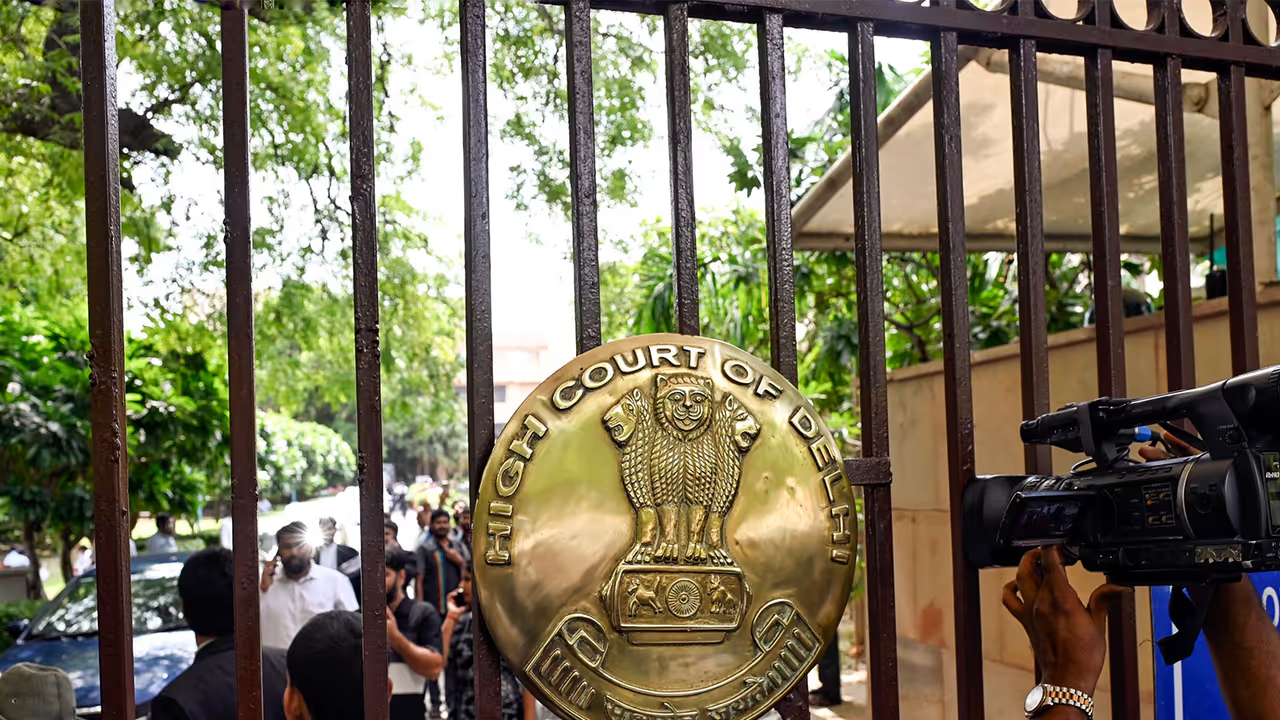
The Delhi High Court upheld a victim's unconditional right to challenge an acquittal, dismissing a petition that sought to declare the proviso to Section 372 CrPC and Section 413 BNSS unconstitutional. The right is absolute, says the court.
The Delhi High Court on Wednesday upheld the independent and unconditional right of a victim to challenge an order of acquittal and dismissed a petition seeking to declare the proviso to Section 372 of the Code of Criminal Procedure (CrPC) and its corresponding provision under Section 413 of the Bharatiya Nagarik Suraksha Sanhita (BNSS) unconstitutional.
A Division Bench comprising Chief Justice Devendra Kumar Upadhyaya and Justice Tejas Karia also upheld the order of a Sessions Court rejecting preliminary objections to the maintainability of an appeal filed by a victim against the acquittal of an accused.
The Petition and Its Dismissal
Dismissing the writ petition filed by Shivdhar Upadhyay, the Bench held that there was no merit in the challenge to the constitutional validity of the provisions or in the objection to the Sessions Court's order dated April 6, 2026. "In view of the discussions made and reasons given above, the writ petition lacks merit, which is hereby dismissed along with pending application(s), if any," the Court directed, adding that there would be no order as to costs.
The petition challenged the proviso to Section 372 CrPC and Section 413 BNSS on the ground that while the State is required to obtain leave of the court before filing an appeal against an acquittal in certain cases, a victim can file such an appeal as a matter of right. The petitioner also sought a declaration that the victim's right of appeal should apply only to cases instituted through private complaints and not to cases originating from police FIRs.
Background of the Dispute
The controversy arose from FIR No. 247/2016 registered at Neb Sarai police station under Section 509 of the Indian Penal Code. Following trial, Upadhyay was acquitted by a Judicial Magistrate on October 16, 2024. The victim subsequently filed an appeal before the Sessions Court challenging the acquittal under the proviso to Section 372 CrPC.
The petitioner objected to the maintainability of the appeal, contending that an appeal against acquittal in the case could only lie before the High Court and only after obtaining leave to appeal. The Sessions Court rejected the objection on April 6, 2026, following which he approached the High Court.
Court Upholds Victim's 'Absolute Right'
Rejecting the constitutional challenge, the Division Bench relied extensively on recent Supreme Court judgments, including Celestium Financial v. A. Gnanasekaran and Khem Singh v. State of Uttarakhand. The High Court observed that the Supreme Court has clearly distinguished between the right of appeal available to the State, a complainant and a victim.
The Court noted that the Supreme Court in Celestium Financial held that the right of a victim to prefer an appeal cannot be equated with the right of the State or a complainant to challenge an acquittal. According to the High Court, the Supreme Court has recognised that a victim must have an absolute right to prefer an appeal without being subjected to a condition precedent such as obtaining leave to appeal.
The Court observed that Parliament inserted the proviso to Section 372 CrPC to confer an independent right upon victims and did not intend to circumscribe that right by importing the requirements applicable to appeals filed by the State or a complainant under Section 378 CrPC. It further held that the victim's right to appeal has to be placed on par with the right of an accused person to challenge a conviction as a matter of right.
Rejection of Discrimination Argument
The Bench rejected the petitioner's argument that the provision creates discrimination between the State and the victim, describing the submission as "absolutely fallacious". The Court said that the rights of the State, complainant and victim arise from different statutory schemes and cannot be treated as identical.
Appeal Right Not Restricted to Private Complaints
The High Court also rejected the alternative plea seeking to restrict the applicability of the victim's right of appeal only to privately instituted complaint cases. It held that neither the proviso to Section 372 CrPC nor Section 413 BNSS restricts the right of a victim to challenge an acquittal only to cases arising out of private complaints. "By making the alternative prayer, the petitioner seeks to read something which the legislature itself has not provided for in the statute," the Court observed.
Clarification on Mallikarjun Kodagali Judgment
The Bench also dealt with the petitioner's reliance on the Supreme Court judgment in Mallikarjun Kodagali v. State of Karnataka. It noted that the observations relied upon by the petitioner regarding scrutiny of appeals filed against acquittals represented the minority view in that judgment.
The High Court emphasised that the majority judgment in Mallikarjun Kodagali had held that the proviso to Section 372 CrPC must receive a realistic, liberal, progressive and beneficial interpretation in favour of victims of offences. The majority view, the High Court noted, recognised that a victim is entitled to file an appeal before the court where an appeal would ordinarily lie against an order of conviction.
Finding no merit in either the constitutional challenge or the objection to the Sessions Court's jurisdiction to entertain the victim's appeal, the High Court dismissed the petition. (ANI)
(Except for the headline, this story has not been edited by Asianet Newsable English staff and is published from a syndicated feed.)