
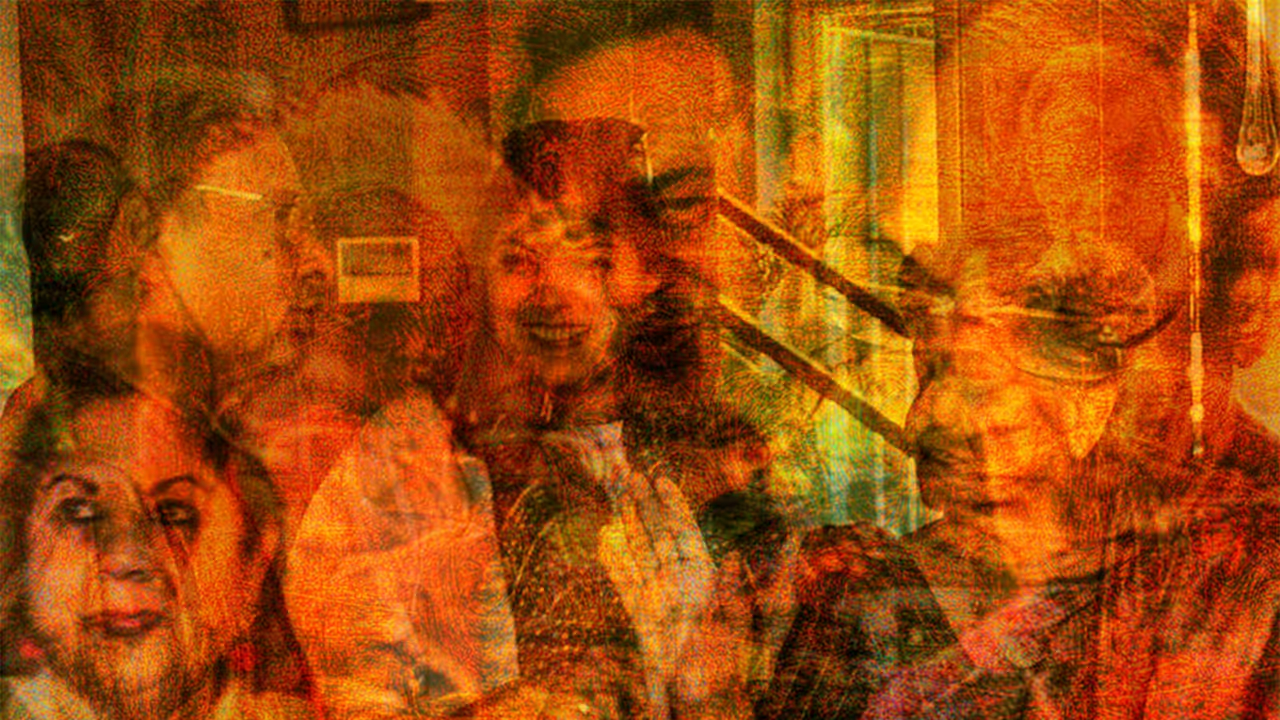
Suvir Saran pays a poignant tribute to his late uncle, Om Phuphaji, reflecting on his life, his deep love for his wife, and the devastating void his loss creates, urging readers to cherish family before it's too late.
Come in. Before I tell you about Om Phuphaji, I want you to think about someone in your own family. An uncle, perhaps. A brother. A nephew. A brother-in-law. Someone who could walk into a room and, without ever announcing his arrival, somehow change the temperature of it. The handsome one. The charming one. The one who always had a particular way of smiling. The one whose clothes you remember. The one whose voice, laughter, teasing, habits and stories have become so familiar that you have never imagined a world in which they would not exist.
Perhaps you have already lost him. Perhaps you have not. But if you have, then you will understand why I am writing this. And if you haven’t, call him.
Because when someone like that dies, the devastation is never individual. It is familial. It travels through bloodlines and marriages, through childhoods and cities, through cousins who live on different continents and relatives who may not have seen one another for years. One person’s death can suddenly leave an entire family standing in the ruins of its own memories.
Every family has a tragedy like this. Every family, somewhere, has lost the uncle who charmed everyone, the brother who held the siblings together, the nephew who grew into a man everyone was proud of. Every family has someone whose life was so full and rich that when it ended, people were left mourning with a shock so profound that even grief seemed too small a word. I am sharing Om Phuphaji with you knowing that somewhere in his story is someone you have loved too. He was our man. But perhaps, by the time you finish reading this, you will recognise him as someone from your own family.
The Boy from Kanpur
Only days after we lost Sunita Bhua, the woman he loved for a lifetime, we lost Om Phuphaji too. There are losses for which language feels almost insulting. How does one explain the absence of someone who had become part of the architecture of one’s life? How does one describe the shock of knowing that the person whose voice you have heard for decades will never again answer the telephone? That there will be no more teasing, no more stories, no more arrivals at family gatherings? That one day you are remembering the person in the present tense, and the next you are holding them entirely inside memory?
Om Phuphaji’s story began in Kanpur. He was a Kanpur boy, proud of his roots. His parents were from Kanpur, and he studied there until completing his M.Com. He would often tell us, with the particular pride of a man who never forgot where he had begun, that he had gone to university in a simple shirt and pyjama. He said it with amusement. But there was pride in it too. He knew his beginning. And perhaps that is why the life he went on to build was such an inspiration.
A Fateful Meeting in Gorakhpur
From Kanpur, he joined the Indian Air Force and served in its Accounts Division. One of his early postings was at the Gorakhpur Air Force Base. And Gorakhpur changed his life. The story of how he met Sunita Bhua has survived in our family through memory, recollection and the wonderful unreliability of family lore, the way one person remembers a date, another remembers a restaurant, another remembers who was sitting where, and somehow, across generations, the fragments become a story.
The young Air Force officer from Kanpur came to the attention of Sunita Bhua’s family. Someone spoke about him. Pata chala, kaisa ladka hai? What kind of young man was he? Where was he from? What did he do? He was educated. He was decent. He was in the Air Force. And the family liked what they heard. Introductions were made. Om Phuphaji and Sunita Bhua met. And somewhere along the way, there was a yes. A yes from both sides. They met several times. They got to know one another. And, as happens in the best of love stories, somewhere between an introduction arranged by family and the conversations that followed, two people began choosing one another.
Family memory also preserves the story of their early courtship. Before they were formally engaged, after they had decided that they liked each other, they went to Golghar in Gorakhpur. Golghar, in those days, was not merely a market. It was a destination. There were shops, restaurants and the bustle of a city going about its life. People went there to shop, to eat, to wander, to see and be seen. And somewhere in that geography of Gorakhpur, Om Phuphaji and Sunita Bhua went on what family memory has come to regard as one of their first proper dates. Of course, this was another generation. Young people were not always permitted the privacy that romance seems to demand today. Cousins hovered. Relatives watched. Families knew more than anyone imagined. And yet, love found its way. It always does.
Eventually, the families met. The marriage was decided. And Om Phuphaji came into our family. But “came into” does not quite describe what happened. He became family. Completely.
A Man of the World with Humble Roots
His career took him across India and eventually beyond it. He served with the Indian Air Force, including with the Eastern Air Command in Shillong, and had postings in Delhi and elsewhere. He was later seconded to the Indian Audit and Accounts Service and, as I remember, also had a stint with the UGC. His work took him abroad, including to Armenia. The young man from Kanpur travelled the world. But he never seemed to leave Kanpur behind. That was one of the things I admired about him. He showed us that you could come from a small town and belong to the world. You could travel without losing home. You could grow without becoming arrogant. You could acquire sophistication without losing simplicity.
For me, though, Om Phuphaji was never merely his career. He was a father figure. I remember him as handsome, charming and curious, with intelligent eyes and a smile that made people respond to him. He was always beautifully dressed, always dapper, always crisp.
The Theatre of Diwali Cards
And then there are the Diwalis. How can I remember Om Phuphaji without remembering the Diwali card tables? Those were not evenings of cards. Those were theatre. Family theatre. Competitive theatre. Sometimes comedy. Sometimes drama. Sometimes, if you knew the players well enough, three separate shows happening simultaneously.
Sunita Bhua was one of the queens of the card floor. Put her with my Deepa Bhua and my father, and you knew you were not watching three people playing cards. You were watching three productions. There were expressions.Declarations. Accusations. Triumphs. Little conspiracies. Theatrics. The cards were only the excuse. The real game was personality.
And then there was Om Phuphaji. For all his charm and warmth, for all the showmanship that came naturally to him, at the card table he could become wonderfully tight-lipped. He played a tough game. A very good game. Crisp in his beautiful kurta, looking dapper as ever, he would hold his cards close and reveal nothing. Absolutely nothing. His cards were his business. Nobody else needed to know what he had. There might be a little fun at Bhua’s expense. A teasing smile. A moment of mischief. But do not imagine for a second that he was going to show you his hand. The man who could charm an entire room could sit silently at a card table and play his game. And I love that memory of him. Perhaps because it contains so much of what I remember about family. The clothes. The laughter. The competition. The affection that was secure enough to survive teasing. The rituals that repeated year after year until we foolishly assumed they would go on forever.
The Inheritance of Family
That is the trick families play on us. They make eternity look ordinary. You think there will always be another Diwali. Another card table. Another wedding. Another picnic. Another lunch where somebody arrives late, somebody complains about the food and somebody tells the same story for the twenty-seventh time. And then, one year, there is an empty chair. And you realise that what you had mistaken for repetition was inheritance.
Our family taught us that. On both my father’s side and my mother’s side, we have been blessed with an extraordinary connectedness. One loss is a loss for all of us. And that did not happen by accident. Our parents did the work. Their parents did the work. They made the effort to keep the family connected. They took us to weddings and celebrations. They organised picnics. They made sure cousins knew cousins. They picked up telephones. They travelled. They showed up. And without ever knowing it, we were being educated. We learned history. Sociology. Philosophy. Psychology. Political science. We learned all of it at dining tables. Through picnics. At weddings. During Diwali card games. Through arguments and reconciliations. Through stories that began with, “Do you remember when…?”
Our elders were teaching us how to belong. They were teaching us that blood alone does not make a family. Blood is biology. Family is labour. Family is memory. Family is the effort to return to one another. That is why this loss is so devastating. It belongs to all of us.
A Love That Showed
Om Phuphaji leaves behind his daughter Vaishali, his son Vishal, Vishal’s wife Rashmi, Vaishali’s husband Sumant, and three grandchildren. But he also leaves behind a family far larger than a family tree can explain. He leaves behind cousins, nephews, nieces, brothers, sisters and generations of people who carry memories of him.
And I carry, above all, the memory of him beside Sunita Bhua. She was always beautifully dressed. And they were deeply in love. You could see it. In the way they looked at one another. In the smiles. In the mischief. In the way they held hands. Their love showed. It was splendid.
The Grace of Quiet Devotion
And perhaps the greatest expression of that love came in the later years of their marriage. When Sunita Bhua could no longer always care for every aspect of her life herself, Om Phuphaji became her quiet, intuitive support. He did what few spouses can do. He cared without making care the story. He never sought applause. He never asked to be admired. He never made his devotion into a performance. Instead, he quietly made Bhua’s life easier. He made sure she was comfortable. He made sure she continued to look beautiful. He made sure she never lost herself. She remained the queen of her home. And Om Phuphaji quietly ensured that her crown never slipped.
That is a rare kind of love. The world knows how to celebrate grand gestures. Flowers. Photographs. Anniversary messages. Declarations. But the deepest love is often invisible. It is the person who notices before you ask. Who remembers what you have forgotten. Who understands a mood before you speak. Who quietly rearranges their own life to make yours easier. Om Phuphaji did that. And he did it with such grace that sometimes we did not even realise how much he was doing. Only now, looking back, do I understand the magnitude of that devotion.
And now he is gone. Only days after Bhua. Two people who had spent a lifetime looking at one another are no longer here. There is something unbearably painful in that. But there is also something beautiful.
A Legacy of Love and Connection
A life can be measured in many ways. By titles. By institutions. By careers. By promotions. By the countries one has travelled to. Om Phuphaji had all of that. He was an Air Force officer. A public servant. A professional. A traveller. A husband. A father. A grandfather. But I hope he would forgive me for believing that those titles do not tell us enough. The life of Om Phuphaji was greater than his resume.
He was human. He was empathetic. He was kind. He was generous. He listened. He loved children. He charmed people. And he understood something that perhaps we all understand only too late: that the people around us are not permanent. So we must love them while they are here.
I am writing this for Om Phuphaji. But I am also writing it for the uncle in your family. The brother. The nephew. The relative who married into your family and became its heart. The person you have lost and still cannot believe is gone. Or the person who is still here. Call them. Ask them questions. Ask them where they first fell in love. Ask them what they wore to university. Ask them about the town they came from. Ask them who they were before you knew them. Listen when they tell the same story again. Record their voices. Write things down.
Because beyond people, there are emotions. Beyond surnames, there are geographies. Beyond family trees, there are little discoveries, scraps of memory, stories of love and courtship, mischief and mistakes. There is lore. There is legend. And all of it connects us. These are the threads that hold families together across generations. If we do not invest in our relationships with our uncles and aunts, cousins and nieces, nephews and grandparents, the future generations may inherit our names but not our stories. They will know who belonged to the family. But they may never know who they were.
We cannot let that happen. Our elders made the effort for us. Now it is our turn. Om Phuphaji came from Kanpur and became one with a family whose roots stretched across other cities, other histories and other generations. But he also expanded our world. He showed us how to leave home without abandoning it. How to travel without losing one’s roots. How to love without performance. How to care without applause. And how to live a life so full that when it ends, an entire family is left asking how the world can possibly continue without you in it.
That is the devastation of love. But it is also its blessing. To be shattered by someone’s absence is to know that their presence mattered. Om Phuphaji mattered. To us. And perhaps now, through this story, to you too.
So come in. Look around your own family. Remember the Diwali tables. Remember the weddings. Remember the picnics. Remember the person whose chair you never imagined would be empty. And if they are still here, hold them close. Because one day, all of us will become a story somebody wishes they had asked more questions about.
Om Phuphaji, thank you for the life you lived. For the journeys you took. For the family you embraced. For the laughter you gave us. For the cards you never showed us. For the beautiful clothes. For the charming smile. For the way you loved Sunita Bhua. And for teaching us, without ever setting out to teach us, that love does not care about geography. Love does not keep accounts. Love does not ask for applause. Love simply gives. And gives. And gives.
What a life. What a love. What a man. What a man, Om Phuphaji.
(ANI/Suvir Saran)
Disclaimer: Suvir Saran is a Masterchef, Author, Hospitality Consultant And Educator. The views expressed in this article are his own.
