
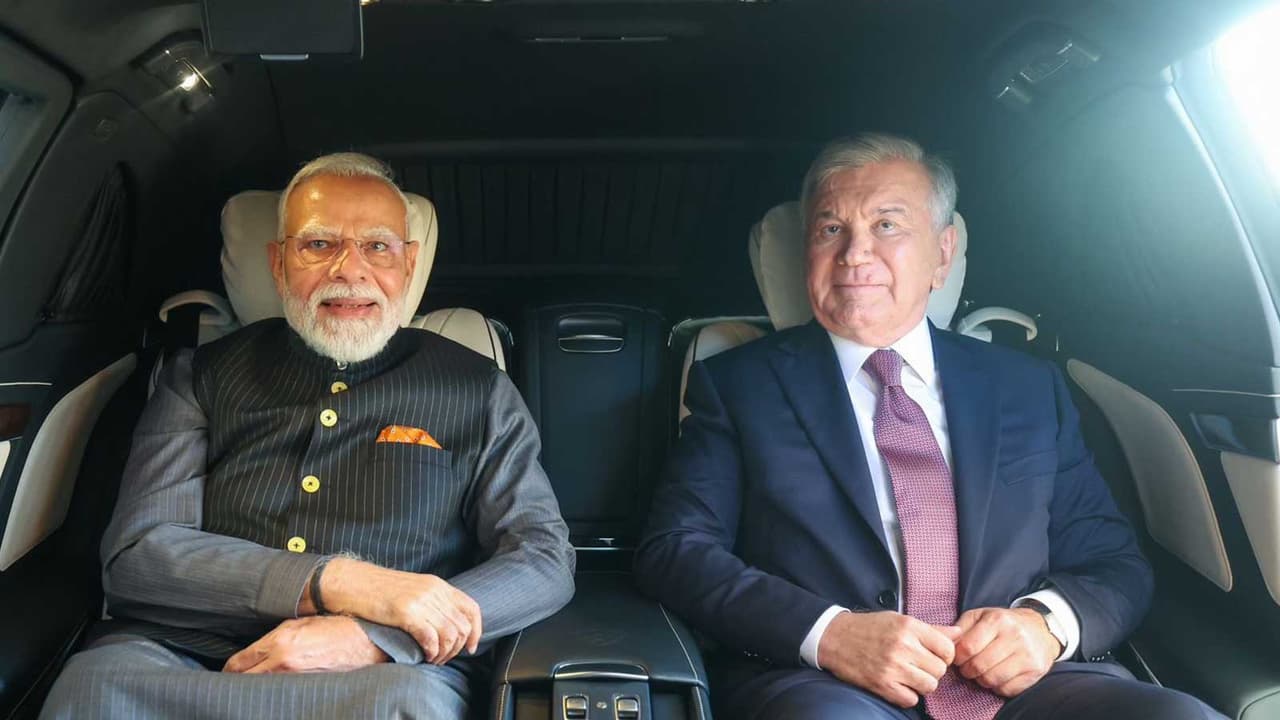
PM Modi arrived in Tashkent on his fourth visit to Uzbekistan. He was received by President Shavkat Mirziyoyev, and the two leaders will hold talks to review the strategic partnership and strengthen cooperation in various key sectors.
Prime Minister Narendra Modi arrived in Tashkent on Saturday for his fourth visit to Uzbekistan, where he will hold talks with President Shavkat Mirziyoyev to review the strategic partnership and strengthen cooperation in trade, investment, defence, energy, digital connectivity and other key areas.
Warm Welcome in Tashkent
PM Modi was warmly received by President Mirziyoyev at the airport, with the Uzbek leader personally welcoming him on his arrival. "Landed in Tashkent to a warm welcome by President Shavkat Mirziyoyev. Grateful to him for the special gesture. This is my fourth visit to Uzbekistan, reflecting the depth and growing momentum of our bilateral relations. Shortly after landing, Prime Minister Modi joined President Mirziyoyev at the Yangi Uzbekistan Park to lay a wreath at the Independence Monument (Mustaqillik Monumenti)," he wrote. https://x.com/narendramodi/status/2093700760441938367
Soon after his arrival, PM Modi joined Mirziyoyev at Yangi Uzbekistan Park and laid a wreath at the Independence Monument. "Upon landing in Tashkent, went to lay a wreath at the Yangi Uzbekistan Monument with President Mirziyoyev. The Yangi Uzbekistan Monument reflects the aspirations and progress of the Uzbek people. Glad to begin my visit by coming here," the PM wrote. https://x.com/narendramodi/status/2093728335113425352
Underscoring the close, enduring partnership between the two nations, the Ministry of External Affairs noted that the PM's fourth visit to Uzbekistan imparts further momentum to bilateral relations. "Prime Minister @narendramodi has arrived in Tashkent on a State Visit to Uzbekistan. He was warmly received by President Shavkat Mirziyoyev of Uzbekistan at the airport. This is Prime Minister's fourth visit to Uzbekistan. The visit underlines the close and enduring partnership between India and Uzbekistan and will impart further momentum to the bilateral ties," MEA spokesperson Randhir Jaiswal wrote on X. Jaiswal also said the wreath-laying ceremony at Yangi Uzbekistan Park honoured Uzbekistan's history, heritage and national spirit while highlighting the longstanding friendship between the two countries. "Prime Minister @narendramodi laid a wreath at Yangi Uzbekistan Park in Tashkent, honouring Uzbekistan's rich history, heritage and national spirit. The occasion underscored the deep-rooted and longstanding friendship between India and Uzbekistan," he wrote.
Strengthening Strategic Partnership
During the visit, the Prime Minister will hold delegation-level talks with Uzbek President Shavkat Mirziyoyev to further strengthen the strategic partnership between the two countries. The two leaders will review cooperation in trade and investment, defence, digital connectivity, energy, education and people-to-people domains and set the agenda for the road ahead.
In his departure statement, PM Modi said the India-Uzbekistan Strategic Partnership has seen significant advancement in recent years. "I look forward to my discussions with President Mirziyoyev on further deepening our cooperation in trade and investment, digital connectivity, defence, energy, and on advancing our shared visions of Viksit Bharat and Yangi Uzbekistan," he said.
PM Modi said he will also visit the Shastri Memorial and the Mahatma Gandhi Centre at the Tashkent State University of Oriental Studies, a tribute to the close cultural and people-to-people ties that bind our two countries.
Review of Bilateral Cooperation
The visit comes as bilateral economic engagement continues to expand. The 14th Session of the India-Uzbekistan Intergovernmental Commission was held in Tashkent on June 19, 2026, where Commerce Secretary Rajesh Agrawal and Uzbekistan's Deputy Minister of Investment, Industry and Trade Shokhrukh Gulamov reviewed bilateral economic cooperation and agreed to deepen trade and investment ties. The two sides identified pharmaceuticals, agriculture, information and communication technology (ICT), digital public infrastructure, energy, critical minerals, healthcare, education, tourism, logistics and manufacturing as key areas for expanding cooperation. The discussions also focused on addressing non-tariff barriers, improving transport and connectivity, enhancing customs and digital payment cooperation, and promoting greater business-to-business engagement, according to the Embassy of India in Uzbekistan.
The 17th round of India-Uzbekistan Foreign Office Consultations was held in New Delhi on May 13, 2026, co-chaired by Secretary (West) Sibi George and Bakhromjon Aloyev, First Deputy Minister of Foreign Affairs of Uzbekistan. The two sides reviewed the full range of bilateral relations, with discussions covering trade and investment, tourism, technology, innovation, energy, education, culture and consular matters.
India and Uzbekistan have maintained diplomatic relations since March 18, 1992, when the protocol establishing diplomatic ties was signed in Tashkent. India was among the first countries to recognise Uzbekistan's sovereignty following its independence. The two countries elevated their relationship to a Strategic Partnership in 2011. The partnership is supported by several institutional mechanisms at the political and official levels to ensure regular engagement.
PM Modi's current visit follows his previous visit to Uzbekistan in 2015 and his visits in 2016 and 2022 to attend the Shanghai Cooperation Organisation (SCO) Summits. The bilateral relationship has also been marked by high-level exchanges, including Mirziyoyev's State Visit to India in 2018 and his participation in the Vibrant Gujarat Global Summit in 2019.
Next Stop: SCO Summit in Bishkek
From Tashkent, PM Modi will travel to Bishkek at the invitation of Kyrgyz President Sadyr Zhaparov to participate in the 26th SCO Summit, which will mark 25 years of the organisation.
At the SCO Summit, India is expected to focus on security, connectivity and historical and cultural ties across the Eurasian region. Security discussions are likely to include cooperation against terrorism, radicalisation and other external threats, while connectivity and regional transport and trade routes are also expected to feature prominently.
India is also expected to emphasise greater cooperation in trade, investment, technology and people-to-people exchanges, including heritage and youth initiatives. (ANI)
(Except for the headline, this story has not been edited by Asianet Newsable English staff and is published from a syndicated feed.)