
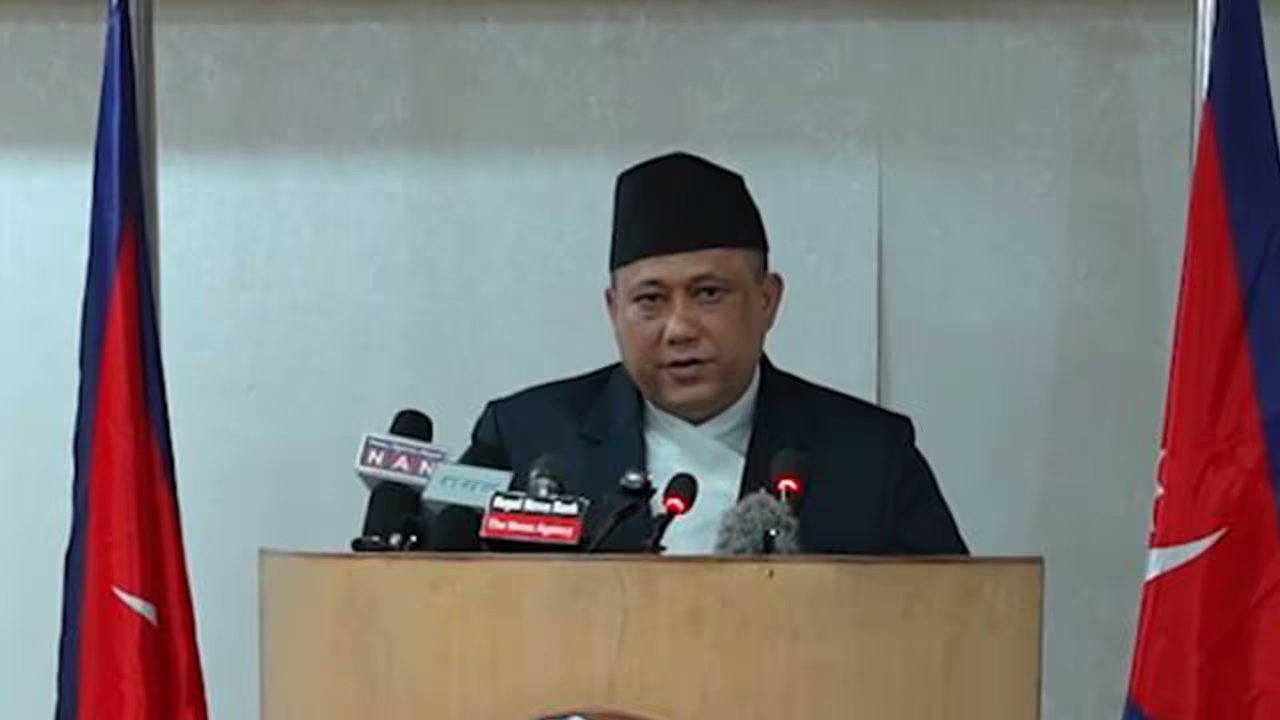
Nepal's Foreign Minister Shisir Khanal refuted claims of rejecting international aid after devastating floods, stressing the urgent need for specialised foreign assistance for rescue, relief, and long-term reconstruction efforts.
Nepal has forcefully rejected media reports claiming that Kathmandu refused international aid following the devastating Bhote Koshi River flash floods, stating that specialised foreign assistance and long-term reconstruction support are urgently needed to recover from the disaster.
Nepal Clarifies Stance on International Aid
Addressing a press briefing, Minister of Foreign Affairs Shisir Khanal said, "We have seen some false reports circulating in national and foreign media that Nepal has rejected international assistance and support. Again, I repeat the scale of devastation is extremely huge, and support and assistance are required, not just in the phase of rescue and relief, but more so in the phase of reconstruction.
Specialised Assistance Requested
Clarifying the government's operational focus, Minister Khanal highlighted that search teams are prioritising missing persons across Rasuwa, Nuwakot, Dhading, and Chitwan districts. However, complex sites require technical expertise beyond local capabilities. "Our security agencies and other response teams are currently handling the situation effectively. As operations continue, we have requested specific and specialized assistance from our friendly neighbours where such support can further strengthen our search-and-rescue efforts in areas such as opening the tunnels where people have trapped, technologies that help us locate people alive in the affected areas, quick forensic and DNA analysis and mortuaries to keep the bodies," Minister Khanal noted.
Gratitude for Foreign Support
He confirmed that "an eleven-member specialised technical reconnaissance team for tunnel rescue from India has been mobilised and a tunnel rescue team from China is expected to arrive very soon."
The Foreign Minister expressed gratitude for regional solidarity, acknowledging that Nepal has recieved overwhelming aid from foreign nations, especially India. "We are deeply grateful to our friends and partners for their solidarity, goodwill and generous offers of support at this difficult time. From India, we have already received more than 57 tons of relief materials. Essential items are also being received from China, Japan, Australia and other friends today. As relief operations continue, further assessments are being made and we will reach out to our neighbours and international partners for additional assistance and support as needed," he noted.
Information for Foreign Nationals and Donors
To manage communications regarding foreign casualties, a dedicated Emergency Control Room has been established at the Ministry. He further urged the international community and media to rely strictly on official data, noting that the Prime Minister Disaster Relief Fund is open for digital contributions.
"The Government of Nepal already has Prime Minister Relief Fund for such catastrophic calamities. Nepali as well as foreign nationals at home and abroad can contribute to this fund through QR Code. Contributions for these efforts can be made through the link: https://pmdrf.nchl.com.np/ as well," he said.
Addressing travel concerns, Minister Khanal reassured international visitors that the impact remains localised to specific river corridors. "Despite massive destruction and difficulties created by the Bhote Koshi River floods in areas of Rasuwa, Nuwakot, Dhading and Chitwan, the other part of Nepal is normal as earlier and open for foreigners/travellers/tourists," he stated.
"We welcome foreign nationals willing to visit Nepal." He noted that Nepal's government remains committed to "save lives, locate missing persons, rescue them, provide urgent relief to survivors, and ensure that affected Nepali as well as foreign receive appropriate assistance and support."
India Intensifies Rescue Operations for its Nationals
Additionally, the Indian Ministry of External Affairs confirmed in an official update issued at 5 PM that four Indian nationals trapped at a hydropower project in Rasuwa were rescued today as search and emergency operations intensify across Nepal. The rescued individuals, identified by the Ministry as Ripu Kumar, Chaneshwar Narzary, Kripa Shankar, and Mohammed Minhajuddin, are being transported to Kathmandu.
According to official figures released by the MEA, 88 Indian nationals have been rescued from flood-affected regions so far. However, 287 Indian nationals and 128 Persons of Indian Origin (PIOs) remain unaccounted for across the impacted zones. Additionally, the MEA stated that 120 Indian nationals successfully crossed into Nepal from China earlier today.
Meanwhile, a specialised technical team sent by India conducted an on-site inspection of submerged hydropower tunnels across flood-devastated districts in Nepal today to accelerate efforts to locate and extract individuals trapped underground. The Indian Embassy in Nepal, in a post on X, confirmed that its officials are maintaining continuous, round-the-clock coordination with Nepalese authorities to locate and assist Indian nationals affected by the severe flooding.
As part of these outreach efforts, the Embassy's First Secretary (Commerce) Suman Shekhar visited Indian workers who were recently evacuated from the Upper Trishuli 1 Hydropower Project site. The official met directly with the rescued personnel to review their condition and gather detailed information regarding their safety, medical requirements, and overall well-being. https://x.com/IndiaInNepal/status/2093698520134099041
The technical inspection of underground structures comes as part of India's targeted specialised assistance to Nepal, focusing on complex tunnel rescue operations, forensic analysis, and critical infrastructure restoration efforts following the disaster along the Bhote Koshi and Trishuli river corridors.
'A Disaster of an Unprecedented Scale'
Earlier, former Nepalese Member of Parliament and Chairman and President of the Chaudhary Group, Binod Chaudhary, expressed deep shock and grief over the catastrophe caused by the recent flash floods in Nepal, describing it as a disaster of an unprecedented scale. Reflecting on the swift destruction brought on by the deluge, Chaudhary noted the sheer speed and magnitude with which the floodwaters inundated communities along the Nepal-China border corridor.
"My immediate reaction was of absolute shock and immense sadness. Nepal, as you rightly pointed out, have gone through many natural disasters and calamities in the past, ranging from 2015 to COVID, and even same area, last year, which saw a lot of damage. But this time, within minutes, we saw that villages got washed away, thousands and thousands of people got affected. Bridges collapsed, and we did not even know where it's going to end, when it's going to stop," Chaudhary said.
Highlighting the extraordinary impact on regional connectivity and infrastructure, Chaudhary emphasised that even robust border infrastructure was severely overwhelmed by the surge. "It is a disaster of a scale which nobody was prepared for, and particularly connecting China," he added.
"I would like to assume, knowing the capabilities of China in terms of building sound and well-designed infrastructure, if this can happen through that, you can imagine the magnitude of the entire episode and its impact."
Official Disaster Toll and Response Efforts
This comes as Nepal's National Disaster Risk Reduction and Management Authority (NDRRMA) confirmed 635 fatalities, including recovered body parts across multiple downstream districts, as of 6:30 PM. Disaster response teams have retrieved 246 bodies in Chitwan, 165 in Nawalparasi East, 63 in Nawalparasi West, 57 in Gorkha, 51 in Nuwakot, 45 in Dhading, 35 in Tanahun, and 13 in Rasuwa.
The authority added that 219 injured individuals are currently undergoing treatment or have been discharged, supported by specialised surgical units deployed directly to the impacted zones.
A total of 2,418 people remain missing or out of contact following the flash floods. This figure includes 933 workers at hydropower projects, 589 foreign nationals, and 127 Nepalis travelling alongside foreign tourists.
Search operations are also trying to locate missing personnel from government entities, including 45 from the Nepal Army, 27 from the Nepal Police, 15 from the Customs Office, 13 from the Armed Police Force, and 4 from the Immigration Office.
Geographically, missing person reports are led by Rasuwa with 562 unaccounted for, followed by Nuwakot with 115, Makwanpur with 65, and Langtang National Park with 3.
To manage the ongoing operations and maintain security, 18,708 security personnel are active in the region, including 8,135 Nepal Police, 6,370 Nepal Army, and 4,203 Armed Police Force members.
Overall rescue numbers have reached 7,514 individuals. Helicopter operations by the Nepali Army and private operators have completed 261 flights, evacuating 279 people from flooded hydropower tunnels over the last two days and airlifting 227 foreign nationals to safety, according to NDRRMA. (ANI)
(Except for the headline, this story has not been edited by Asianet Newsable English staff and is published from a syndicated feed.)