
Japan’s Radio Regulatory Council endorsed the proposed 700 MHz direct-to-smartphone framework, with final regulations expected shortly.
- The ministry retained BlueBird-specific provisions, noting that the standards were based on spectrum-sharing studies using the system’s technical specifications.
- Rakuten and AST SpaceMobile plan to form an equal-stake satellite venture in 2026, with Rakuten leading management.
- ASTS has fully deployed BlueBirds 12 and 13 and is targeting 45 satellites in orbit by early 2027.
Shares of AST SpaceMobile (ASTS) snapped a two-month losing streak in August as Japan cleared a key regulatory hurdle for the company’s BlueBird satellite system, advancing rules that could unlock Rakuten-backed direct-to-smartphone service across the country.
ASTS stock rose 2% on Monday, ending August marginally in positive territory after falling 22% in June and 34% in July.
Japan Endorses 700 MHz BlueBird Rules
Japan’s Ministry of Internal Affairs and Communications said the Radio Regulatory Council endorsed a proposed framework for introducing a 700 MHz-band non-geostationary satellite communications system for mobile phones. After a month-long public consultation, the ministry plans to finalize the relevant regulations shortly.
The filing directly identified AST SpaceMobile’s BlueBird system. One respondent asked the ministry to remove the BlueBird name from the examination standards and replace it with broader language covering other satellite providers. The ministry declined, explaining that the standards were developed from spectrum-sharing studies based on BlueBird’s radio-station specifications.
The ministry also clarified that the framework was not designed to apply broadly to every non-geostationary satellite system using the 700 MHz band. The BlueBird-specific provisions will remain as proposed.
Rakuten Mobile supported the framework and called for its implementation, saying direct satellite connectivity could extend service to remote islands, maritime areas and mountainous regions while supplementing terrestrial networks during emergencies.
Rakuten-ASTS Venture Takes On Starlink
Rakuten Group CEO Hiroshi Mikitani said the company plans to form a satellite-business joint venture with AST SpaceMobile in 2026. The partners will hold equal stakes, while Rakuten will lead management. The venture would put Rakuten directly against Japan’s larger wireless rivals, which already offer direct-to-cell connectivity through SpaceX’s Starlink network. KDDI introduced the service in 2025, with SoftBank and NTT Docomo following in 2026.
Rakuten expects to begin rolling out its satellite-to-smartphone service in phases at the end of 2026 and is targeting nationwide coverage in fiscal 2027.
Japan is expected to provide 150 billion yen ($926 million) in subsidies over three years to support the Rakuten-led network. The funding would cover equipment, ground facilities and systems needed to operate the low-Earth-orbit constellation, with a formal decision expected soon.
Japan considers the project an economic-security priority as it seeks to reduce reliance on foreign-controlled satellite infrastructure, which came into the spotlight when Starlink helped restore communications after the 2024 Noto Peninsula earthquake. Since Rakuten lacks access to the 2 GHz spectrum used by Starlink, AST SpaceMobile’s compatibility with its 700 MHz holdings is key to the strategy.
ASTS Scales BlueBird Constellation
The regulatory progress comes as AST SpaceMobile scales its constellation. Last week, the company fully deployed BlueBird satellites 12 and 13, which launched alongside BlueBird 11 aboard a SpaceX Falcon 9 earlier in August.
Each next-gen satellite carries a 2,400-square-foot array designed to deliver voice, broadband and text directly to standard smartphones, with peak speeds approaching 200 Mbps.
BlueBird 14 is complete, while BlueBirds 15 and 16 are nearing completion and production is advancing through BlueBird 48. AST SpaceMobile is targeting six fully assembled satellites per month and 45 satellites in orbit by early 2027, with its eventual global constellation expected to exceed 100.
How Do Retail Traders Feel About ASTS?
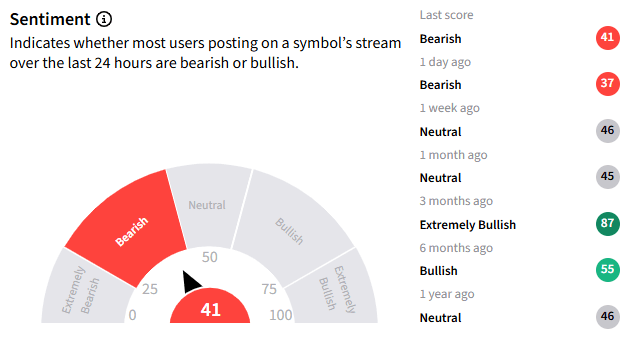
On Stocktwits, retail sentiment for ASTS was ‘bearish’ amid an 819% surge in 24-hour message volumes.
One user said, “$ASTS heading back to $100 end of Sept”
View this Stocktwits post
Another user said, “$ASTS up or down trends have started/ ended exactly the first or last day of month. Looks like September may be good month for us”
View this Stocktwits post
ASTS stock has risen 21% over the past year.
For updates and corrections, email newsroom[at]stocktwits[dot]com.<
