
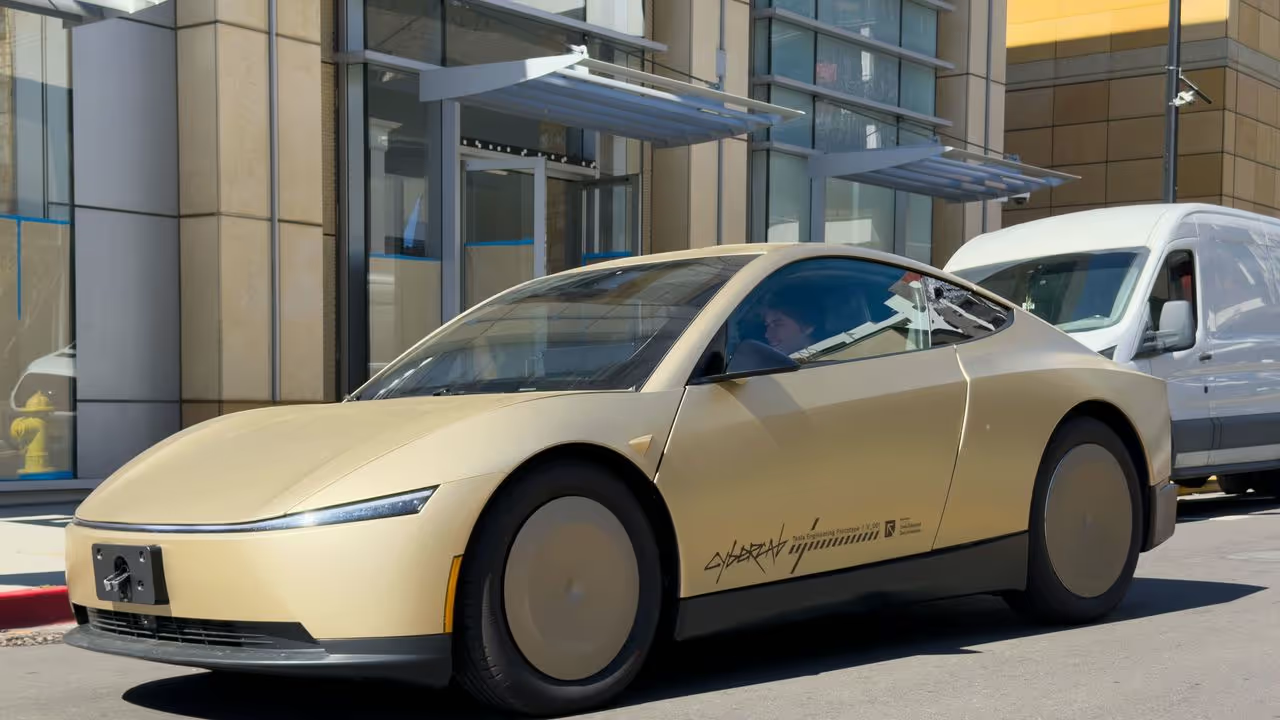
Tesla opened Cybercab fleet registrations, with Chamath Palihapitiya saying he had signed up to build a “huge fleet.”
- The absence of a public Cybercab livestream sparked retail backlash and “sell-the-news” fears.
- The two-seat Cybercab has no steering wheel or pedals, an Unreal Engine-powered interface and 20.2 cubic feet of cargo space.
- Tesla bulls said the Cybercab put Waymo, Uber and Lyft “on notice,” while Jason Calacanis forecast 40% global AV market share.
Shares of Tesla, Inc. (TSLA) slipped nearly 1% overnight late Thursday as U.S. safety regulators evaluated the company’s Cybercab rollout, while the showcase’s lack of a public livestream fueled frustration among retail investors.
TSLA stock jumped 5% on Thursday to its highest level in over a month, marking a second straight session of gains. Shares are up 8% this week and are on track for their best weekly performance in nearly four months.
The National Highway Traffic Safety Administration (NHTSA) is apparently evaluating Cybercab rides in Austin as the two-seater lacks steering wheels, pedals and mirrors, which are generally required under safety standards. "NHTSA is in contact with Tesla and is evaluating the situation," a spokesperson told Reuters.
Cybercab Event Blackout Sparks Retail Backlash
“We are indeed entering a literal golden era of transport,” Musk said on X, joking that this was why the Cybercab was painted gold. Yet the glossy pitch did little to settle a heated debate among retail traders over whether Tesla had delivered a major glimpse of its autonomous future or set the stage for a familiar “sell-the-news” moment. Sentiment on Stocktwits around TSLA slipped to a borderline ‘bullish’ 59/100, as 24-hour message volume surged 94%.
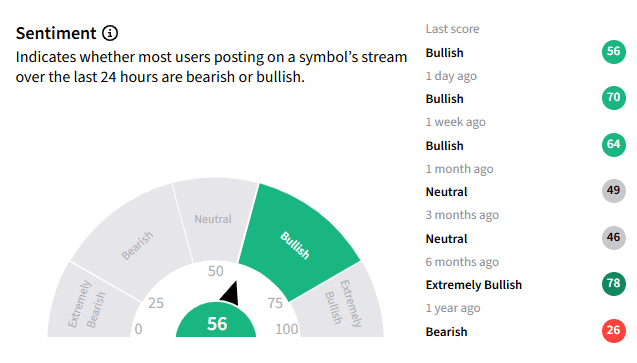
“NO LIVE STREAM! LOL,” one bearish user said. Another asked: “Why no live feed? Doesn’t the product work?”
Others called the event “secretive” and wondered why Tesla would not publicly showcase a product key to its long-term valuation story. One user called the presentation a “nothing burger.” The blackout also fed fears that the event had already been priced into Tesla shares. Several bearish traders called it a “sell-the-news” setup, with one predicting a “rug pull” and another betting on a 10% or greater decline.
Retail skepticism extended beyond the event format to Cybercab’s commercial prospects. Users questioned whether consumers would embrace a vehicle without conventional controls and pointed to regulatory constraints and the limited scale of Tesla’s current robotaxi operations.
Inside Tesla’s Purpose-Built Cybercab
Musk said that Cybercab is not a conventional vehicle adapted for autonomy. It was designed from the ground up to operate without a human driver. “Cybercabs have no steering wheels or pedals,” Musk said. “They are designed and built for maximally efficient autonomous operation.”
The vehicle has two seats and 20.2 cubic feet, or 572 liters, of rear cargo capacity. Its trunk can carry up to 220 pounds and, according to Tesla’s newly published rider and compliance guides, can fit two checked bags and two carry-ons. It can also accommodate one large folded stroller and one small folded wheelchair.
Cybercab has a low 16.5-inch step-in height, 43.4 inches of legroom and 38.3 inches of headroom. Both seatbacks can be adjusted independently, although the two seats move forward and backward together. “Cybercab is basically a super comfortable lounge on wheels with a great TV and epic sound,” Musk said.
Its touchscreen interface is built using Epic Games’ Unreal Engine, best known for powering video games and photorealistic digital environments. After a Tesla influencer highlighted the Epic Games credit, Musk responded: “Unreal ftw,” tagging the gaming company.
Beyond Cybercab, Musk highlighted Tesla’s growing footprint in Austin, Texas. “Probably over 30k people working in high-paying jobs at Tesla HQ & manufacturing in Austin by 2028,” he said.
Tesla Puts Robotaxi Rivals ‘On Notice’
The reveal also sparked comparisons with Tesla’s biggest autonomous-transportation rivals. Patrick Moorhead, chief analyst at Moor Insights & Strategy, shared images of a gold Cybercab, a black Tesla carrying “Robotaxi” markings and a Waymo vehicle, saying: “One FSD taxi is not like the other.”
New Street Research analyst Pierre Ferragu focused on the contrast between the Cybercabs and a Waymo vehicle spotted nearby. “The funniest part of all is the Waymo car hanging around surrounded by cybercabs,” Ferragu said. “It looks like a car from the past; the voyager probe in Star Trek.” Additionally, Deepwater Asset Management Managing Partner Gene Munster said that Tesla had “just put Waymo, Uber, and Lyft on notice.”
Tesla is betting on purpose-built vehicles, camera-based autonomy and its own ride-hailing platform. Waymo, by contrast, relies on sensor-heavy robotaxis, while Uber is building a network of autonomous-driving partners instead of developing its own vehicle system.
Musk ally and investor Jason Calacanis expects Tesla to capture 40% of the global autonomous-vehicle market within a decade. He also projected a 35% share for Uber’s network of partners, 15% for Waymo and 10% for other operators. Calacanis called both Tesla below $400 and Uber below $100 “generational buys.”
Tesla has also released a form allowing prospective buyers to register their interest in purchasing fleets of Cybercabs. Billionaire technology investor Chamath Palihapitiya said he had already registered. “Signed up! Let’s build a huge fleet,” he said. “Put me in coach!”
So far this year, Tesla's stock has lagged its "Magnificent Seven" peers, making it the group's worst performer, down about 16%.
For updates and corrections, email newsroom[at]stocktwits[dot]com.<
