
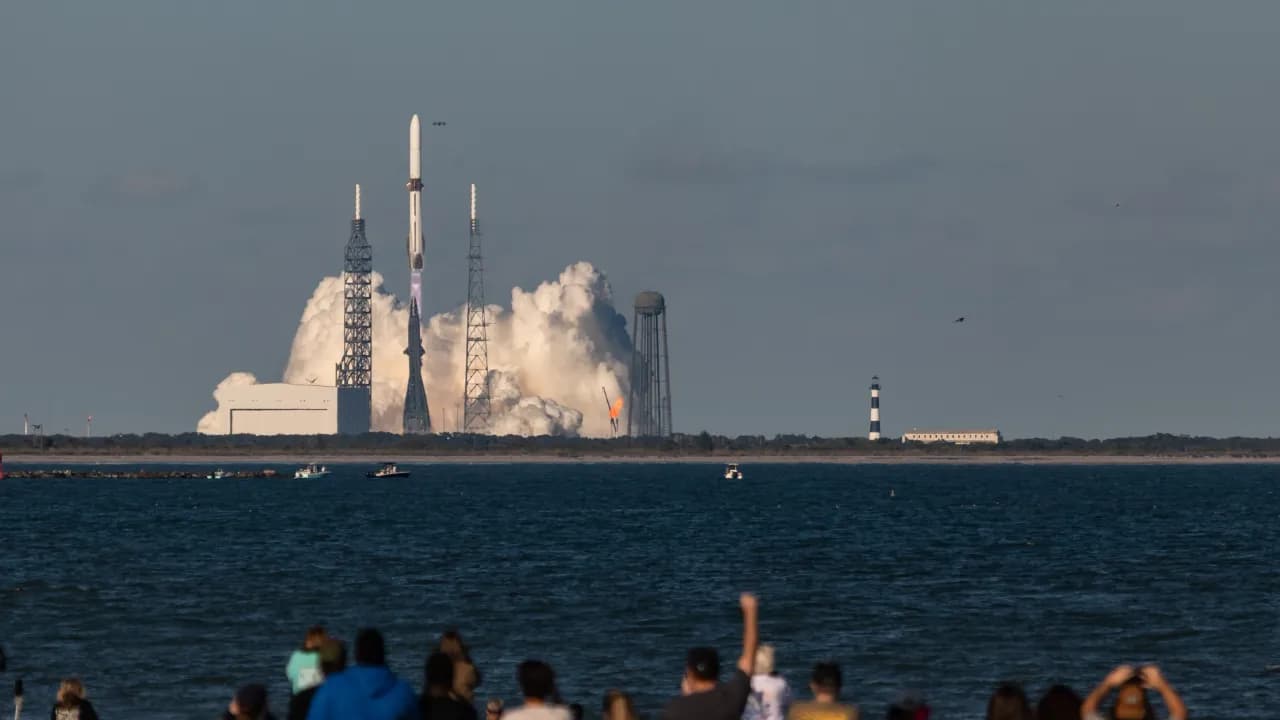
Oppenheimer raised its SpaceX target to $280, while Gavin Baker said orbital data centers could eventually propel its valuation to $20 trillion.
- SpaceX and Nvidia target a space-optimized Rubin system for late 2027.
- Berenberg initiated ASTS at ‘Buy’ with a $92 target as its satellite rollout and carrier expansion accelerated.
- RKLB lost NASA’s Mars contract as Neutron’s launch window narrowed, while LUNR secured an order for two spacecraft.
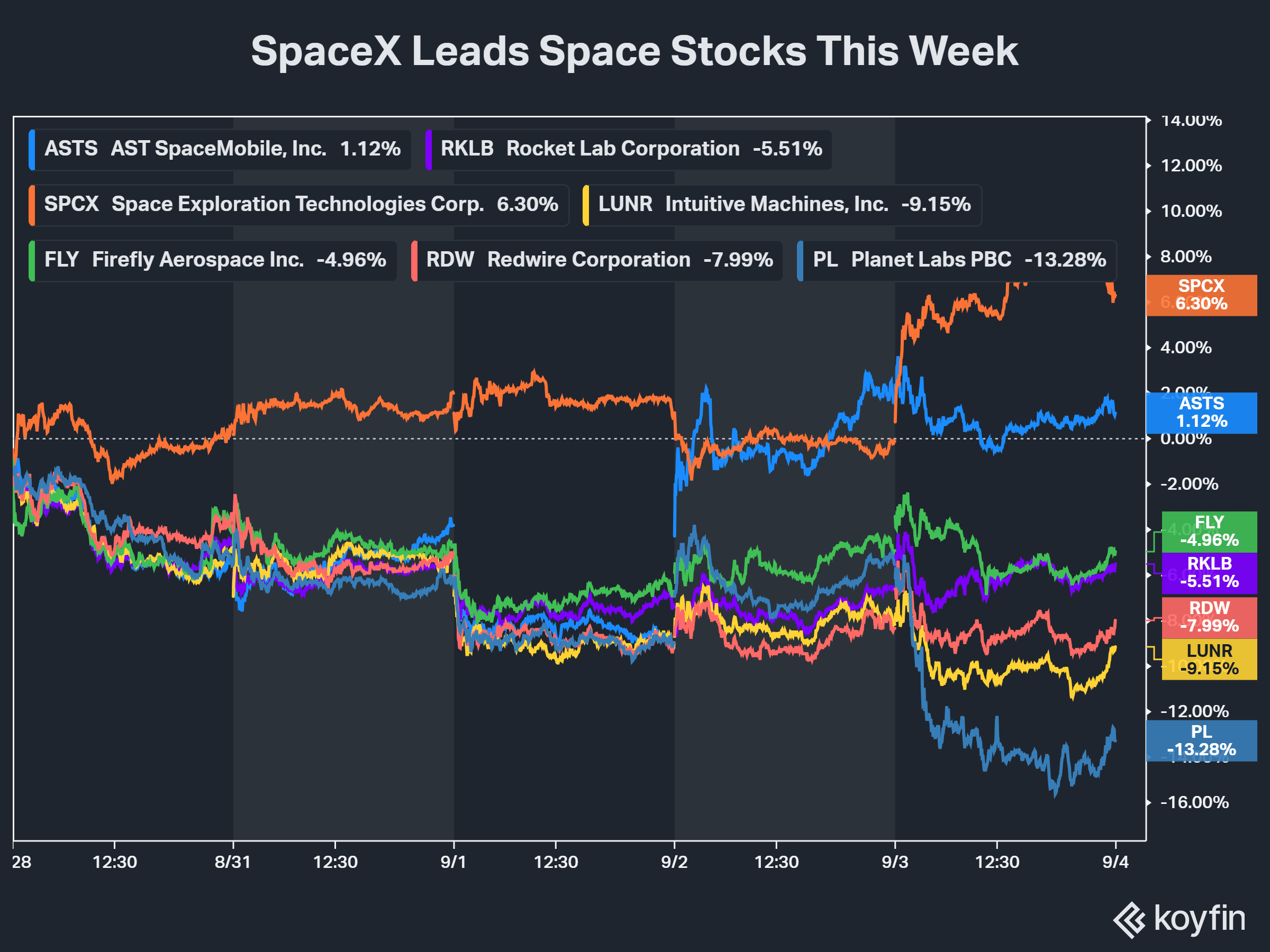
SpaceX reclaimed a $2 trillion valuation this week as enthusiasm for its AI platform and orbital-computing ambitions pushed it ahead of AST SpaceMobile, Rocket Lab, Intuitive Machines and Planet Labs.
Over the past week, SPCX climbed 6% and ASTS gained 1%, while PL plunged 13%, LUNR fell 9%, RDW dropped 8%, RKLB lost nearly 6%, and FLY declined 5%.
SpaceX’s $2 Trillion Comeback
Oppenheimer raised its SpaceX price target to $280 from $250 and reiterated an ‘Outperform’ rating, citing the company’s data, capital, GPUs and ability to rapidly build infrastructure. The firm also called SpaceX’s Cursor acquisition transformative and said Nvidia’s (NVDA) Rubin chips could deliver a one-year payback.
However, the larger bull case is orbital AI. Investor Gavin Baker said reusable Starship launches could make space-based data centers economical and potentially put SpaceX in the race to become the first $20 trillion company. “There’s not a physics reason why this can’t work,” Baker said, predicting that “an increasing fraction of the world’s compute is going to be in orbit.”
SpaceX and Nvidia have designed a space-optimized Vera Rubin NVL72 system targeted for launch in late 2027. “Elon said that he and Jensen have co-designed a Rubin rack,” Baker said. “Nobody’s really paying attention to this. It’s kind of happening in plain sight.” Starship reusability remains crucial. If launch costs fall while terrestrial power and cooling expenses rise, Baker said, “the economics just instantly flip.”
Execution risks remain, however. CEO Elon Musk reportedly recently reshuffled SpaceX’s data-center leadership following engineering concerns and reliability problems at facilities in Tennessee and Mississippi. Meanwhile, SpaceX’s role in Tesla’s Cybercab strategy added another catalyst. Tesla plans to use Starlink to reduce connectivity dropouts across its robotaxi fleet and provide high-speed entertainment streaming to riders.
AST SpaceMobile Lands A Bull Case
Berenberg initiated AST SpaceMobile with a ‘Buy’ rating and a $92 target, calling it the only company to have demonstrated true cellular broadband from space to unmodified smartphones. The firm highlighted AST’s more than 60 carrier partnerships covering about 3 billion subscribers, premium spectrum and growing government business. It expects rapid, high-margin growth once continuous commercial service begins in 2027.
The bullish call followed $619,200 in ASTS purchases through accounts linked to director Adriana Cisneros. AST’s rollout is also accelerating. BlueBirds 12 and 13 have fully deployed, BlueBird 14 is complete and satellites 15 and 16 are nearing completion. The company targets about 45 satellites in orbit by early 2027 and production of six per month.
US Mobile plans to add AST-powered coverage to its Verizon-based Warp network in the fourth quarter. Japanese regulators also endorsed a 700 MHz framework based specifically on BlueBird’s specifications, supporting Rakuten’s plan for nationwide coverage in fiscal 2027.
Rocket Lab’s Bull Call And A Mars Loss
Berenberg initiated Rocket Lab with a ‘Buy’ rating and an $83 target, calling it the only end-to-end public space pure-play spanning launch, satellites, components and spectrum. The firm said Rocket Lab has an effective monopoly in dedicated small launch and called it “perhaps the most compelling and differentiated long-term asset to own” in space. It also said the proposed Iridium acquisition would add valuable spectrum and recurring applications revenue.
Electron completed Rocket Lab’s 15th launch of 2026 this week, deploying Synspective’s latest radar satellite. Another 16 Synspective missions and nine iQPS launches remain booked through 2030. Rocket Lab, however, lost NASA’s Mars Telecommunications Network contract to Blue Origin. CEO Peter Beck had argued that “very few folks” could demonstrate Rocket Lab’s level of experience and said the company felt “strongly positioned.”
The decision also renewed attention on Neutron’s delayed debut. Beck said delivery to Virginia remains planned for the fourth quarter but acknowledged that “the window for an end-of-year launch is narrowing.” Meanwhile, Cathie Wood’s ARK Invest bought 705,102 RKLB shares worth about $44.4 million across two sessions.
Intuitive Machines Adds A New Customer
Intuitive Machines secured an order from an undisclosed new customer for two IM 300 spacecraft, expanding the platform into a new market segment. The modular platform supports commercial, civil and national-security payloads and will be produced at the company’s high-volume Palo Alto facility. The order broadens Intuitive Machines’ business beyond lunar landers into serial spacecraft manufacturing and networked space infrastructure.
Planet Labs Delivers A ‘Rule Of 70’ Quarter
Planet Labs reported record fiscal second-quarter revenue of $116.1 million, up 58% from a year ago and above the $104.22 million consensus. Adjusted earnings of $0.02 per share also beat expectations for a $0.02 loss. The company cleared the Rule of 40, which combines revenue growth and adjusted EBITDA margin, for a fourth consecutive quarter.
Planet raised the lower end of its fiscal 2027 revenue outlook to $430 million to $441 million and forecast adjusted EBITDA profit of $3 million to $10 million. Its third-quarter revenue guidance of $101 million to $105 million missed the $114.49 million consensus, partly because revenue from a Swedish military satellite was recognized earlier than expected. Planet’s sovereign satellite-services pipeline now exceeds $4 billion, with more than $1 billion classified as near-term.
The company is pairing sovereign satellite services with AI tools built on its daily Earth scan and decade-long image archive.
How Do Retail Traders Feel About Space Stocks?
On Stocktwits, retail sentiment for SPCX, RKLB and LUNR was ‘bearish’ amid ‘low’ message volume. ASTS sentiment was ‘neutral’ with ‘normal’ activity, while PL stood out as ‘extremely bullish’ amid ‘extremely high’ message volume.
Over the past year, PL surged 185%, followed by LUNR at 74%, RKLB at 47%, ASTS at 37% and RDW at 25%, while SPCX fell 7% and FLY tumbled 53%.
For updates and corrections, email newsroom[at]stocktwits[dot]com.
