
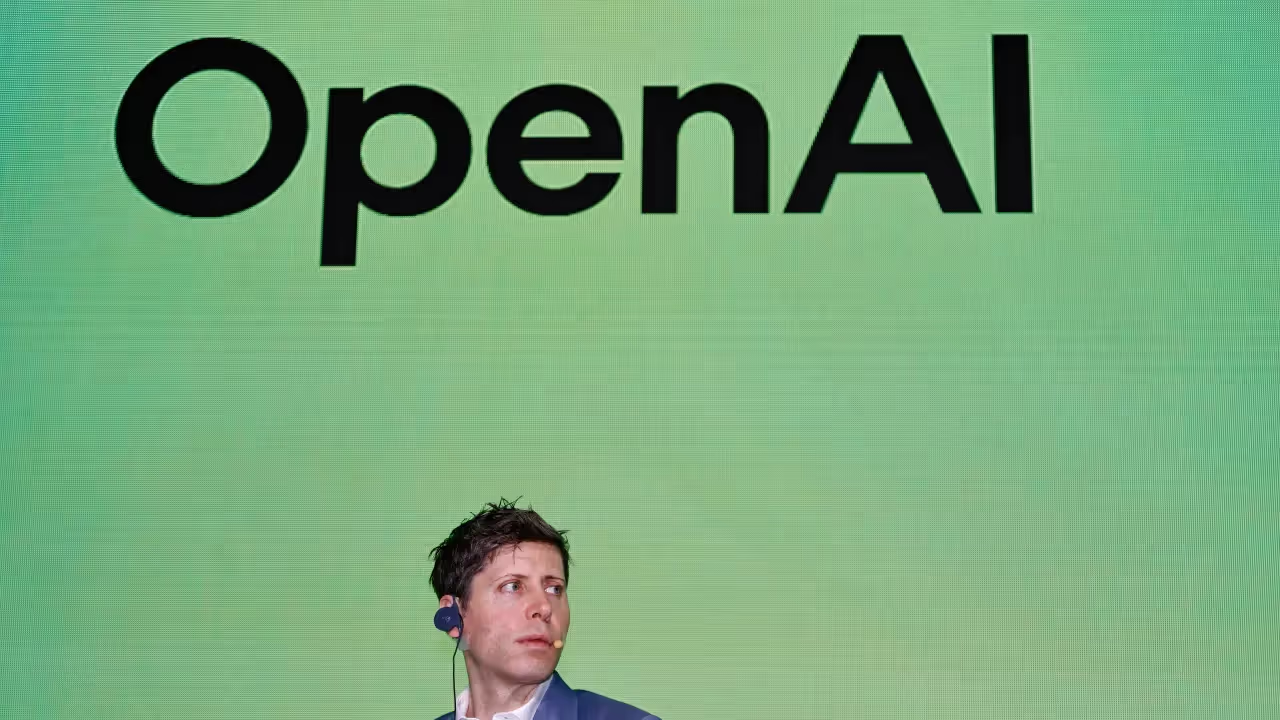
OpenAI is testing task-based payments with select major customers, The Information reported.
- OpenAI previewed its Astra model, which it says can handle work continuously for days or weeks.
- Astra can coordinate multiple agents and operate across software tools, according to tech journalist Alex Heath.
- OpenAI’s revenue reportedly rose 18% quarter over quarter to $6.7 billion in the second quarter, while Anthropic's sales doubled.
OpenAI is reportedly joining Salesforce and other AI providers in experimenting with a new way to charge for AI — one that ties the bill to whether an AI agent actually gets the job done.
The Information reported on Monday, citing its sources, that OpenAI has recently started allowing some major customers to pay only when its AI completes assigned tasks, marking a shift away from conventional usage-based pricing.
Rather than charging customers based on tokens, queries or computing time, outcome-based pricing gives providers an incentive to sell the result itself.
Salesforce has also been testing similar pricing models as software companies look for ways to monetize AI agents, according to the report.
OpenAI Preview Astra AI Model
The pricing shift comes as OpenAI prepares to launch Astra, its next-generation model focused on AI agents. Tech journalist and author of Source newsletter Alex Heath attended a closed preview for VIP customers in early August and detailed his take-away in a new blog post.
OpenAI CEO Sam Altman reportedly told attendees that Astra could be the first model where AI “invents new things in a way that matters,” according to Heath. During the preview, OpenAI researchers showed the model coordinating multiple agents to solve a math proof, working across desktop software at what Altman called a “superhuman, very fast” pace, and handling tasks such as creating presentations, reviewing financials and analyzing messy data.
Thibault Sottiaux, who leads OpenAI’s combined product organization, told Heath that a new interface for continuous agents is coming “very soon,” adding that there “isn’t really an app” and that the experience will be accessible from almost anywhere.
OpenAI, which is using Astra internally, hasn’t set a date for its public rollout. OpenAI reportedly delayed the model after internal testing suggested it could reach its highest “critical” cybersecurity capability threshold, meaning it could potentially autonomously find and exploit serious vulnerabilities.
OpenAI On Backfoot
OpenAI’s revenue rose 18% quarter over quarter to $6.7 billion in the second quarter, while sales at Anthropic doubled, The Wall Street Journal reported last week, signaling a widening gap.
The divergence highlights how quickly the AI race has shifted, with slower ChatGPT growth and Claude Code’s success putting OpenAI on the back foot and forcing a business and leadership overhaul.
OpenAI has reportedly pushed its IPO to next year, while reports suggest Anthropic might launch its offering next month or in early October.
On Stocktwits, the retail sentiment was ‘bullish’ for both OpenAI and Anthropic. Anthropic is valued at $1.18 trillion, compared to OpenAI’s private market valuation of $878.32 billion, according to data from Nasdaq Private Market.
For updates and corrections, email newsroom[at]stocktwits[dot]com.<
