

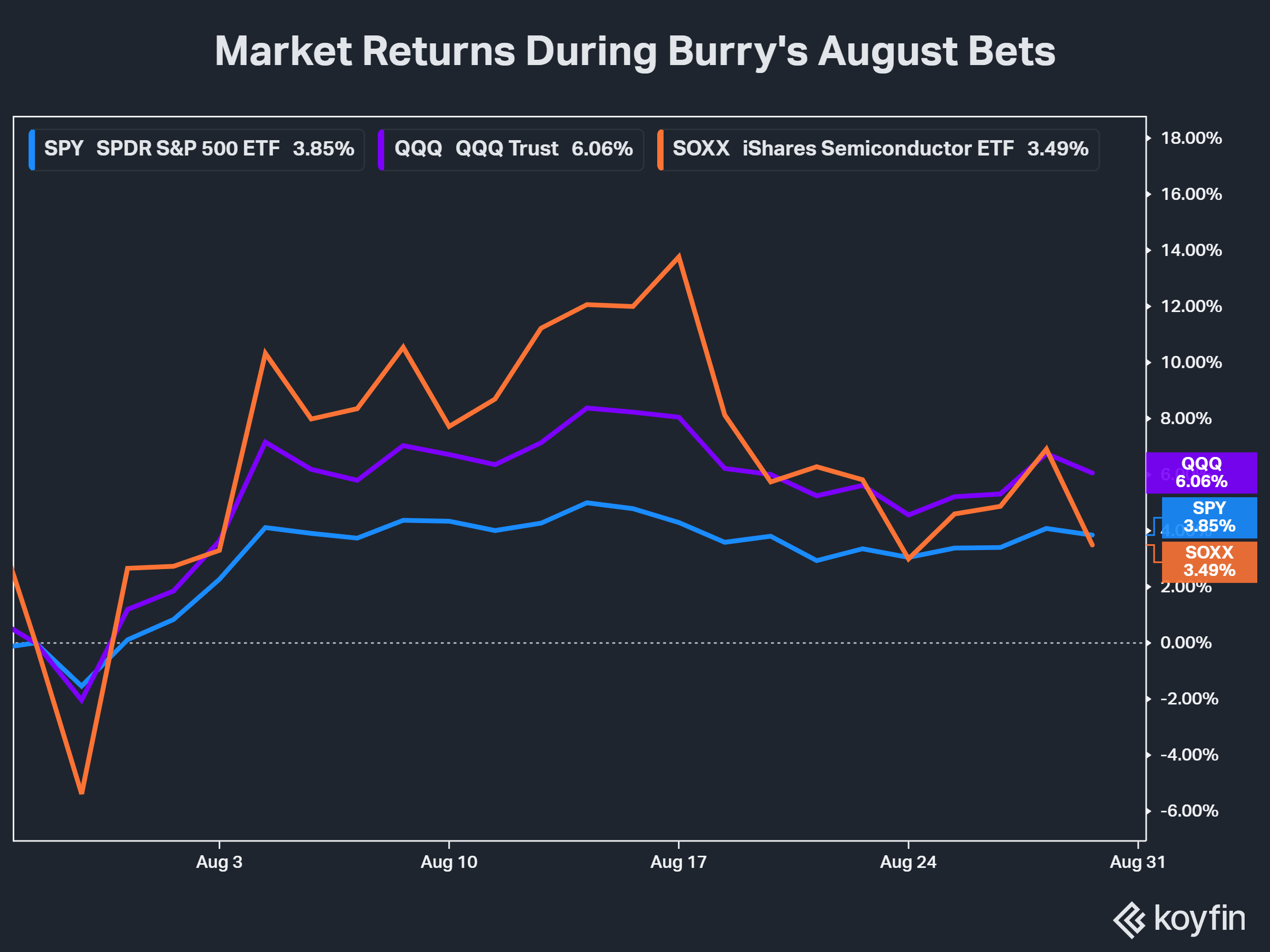
The AI rally put Burry’s bearish stance under pressure as Palantir, CoreWeave, Oracle, Micron, Tesla, Nebius and Nvidia all climbed during August.
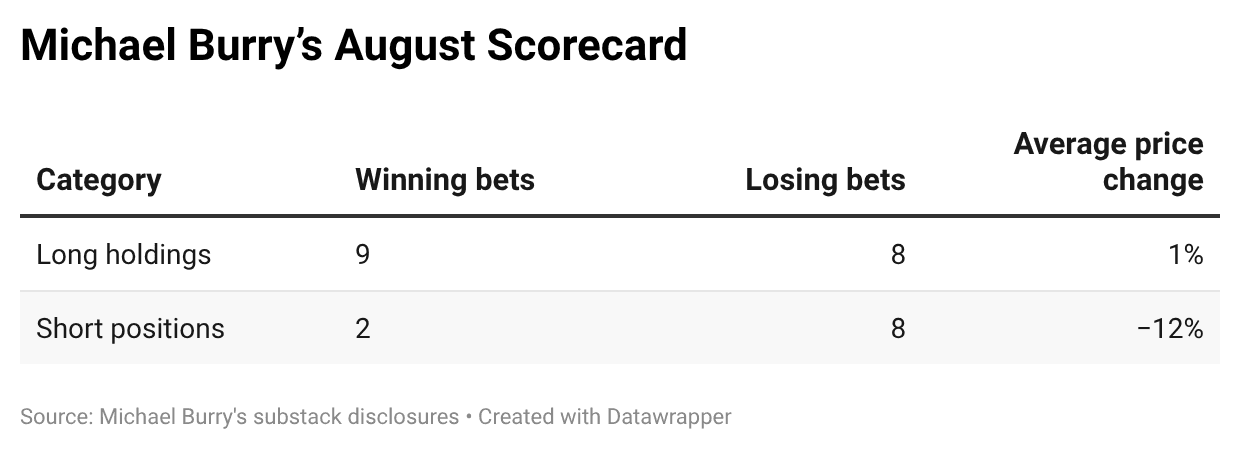
- His long book delivered a split verdict: nine of 17 tracked holdings rose, while eight fell, with Veeva and Adobe leading the charge.
- Several purchases paid off from Burry’s disclosed entry points, including MercadoLibre and Zoetis.
- Timing softened the blow: Nebius, Micron and SOXX moved below Burry’s later short entries, while Palantir was a clear miss.
“The Big Short” investor Michael Burry spent August buying beaten-down stocks and betting against the market’s AI favorites, producing a mixed scorecard as several well-timed trades paid off even while the broader tech rally challenged his bearish stance.
In August, Burry disclosed purchases of out-of-favor stocks including MercadoLibre (MELI), Zoetis (ZTS), Lululemon Athletica (LULU) and Molina Healthcare (MOH). He also expanded shorts against Palantir Technologies (PLTR), Nvidia (NVDA), Oracle (ORCL), Micron Technology (MU) and Nebius Group (NBIS).
Burry Builds His Value Stock Book
Burry began August by positioning against the “pod shops’ favorite trade”: going long undervalued, out-of-favor securities while shorting the AI narrative, the memory cycle and other highly valued momentum favorites. He called several of his long positions “BETS,” short for “brutally euphoria-truculent stocks.” The group included Adobe (ADBE), Temple & Webster (TPLWF), Zoetis, Lululemon, Molina Healthcare and Sprouts Farmers Market (SFM).
Burry compared the market with the dot-com bubble, when inexpensive, easily understood businesses struggled as tech stocks hit their peak, only to outperform after the Nasdaq collapsed. “No one can time an era-defining top,” Burry said on Sunday, arguing that investors could still prepare without moving overwhelmingly into cash or “shorting everything to our oblivion.”
He had already spent the month acting on the same view. Burry sold DraftKings (DKNG) on Aug.5 and more than doubled his Flutter Entertainment (FLUT) position, lowering its average cost into the $98s. He called Flutter a “fat pitch,” though the stock fell 2.6% in August, while DraftKings gained 7.6%.
Over the following week, he added to Fiserv (FISV), Freddie Mac (FMCC), MercadoLibre, Lululemon, Zoetis and Molina. Between Aug. 18 and Aug. 20, he bought more Birkenstock (BIRK), Build-A-Bear Workshop (BBW), Temple & Webster, Sprouts, Lululemon, Molina and MercadoLibre. The additions lifted Lululemon to 17.4% of his portfolio, MercadoLibre to 12%, and Molina and Temple & Webster to 9% each, according to Burry’s disclosures.
How Burry’s Long Positions Fared
Nine of the 17 disclosed long holdings tracked for August rose, while eight fell. Veeva Systems (VEEV) led the winners with a 35.8% surge. Adobe gained 16.4%, Fannie Mae (FNMA) rose 7.2%, MercadoLibre advanced 4.7% and HCA Healthcare (HCA) added 3.8%.
JD.com (JD), however, fell 12.9%. Build-A-Bear dropped 12%, Temple & Webster’s U.S. listing lost 9%, Birkenstock declined 7.9%, Sprouts fell 6.5% and PayPal (PYPL) shed 6.2%. The 17 tracked long holdings rose an average of 0.8% in August, trailing the broader market. SPY is included solely as a benchmark and Burry did not disclose a position in it. He held bearish QQQ puts and shorted SOXX shares, alongside SOXX puts that he later sold.
Looking beyond the monthly moves, several of Burry’s individual entries finished in positive territory. His earliest August purchase of MercadoLibre gained about 8.5% by month-end, while his Zoetis additions rose as much as 6.4%. Timing made the difference in Lululemon: an early purchase declined about 5%, while a later addition gained around the same amount.
Burry’s AI Bearish Bets Face Pressure
Burry’s bearish bets faced a far tougher market. Palantir surged 51.4% in August, CoreWeave (CRWV) climbed 17.4%, Oracle rose 16.2% and Micron gained 13.3%. Tesla (TSLA) advanced 12.1%, Nebius added 9.9% and Nvidia rose 8.4%. Only Applied Materials (AMAT), down 9%, and Caterpillar (CAT), down 1.8%, declined among the 10 tracked short targets.
Burry entered August already short SOXX, Micron, Nvidia, Caterpillar, Palantir, Tesla and Applied Materials. He opened fresh Oracle and Nebius shorts on Aug.6, then added to SOXX, Palantir, Caterpillar and Oracle over the following week. As AI stocks rallied earlier in the month, Burry shorted more Oracle at $152, Micron at $924 and Nebius at $247.
“Nebius is what the top of a boom looks like,” Burry said about three weeks ago . He added that customers’ willingness to pay steep premiums for short-duration AI-compute contracts signaled extreme immediate demand but diminishing longer-term value as GPUs, customers, or both depreciated. Later in August, Burry opened a CoreWeave short and added to Micron, SOXX and Palantir. By then, stock shorts represented more than 21% of his portfolio, excluding puts.
Timing Helps Burry’s Short Bets
Although Burry’s short targets climbed 11.9% on average in August, several bets moved in his favor after he added at higher prices. Nebius is a prime example. Despite rising for the full month, it closed Aug.28 at $209.18, which is about 15.3% below Burry’s later $247 short entry.
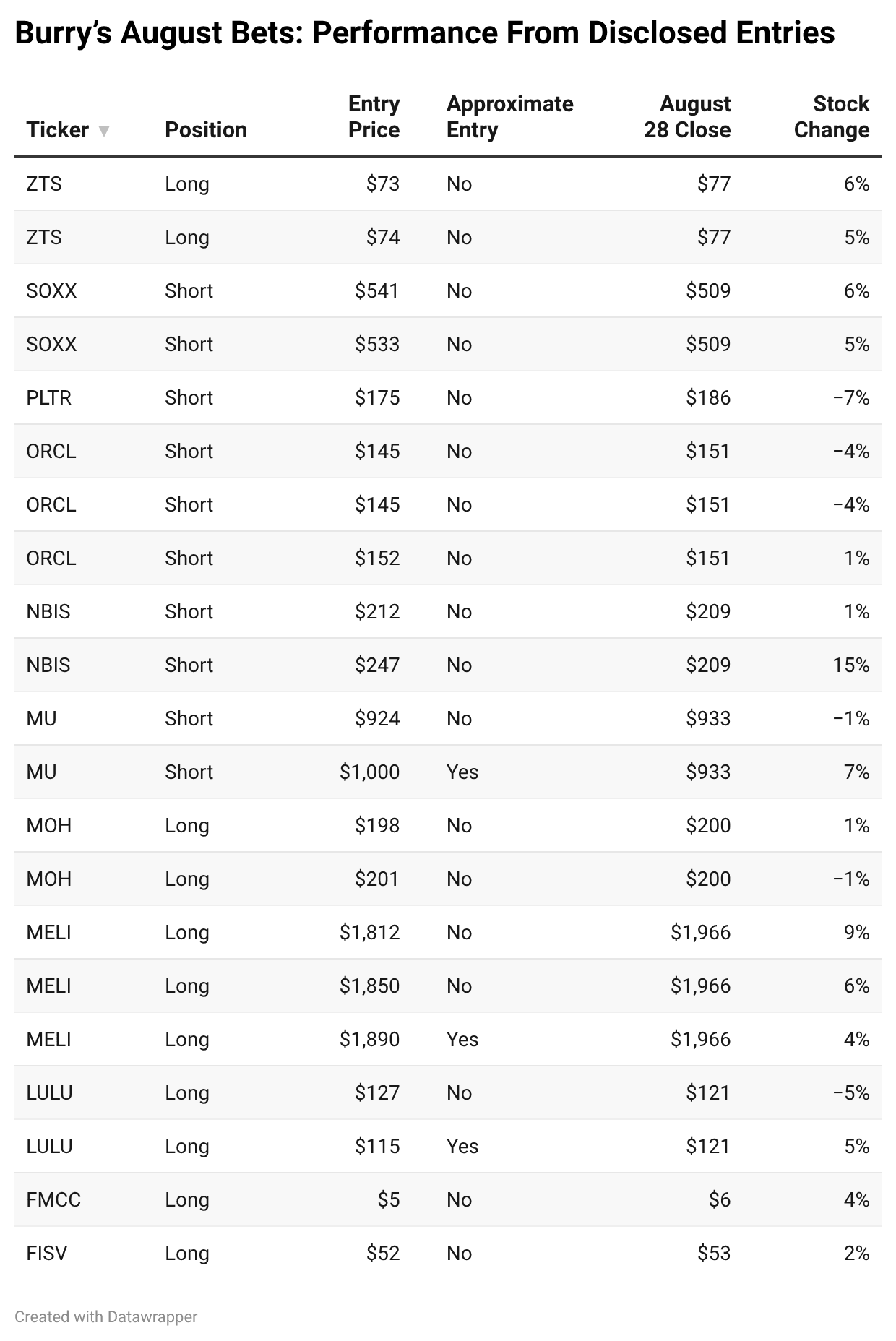
Micron’s initial short at $924 was slightly underwater, but the stock ended about 6.7% below his later entry near $1,000. SOXX similarly closed about 6% and 4.6% below Burry’s disclosed short entries of $541 and $533. Palantir was a clear miss. Its Aug.28 close of $186.29 was about 6.5% above Burry’s $175 short entry. The performance of his Palantir puts cannot be determined without their exact purchase prices.
Burry Cuts Risk And Raises Cash
Burry did not passively endure the rally. By Aug.13, he said a short book that had been around break-even was tipping into a loss. He responded by lowering gross exposure, raising cash, and shifting into options with cheaper volatility.
Burry sold his SOXX puts and replaced them with a larger QQQ put position representing about 6% of his portfolio. He retained Nvidia and Palantir puts, increased the Micron short near $1,000 and kept SOXX as his largest stock short at 7%. He also covered Tesla and Applied Materials following gains, trimmed Caterpillar by 25% and reduced positions across his long book, raising cash to about 12%.
“Quick sizable short sale gains are gift horses,” Burry said. “This is how the sausage is made,” he added. “Still, I love sausage.”
Burry Scores A Quick Win On Nvidia Calls
Burry’s Nvidia strategy showed how he separated his long-term thesis from short-term risk management. Ahead of Nvidia’s earnings report last week, he bought December call options with strikes in the mid-to-high $200s to hedge his short and put exposure. Burry stressed that the calls were not a bullish reversal. Less than 24 hours later, he sold half the calls for a gain of between 50% and 60%.
“They did their job,” Burry said, while reiterating that he remained bearish over the longer term. Burry believes Nvidia’s monopoly-like margins could eventually decline as competition increases, chips depreciate, and customers struggle to generate adequate returns from enormous AI investments.
Build-A-Bear Earnings Challenge Burry’s Bet
Burry revealed that he had returned to toy retailer Build-A-Bear two weeks after disclosing his entry and following its recent quarterly earnings results. BBW is his newest value bet and one of the month’s weakest performers, down 12%. In his latest post on Sunday, he placed the company alongside the businesses that he believes could outperform after a speculative peak. But he acknowledged that its earnings report, which included weaker commercial guidance, a Walmart non-renewal and declining international franchising, had damaged his case.
“My thesis took a hit with the earnings report,” Burry said. He did not add to or sell the position, instead saying he would wait for the company’s quarterly filing before completing his valuation.
For updates and corrections, email newsroom[at]stocktwits[dot]com.<
