

According to TheFly, analysts at Rosenblatt maintained their ‘Buy’ rating on Webull and raised their price target to $15 from $13.
- Rosenblatt said in its research note that Webull’s “strong” second-quarter results were “highly supportive” of its investment thesis.
- The firm expects the company’s growth trajectory to strengthen as the pattern day trader rule changes.
- Rosenblatt said the regulatory change should drive accelerating revenue growth, not just higher trading volumes, as more customers gain access to Webull without the Pattern Day Trader restrictions.
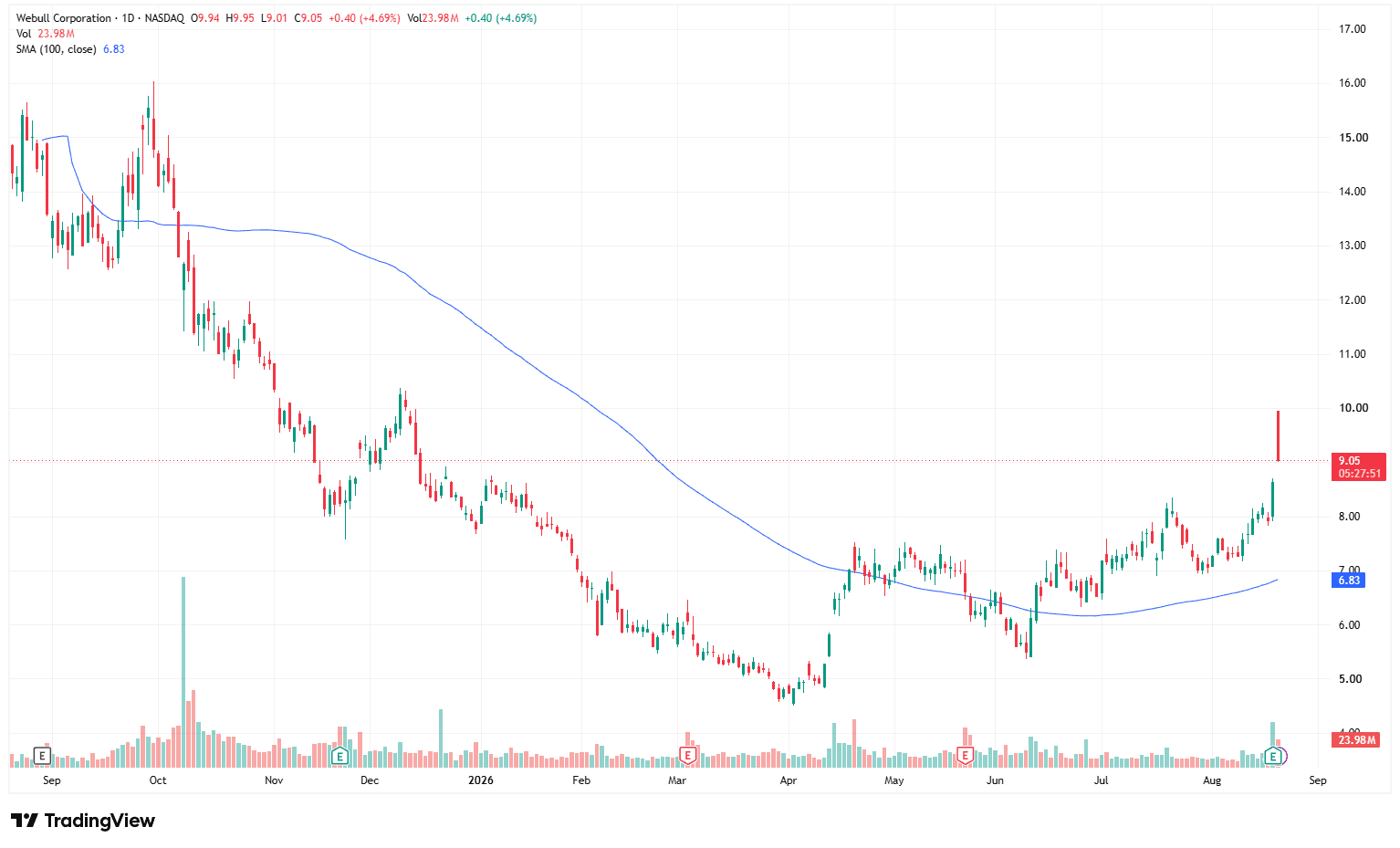
Webull Corp. (BULL) shares were headed for their highest levels in eight months in Thursday morning’s trade after the company’s second-quarter results on Wednesday surpassed Wall Street expectations.
According to TheFly, analysts at Rosenblatt maintained their ‘Buy’ rating on Webull and raised their price target to $15 from $13, implying an upside potential of 67% from current levels.
Webull shares were up nearly 5% in Thursday’s opening trade. BULL was among the top trending tickers on Stocktwits at the time of writing.
Why Rosenblatt Is Bullish On BULL Stock
Rosenblatt said in its research note that Webull’s “strong” Q2 results were “highly supportive” of its investment thesis. The firm expects the company’s growth trajectory to strengthen as the pattern day trader rule changes.
Rosenblatt said the regulatory change should drive accelerating revenue growth, rather than simply higher trading volumes, as more customers gain access to Webull’s platform without the Pattern Day Trader restrictions.
The firm’s outlook also reflects its expectation that Webull can capture additional activity as the rule change takes effect. Rosenblatt sees the regulatory shift as a revenue opportunity in addition to its impact on customer trading behavior.
What The Pattern Day Trader Rule Change Is About
Under the new rules approved by the Securities and Exchange Commission in April, traders will no longer need to maintain a $25,000 account balance to engage in frequent margin day trading.
The Pattern Day Trader designation has also been eliminated, meaning traders are no longer limited by the older rule that triggered the designation after four or more day trades within five business days.
The new framework allows eligible margin accounts with more than $2,000 to access intraday margin buying power, with individual brokerages determining the amount based on current positions and maintenance margin requirements. The rules took effect June 4, 2026, while brokerages have until Oct. 20, 2027, to implement them.
Under the previous framework, the $25,000 minimum was intended to help protect traders from losses associated with frequent margin trading. FINRA said the rule had become outdated as margin-risk controls improved and trading commissions declined, including the widespread shift toward zero-commission trading.
BULL’s Q2 At A Glance
Webull on Wednesday reported earnings per share (EPS) of $0.04 on revenue of $198.8 million, while Wall Street expected an EPS of $0.03 on revenue of $180.7 million, according to Fiscal.ai data.
During a post-earnings call with analysts, Webull U.S. CEO Anthony Denier highlighted the rollout of updated active-trader functionality on Webull following the elimination of the Pattern Day Trader Rule. He said that this was a major focus in Q2, with its technology platform allowing qualified customers to make unlimited day trades under its zero-commission model once the rule took effect.
“We also made significant progress in executing on our 2026 roadmap, including expanding our AI capabilities with the launch of Vega Analyst, extending our global footprint, and scaling our institutional business,” Denier said.
He added that the change contributed to higher trading volumes and record quarterly results.
What Retail Traders Think Of BULL Stock
Retail sentiment on Stocktwits around Webull trended in the ‘extremely bullish’ territory, with message volumes at ‘extremely high’ levels at the time of writing.
BULL stock is up 16% year-to-date, but down 37% over the past 12 months. The iShares Russell 2000 ETF (IWM) is up 33% over the past 12 months, while the iShares Russell 2000 Growth ETF (IWO) is up 30%.
For updates and corrections, email newsroom[at]stocktwits[dot]com.<
