
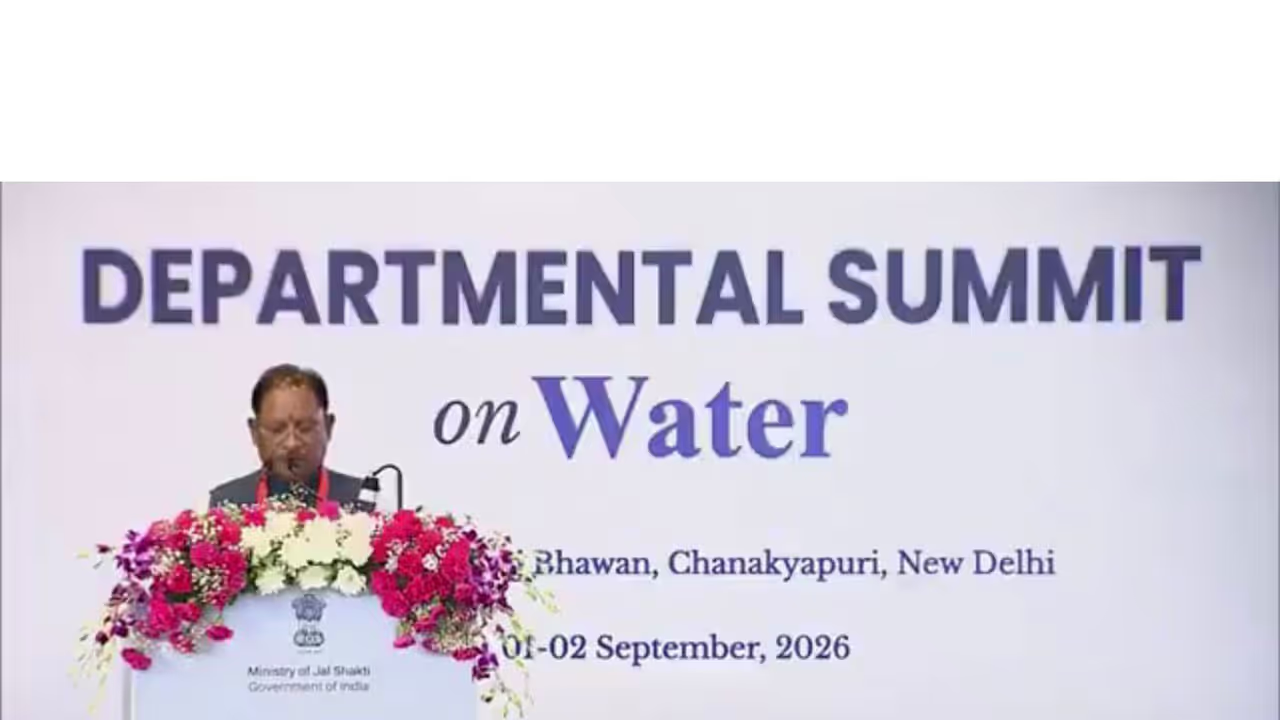
Chhattisgarh has emerged as a national leader in rainwater harvesting and water conservation, securing top rank in the 'Jal Sanchay Jan Bhagidari' and 'Catch the Rain' campaigns. CM Vishnu Deo Sai presented the state's success model in New Delhi.
Chhattisgarh has emerged as a national leader in rainwater harvesting and water conservation, securing the top position in the third phase of the Ministry of Jal Shakti's 'Jal Sanchay Jan Bhagidari' (JSJB) and 'Catch the Rain' campaigns. Chief Minister Vishnu Deo Sai presented the state's water conservation efforts on a national platform during the Ministry of Jal Shakti's departmental summit held at the Sushma Swaraj Bhawan in New Delhi, in the presence of Prime Minister Narendra Modi.
During the 'Catch the Rain' session of the summit, Deputy Chief Minister Arun Sao shared details regarding rainwater harvesting, groundwater recharge, and the conservation of drinking water sources, an official statement said.
CM Highlights Public Participation and Proposes National Measures
At the summit, the Chief Minister presented Chhattisgarh's public participation-driven water conservation model and proposed four measures to conserve every drop of rainwater across the country: state-specific 'Catch the Rain' plans, 'State Water Awards' to recognise high-performing states, mapping of water structures through BISAG-N, and quarterly reviews chaired by the Chief Secretary.
"Having grown up as a farmer's son and personally worked in the fields in his village, Bagiya, he understands first-hand the vital importance of water. He noted that Chhattisgarh, which accounts for around 4% of the country's geographical area, has emerged as a leading performer under the 'Jal Sanchay Jan Bhagidari' campaign. Instead of limiting water conservation to government programs alone, the state has transformed it into a public campaign with the participation of farmers, panchayats and local communities", he said.
'5 Per Cent Model' and Community-Driven Success
Highlighting the '5 Per cent Model' pioneered in Koriya district, Sai described it as a strong example of direct farmer participation in water conservation. Under the initiative, farmers voluntarily dedicate 5% of their land to groundwater recharge, where structures are created to capture rainwater and facilitate its gradual percolation into the ground. The initiative is expected to strengthen groundwater reserves and improve water availability for irrigation and other needs.
"The state's approach focuses on convergence among various schemes and departments, regular reviews, geo-tagging of water conservation structures and, above all, community participation. Key stakeholders include 'Jal Sakhis', 'Jal Mitras', farmers, panchayats, and local communities. He added that Chhattisgarh is ready to share its successful water conservation practices with other states across the country", he said.
Consistent Performance Across Campaign Phases
Chhattisgarh has maintained a strong performance across all three phases of the Ministry of Jal Shakti's 'Jal Sanchay Jan Bhagidari' (JSJB) campaign. Under JSJB 1.0, the state created 4,05,561 water conservation structures, securing the second position nationally. In the second phase, JSJB 2.0, work was initiated on 24,07,456 structures, of which 23,07,768 were completed, again placing Chhattisgarh second in the country. The state has now moved to the first place in JSJB 3.0. A total of 79,775 water conservation structures have been recorded in the third phase, with 77,719 already completed, making Chhattisgarh the country's leading performer in the campaign, it said.
The initiative aims to check rainwater runoff and promote its gradual percolation into the ground, thereby helping replenish groundwater reserves and improve water availability in wells, hand pumps and borewells.
District-Level Success and Groundwater Improvement
Districts in the state have demonstrated remarkable performance in water conservation efforts. Surajpur, Mahasamund, Balod, Baloda Bazar-Bhatapara, and Kabirdham have secured places among the top 10 districts nationwide. In these districts, rainwater harvesting initiatives have gained momentum through the active participation of villages, panchayats, and local residents.
The number of groundwater-stressed blocks in Chhattisgarh, classified as 'critical' and 'semi-critical', has declined from 26 to 19. The number of blocks in the 'critical' category is also projected to fall to normal, indicating the positive impact of the state's ongoing water conservation and groundwater recharge initiatives.
Aligning with National Goals for Widespread Impact
In Chhattisgarh, Prime Minister Narendra Modi's message of 'Catch the Rain--Where It Falls, Let It Be Stored' is being implemented in accordance with local conditions. Water harvesting and groundwater recharge structures are being developed based on the requirements of different geographical regions of the state.
The country has set a target of creating 2 crore new water structures by May 31, 2027. Chhattisgarh's experience demonstrates that with the participation of farmers, panchayats and local communities alongside government efforts, water conservation can be transformed into a large-scale mass movement. When rainwater is retained in fields and villages, improved groundwater levels can increase water availability for irrigation and support crop production. This can help reduce the impact of weather-related challenges on agriculture while creating greater livelihood opportunities for rural families. Improved water availability can also reduce the time and effort women spend collecting water.
Chief Minister's Principal Secretary Subodh Kumar Singh, Secretary, Water Resources Department Rajesh Sukumar Toppo, and other senior officials were present at the summit. (ANI)
(Except for the headline, this story has not been edited by Asianet Newsable English staff and is published from a syndicated feed.)