
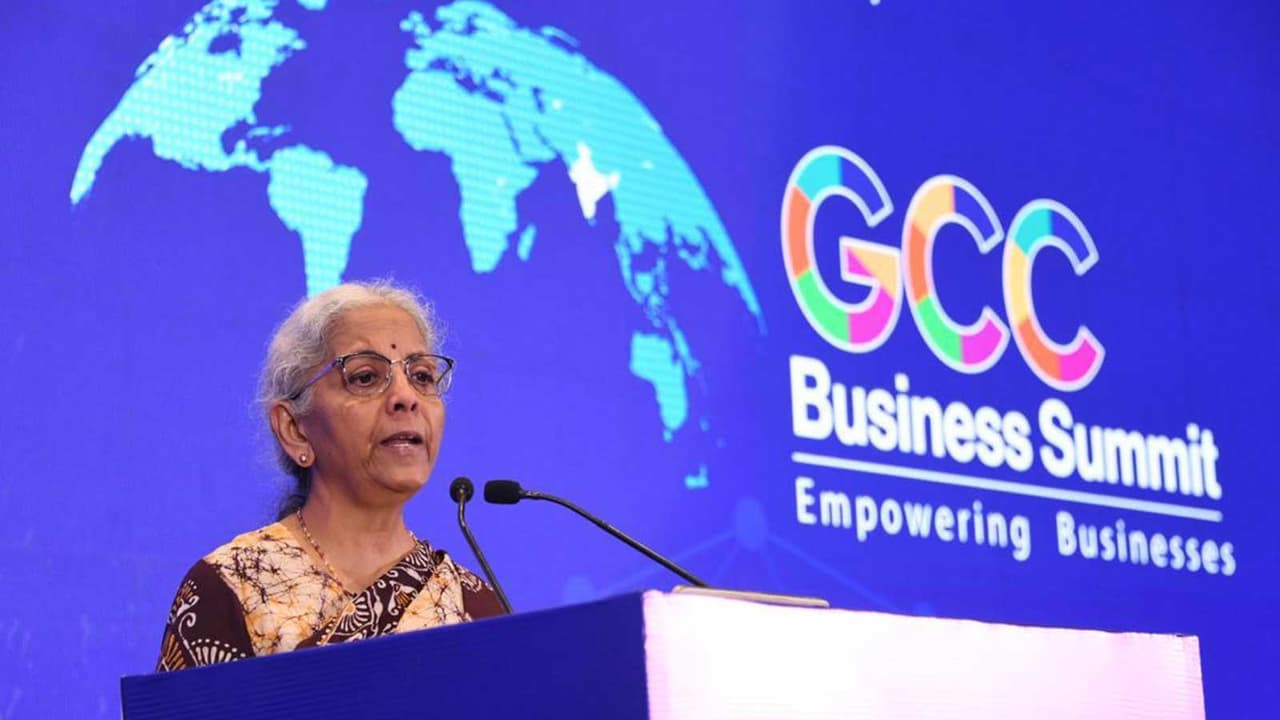
The Centre aims to support around 5,000 Global Capability Centres (GCCs) in India by 2030, a target FM Nirmala Sitharaman called "realistic and achievable," highlighting a vast untapped investment opportunity for Fortune 2000 companies.
The Centre aims to support an ecosystem capable of supporting around 5,000 Global Capability Centres (GCCs) in India by 2030, with Finance Minister Nirmala Sitharaman on Thursday calling the target "both realistic and achievable" as the country seeks to strengthen its position as the world's leading GCC destination.
"The ambition of building an ecosystem capable of supporting around 5,000 GCCs by 2030 is both realistic and achievable. And this is a milestone on a much larger journey," Sitharaman said in her address at the CII GCC Business Summit 2026. She added that around two-thirds of the Fortune Global 2000 companies are yet to establish a GCC in India, describing it as "one of the largest untapped investment opportunities before us."
India's Current GCC Landscape
Highlighting India's growing importance in the global GCC landscape, Sitharaman said the country today hosts more than 2,100 GCCs employing 23 lakh professionals and generating almost USD 100 billion in annual revenues. "More than five hundred Forbes Global 2000 companies have established GCCs in our country," she said, adding that "in many sectors, an MNC is now more likely to build its next capability centre in India than anywhere else."
Shift to Knowledge-Driven Economy
Explaining this shift, Sitharaman said the global economy is increasingly being driven by knowledge and innovation rather than traditional factors of production. "The 21st century is steadily being shaped by a different resource altogether: organised human capability," she said, adding, "Today, the greatest competitive advantage lies in generating knowledge, applying technology and solving complex problems."
Accelerated Growth and Scale
She further highlighted that India's GCC ecosystem has entered a new phase of growth, with the pace of expansion accelerating sharply. "In 2024, one new GCC was set up in India every week. Now, on average, one new GCC gets established every day," she said. "India now hosts more than half of the world's GCCs."
The Changing Face of GCCs
According to the Finance Minister, the nature of GCCs is also changing rapidly. "More than half of new GCCs are now AI-first. Engineering Research & Development (ERD) has emerged as one of the fastest-growing capability areas," she said, adding that Indian GCCs are increasingly taking on global leadership mandates and strategic decision-making responsibilities.
Supportive Policy Measures
On the policy front, Sitharaman said the government has introduced several measures in the Union Budget 2026-27 to strengthen India's attractiveness as a global capability destination. These include a Unified Safe Harbour Regime for IT and IT-enabled services, an increase in the Safe Harbour threshold from Rs 300 crore to Rs 2,000 crore, and a fast-track Advance Pricing Agreement (APA) mechanism to provide greater tax certainty.
She said these measures "reduce compliance burden, improve policy predictability and allow enterprises to devote greater attention for innovation, research and value creation."
States Compete to Attract GCCs
The Finance Minister also noted that states are actively competing to attract GCC investments. "The response from our States has been encouraging, with at least 10 States having either announced or are developing dedicated GCC policies," she said, adding that differentiated state-level strategies would make India's innovation ecosystem more resilient and globally competitive.
Future Aspirations and Call to Action
Calling on industry to play a larger role in India's next phase of growth, Sitharaman urged enterprises to move further up the value chain, deepen partnerships with universities and research institutions, expand into Tier-II and Tier-III cities, and help position India as a global innovation leader.
She said India's aspiration is "not merely to host the world's capability centres, but to shape the next-generation technologies, products and enterprises of the future." (ANI)
(Except for the headline, this story has not been edited by Asianet Newsable English staff and is published from a syndicated feed.)