
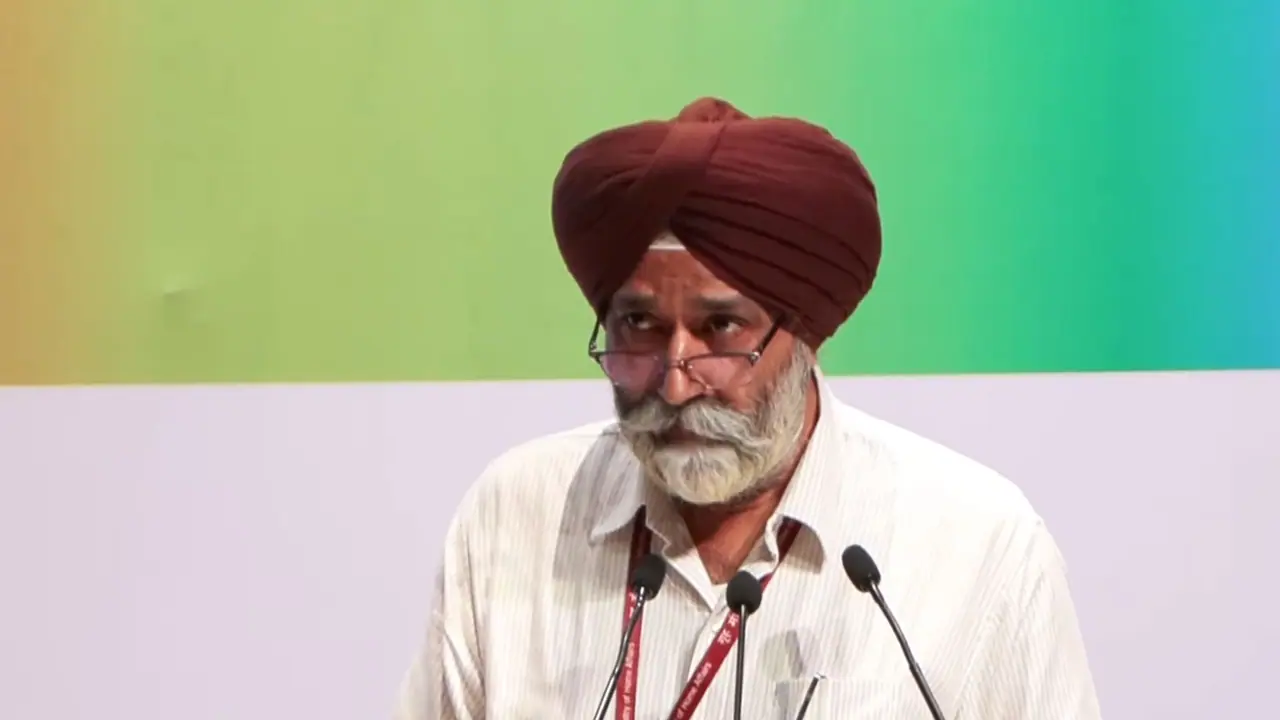
Over 40,000 reforms have been implemented by state governments in the last 10 years, with Gujarat leading the way, says DPIIT Secretary Amardeep Singh Bhatia. He noted that Centre-state collaboration is key to India's economic growth and investments.
More than 40,000 reforms have been undertaken by State governments over the past 10 years, with Gujarat emerging as a front-runner in carrying out these measures, said Secretary of the Department for Promotion of Industry and Internal Trade (DPIIT), Amardeep Singh Bhatia.
Centre-State Collaboration Drives Growth
Addressing the gathering at the Vibrant Gujarat Global Summit 2027 - Curtain Raiser, on Monday, Bhatia stated that India is among the fastest-growing economies and an attractive destination for global investments, largely driven by joint efforts between the Centre and the states.
"Ease of doing business is one of the prime examples where the states and central governments have collaborated through various initiatives. The business reform action plan is one area where reforms have been carried out together by the states in a framework which has been laid down by the central government. And more than 40,000 reforms have been taken forward by the state governments over the last 10 years," Bhatia said.
He noted that the central government has also laid down frameworks for decriminalisation, while the deregulation cell of the Cabinet Secretariat works closely with state Chief Secretaries on sectoral plans.
"In all of these, the State government of Gujarat has been a front-runner in carrying out the reforms. However, there is a lot more that needs to be done and the government of India continues in that trajectory of greater deregulation and more reforms towards ease of doing business," he added.
Deepening Reforms and Infrastructure
Bhatia explained that both tiers of government are implementing a district business reform action plan to ensure reforms reach the ground level, while expanding industrial infrastructure through initiatives like the National Industrial Corridor Development Program, where over 20 industrial townships are being set up.
Boosting Competitiveness and Quality
Speaking on incentives and global competitiveness, Bhatia pointed to the central Production Linked Incentive (PLI) schemes across 14 areas and Gujarat's 22 industrial policies. He emphasized that free trade agreements (FTAs) with partners such as the European Union, the UK, EFTA nations, Australia, and Gulf countries offer long-term demand and push domestic industry to become cost-competitive.
"With regard to quality, it is an extremely important pillar, it has to be industry-led," Bhatia said. "One of the areas with regard to demand for quality products is being met partly through the FTAs and partly through the rising expectations of the domestic consumers."
He stated that the Quality Council of India is currently working across four sectors at the cluster level to address inputs, standards, testing, and productivity. Furthermore, government initiatives like the RDI fund and the fund of funds for startups are driving innovation in deep tech, with consultations ongoing to manufacture intermediate products and deepen local value chains.
Gujarat's Economic Ambitions
Also addressing the gathering, Gujarat Chief Secretary Manoj Kumar Das outlined the state's economic trajectory, stating that Gujarat has set a target of building a USD 3.5 trillion economy.
Das stated that Gujarat's GDP growth has stood at around 10 to 11 per cent in recent years, excluding the pandemic period, with the current year demonstrating stronger growth momentum.
He pointed out that credit flow remains strong, with banks achieving six-month targets within four months, accompanied by robust Goods and Services Tax collections and rising power demand.
Das noted that the State now requires an acceleration in its pace of growth to achieve the USD 3.5 trillion economy target. (ANI)
(Except for the headline, this story has not been edited by Asianetnews Editorial staff and is published from a syndicated feed.)