
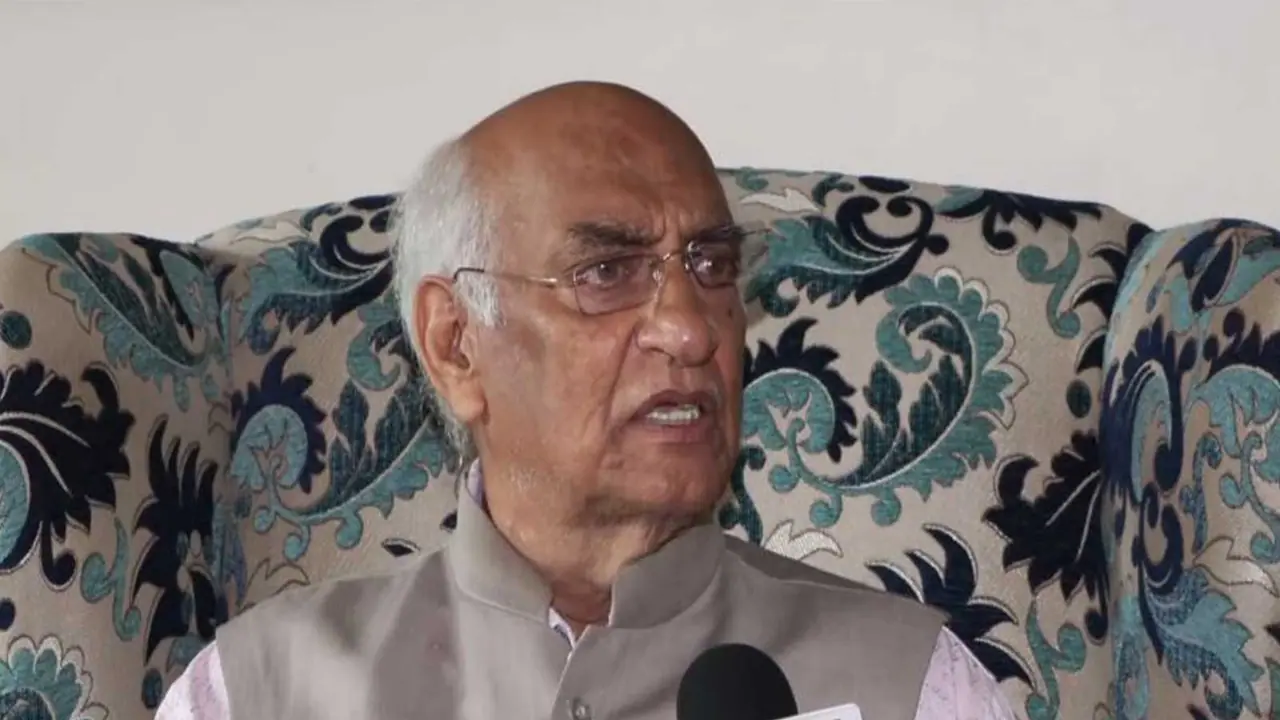
Former diplomat Vidya Bhushan Soni said the US welcomed the Mecca pact as it signals waning US influence. He added that the deal lets Trump focus on Iran while Saudi Arabia, Turkiye, and Pakistan handle threats like the Houthis in the region.
As the United States welcomed the signing of the Mecca Joint Defence Agreement between Saudi Arabia, Turkiye and Pakistan, former senior diplomat Vidya Bhushan Soni said that Washington's acceptance of the pact comes amid waning US regional influence and could allow President Donald Trump to focus more closely on Iran.
Speaking to ANI on Monday, Soni said the agreement indicates that the US is no longer in a position to single-handedly stabilise regions where it previously played a significant role. "The signing of an agreement is testifying to the fact that America is not in a condition anymore to stabilise the various regions of the world where it had a role," Soni said.
The Houthi Factor
He, however, highlighted the Houthi factor as a major concern for Saudi Arabia, saying Riyadh remains worried about the group's ability to destabilise the region and disrupt maritime trade, particularly around the Bab-el-Mandeb. "But the other factor which people do not take into account is the Houthi factor. Houthi is a very important factor, not for the outside world, but for Saudi Arabia. It's one of the most significant headaches," he said.
According to Soni, Saudi Arabia sees the Houthis as a major security challenge, while the international focus remains largely on the Israel-Palestine conflict and Iran. "Saudi Arabia feels that Israel is interested in only Palestine and, of course, Iran. Nobody's paying attention to the Houthis as the troublemakers for them," he said, adding that Houthi activity around the Bab-el-Mandeb was also having a negative impact on cargo movement.
The former senior envoy also pointed out that Saudi Arabia and Pakistan had already signed a pact last year on broadly similar lines, but questioned its impact on the Houthi threat. "Please remember that they already had signed a pact with Pakistan last year, somewhat on similar lines, though not exactly that. But has it had any effect? Houthis are still attacking. Pakistan is not able to come in, join in," he said.
Trump's Rationale: A Focus on Iran
On Trump's decision to welcome the new agreement, Soni said the development should be viewed in the context of Washington's priorities towards Iran. "What is happening is Trump's priorities are all on Iran, less on the Houthi front. So if there is an alternative source which can take care of Houthis, as this particular defence pact attempts to do, to that extent, the pressure on the US on them will be a little less," he said.
"So that's why he has not condemned it, has accepted it, he has welcomed it," Soni added.
Link to Abraham Accords
He further linked the development to Trump's efforts to expand the Abraham Accords and told ANI, "Remember that all along Trump has been trying for the Abraham Accords to be accepted by the other countries of the world, but Pakistan cannot because of the fact that they cannot abandon Palestine cause nor be seen supporting Israel," Soni said.
Soni said that broader acceptance of the Abraham Accords would, in Washington's view, contribute to Israel's security and could be another reason behind Trump's support for the Saudi-Turkiye-Pakistan defence arrangement. "This is also Trump's attempt to promote more countries joining the Abraham Accords because once it gains acceptance, Israel's security and safety is to that extent ensured," he said.
A Cost-Effective Arrangement for Washington
He further argued that the arrangement would not impose a direct financial or military burden on the US, as the three participating countries would bring different capabilities to the table. "It doesn't cost them anything at all because he's (Trump) not going to contribute in any manner. To that extent, the effort will go to Saudi Arabia's coffers in terms of money, technology by Turkiye and ground forces by Pakistan," Soni said.
"For them, somebody else would take care where his obligation to ensuring regional security and peace would lessen to that extent. So he can concentrate more on his main objective of containing Iran," he added. (ANI)
(Except for the headline, this story has not been edited by Asianet Newsable English staff and is published from a syndicated feed.)