
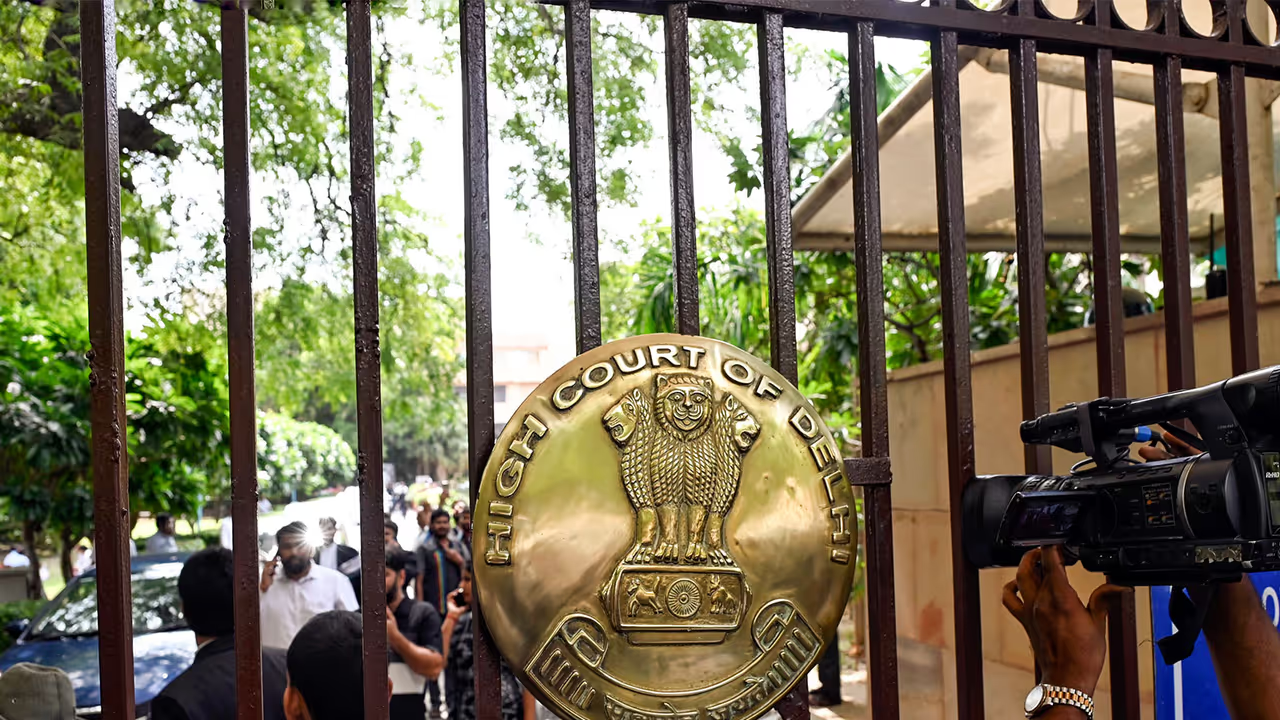
The Delhi High Court tagged a PIL challenging the mandatory MP/MLA endorsement for the Delhi Lakshmi Yojana with a similar case. The court has sought a response from authorities and will hear the matter, concerning access to the scheme, on September 17.
The Delhi High Court on Wednesday tagged a Public Interest Litigation challenging the mandatory requirement of obtaining an MP or MLA endorsement or recommendation letter for registration and availing benefits under the Delhi Lakshmi Yojana with a similar pending matter.
A Division Bench comprising Chief Justice DK Upadhyaya and Justice Tejas Karia directed that the plea be heard along with the connected matter, which is listed for hearing on September 17. The Court also directed the authorities to file their responses.
PIL Challenges Political Endorsement
The PIL challenges the requirement of securing an endorsement or recommendation letter from an elected MP or MLA as a pre-condition for accessing benefits under the Delhi Lakshmi Yojana, which provides financial assistance of Rs 2,500 per month to eligible women from economically weaker sections.
Advocate Ashu Bidhuri, appearing for petitioner Shabana Hussain, submitted that the scheme should be implemented through an objective, transparent and accessible verification mechanism rather than making political endorsement a mandatory gateway for beneficiaries.
Arguments Against the Requirement
The plea states that an otherwise eligible woman is required to approach an elected representative, obtain an endorsement or recommendation letter and upload the document on the registration portal. It contends that there are no clearly defined objective criteria governing the grant or refusal of such an endorsement.
The petitioner has also argued that there is no adequate review or alternative mechanism available to an eligible applicant who is unable to obtain the recommendation from an MP or MLA.
According to the plea, making the endorsement compulsory introduces an additional political interface between the government and beneficiaries of a welfare scheme and could result in similarly placed women being treated differently depending on their ability to secure such a recommendation. The petition further highlights the practical difficulties that economically vulnerable women may face, including repeated visits to political offices and expenses related to printing, scanning and uploading documents.
Court Already Considering the Issue
During the hearing, the Bench referred to the similar matter already pending before it and noted that the issue concerning the MP/MLA endorsement clause was already under consideration.
In the connected case, the Court had earlier sought an explanation from the Delhi Government regarding the objective sought to be achieved by incorporating the endorsement requirement into the welfare scheme. The Bench had observed that there would be no issue if an endorsement were merely one of several options available to applicants. However, the concern before the Court was that the endorsement had allegedly been made the only route for applicants seeking to avail the benefits.
Plea Calls for Objective Verification
The present PIL seeks deletion of the mandatory MP/MLA endorsement or recommendation letter requirement and calls for implementation of the Delhi Lakshmi Yojana through an objective and transparent verification mechanism.
The petitioner has contended that the government already has mechanisms to verify identity, residence, income, family particulars and bank details through official records and administrative systems. It argues that requiring a political recommendation therefore adds an unnecessary layer to the process.
The plea also refers to women-centric welfare schemes in Karnataka, Maharashtra, Madhya Pradesh, Chhattisgarh and Odisha, stating that such schemes use government records, digital databases, e-KYC and administrative verification mechanisms to establish eligibility. The petitioner has argued that these mechanisms demonstrate that eligibility and wrongful inclusion can be checked through administrative processes without making a personal recommendation from an elected representative a mandatory condition for receiving welfare assistance.
The matter will now be heard along with the connected case listed before the Delhi High Court on September 17. (ANI)
(Except for the headline, this story has not been edited by Asianet Newsable English staff and is published from a syndicated feed.)