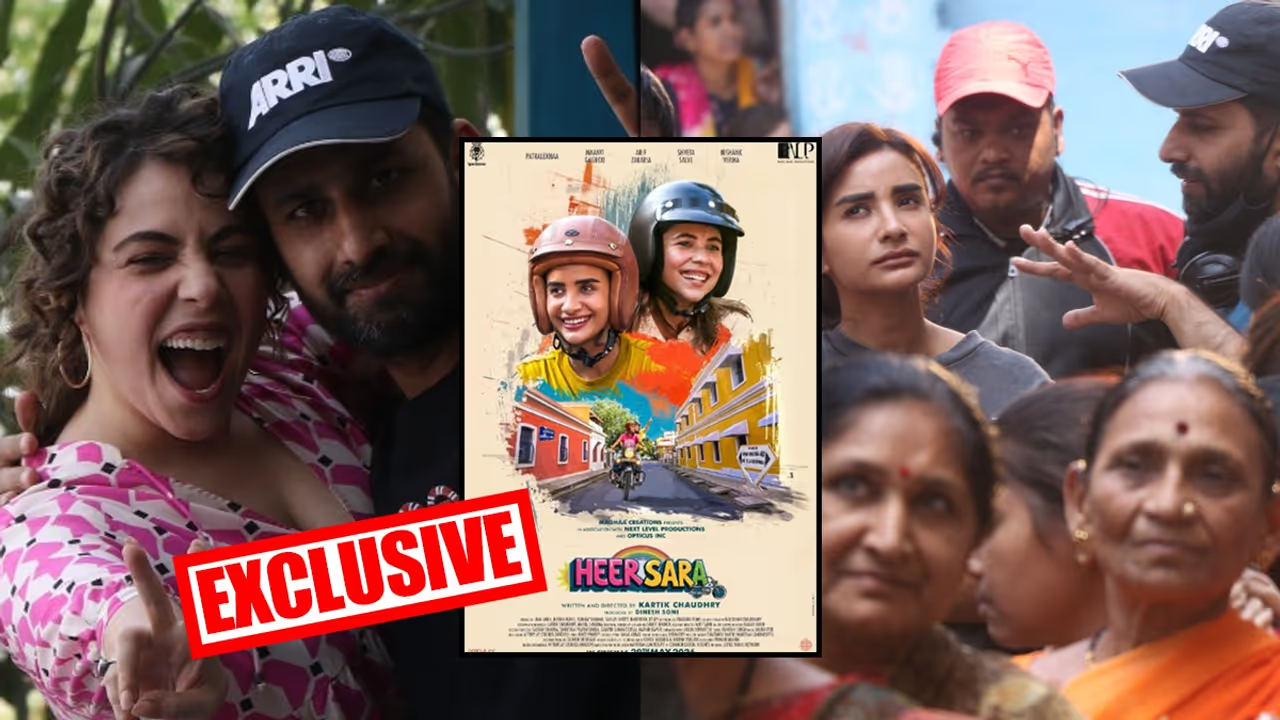
This is an exclusive interview with Kartik Chaudhry, director of the upcoming film 'Heer Sara.' He discusses the film's origins, following two women on a motorcycle journey of self-discovery to Pondicherry, and delves into its deeper themes of emotional healing and mental health beyond the feel-good travel narrative.
There is a timeless magic to the classic cinematic road trip, but it is rarely captured with the raw, pulsating energy of sisterhood and self-discovery found in Heer Sara. Slipping into theaters on June 12, 2026, this coming-of-age adventure follows two women from Indore—Heer (played by Maanvi Gagroo) and Sara (played by Patralekhaa)—who mount a motorcycle and embark on a rebellious, chaotic odyssey across India to the serene coastal town of Pondicherry.
As excitement builds around the film's release, Asianet Newsable caught up with director and co-writer Kartik Chaudhry, the creative mind behind the project.
Q1. How was it working on a women-centric film?
Related Articles

For me, I never really looked at Heer Sara as a women-centric film. I looked at it as the story of two people whose journeys felt important to tell. They happen to be women, yes, and naturally their life experiences, challenges, and perspectives are different from those of men. But what drew me to the film was not their gender as much as who they are as individuals. Heer and Sara are compelling characters with emotional journeys that felt worth exploring.
Q2. What was the seed idea behind Heer Sara? Was it inspired by a real-life incident or personal experience?
The seed of the story goes back to my solo travels to Pondicherry in 2010. I found the city incredibly fascinating. It wasn't like Goa or other popular holiday destinations. There was something peaceful, artistic, and almost timeless about it. Around the same period, I was directing a biking show for MTV called Chase the Monsoon, where I met many women riders who were deeply passionate about motorcycling and travel.
Somewhere along the way, these two worlds started coming together in my mind. I found the idea of two women riders navigating a journey through Pondicherry and its surrounding spaces very intriguing. That became the starting point of Heer Sara.
Q3. What made you write a women-centric film when alpha male stories are doing well in cinema today?
I actually see Heer and Sara as alpha women. We often associate heroism with physical strength or larger-than-life action, but heroes don't have to defeat ten people at once to be heroes. Sometimes heroism lies in making difficult choices in everyday life. For me, Heer and Sara become heroes the moment they decide to take charge of their own lives and search for answers to questions that have been weighing on them for years.
The courage to step out of familiar surroundings and confront unresolved emotions is heroic in its own way. Their gender was never the defining factor for me. Their choices and actions were.
Q4. What made Patralekhaa and Maanvi Gagroo the perfect choices for these roles?
One of the things that fascinated me about the women riders I met over the years was their nonchalance. They would accomplish remarkable things without making a big deal out of them. There was a quiet confidence and self-assurance about them.
When I met Patralekhaa, I immediately sensed that quality in her. She came across as effortlessly cool and self-possessed, very much like Sara. The fact that she was willing to learn motorcycle riding for the role only strengthened my conviction that she was the right person to play the character.
Maanvi was actually someone we had in mind even while writing the film. She has a very strong emotional undercurrent beneath her naturally warm and lively personality. Heer may appear fun, cheerful, and easy-going on the surface, but there is a lot of depth and vulnerability within her. Maanvi understood those layers instinctively and brought tremendous emotional richness to the character.
Q5. Why did you choose a road-trip format to tell this story?
Road trips are a wonderful storytelling device. They can be beautiful, uncomfortable, adventurous, risky, soulful, and unpredictable all at the same time. Every turn brings a new challenge, a new person, or a new discovery. As a filmmaker, that gives you a very dynamic canvas to work with.
More importantly, journeys often change people. A road trip allows characters to physically move through spaces while also going through emotional transformations. That made it the perfect format for Heer and Sara's story.
Q6. Pondicherry almost feels like a character in the trailer. Why was it important to set the story there?
Absolutely. Pondicherry is the third character in the film after Heer and Sara. Beyond its visual beauty, Pondicherry has a unique identity shaped by both French and Tamil influences. It has a very distinct rhythm and personality that you don't find elsewhere in India.
One of the important characters in the film is connected to Auroville, the experimental township located near Pondicherry. I have always found the spirit of Auroville inspiring. It is a place built around ideas of openness, acceptance, and alternative ways of living. Those themes resonated strongly with the story we were trying to tell, which made Pondicherry the perfect setting.
Q7. What were the biggest challenges of shooting in Pondicherry and capturing its unique atmosphere?
The people of Pondicherry were incredibly warm and welcoming throughout the shoot. What surprised me is that despite being such a picturesque location, it hasn't been explored extensively in cinema. That made the experience even more exciting for us.
From a production standpoint, the motorcycle sequences were definitely the most challenging. Whenever actors are riding on real roads, there are safety concerns, traffic management issues, and countless logistical challenges that need to be addressed. At the same time, the actors still have to remain emotionally present in the scene. Since many of the film's key conversations happen while Heer and Sara are on the bike, balancing performance and safety required a lot of planning.
Q8. The trailer hints at emotional baggage carried by both women. How deeply does the film explore mental health and self-discovery?
Very deeply. In many ways, those are the central themes of the film. The travel and road-trip elements are really tools through which we explore mental health, self-discovery, and emotional healing. We live in a society where people often suppress difficult emotions and avoid confronting uncomfortable questions about themselves.
But healing can only begin when we face those questions honestly. Both Heer and Sara are carrying emotional burdens that they can no longer ignore. Their journey becomes an attempt to confront those unresolved issues rather than continue living with them. I hope the film encourages people to face their own challenges head-on instead of pushing them aside.
Q9. What was the most emotionally challenging scene to shoot?
There were quite a few emotionally demanding scenes during the shoot. However, there is one particular scene that stands out for me. Unfortunately, I can't talk about it right now because it would reveal a major spoiler. Let's revisit this question after the film releases!
Q10. Are you working on any other projects?
Yes, I am currently developing two scripts that I hope to direct.
One is a whodunnit set in the Middle East, which is a very exciting space to explore. The other is an emotional story about the relationship between a couple and their pet. Apart from directing, I am also producing a few interesting projects that are in different stages of development. I look forward to sharing more details about them at the right time.
Q11. After watching the trailer, viewers may think this is a feel-good travel film. What surprises are you hiding from the audience?
Let's keep this interview spoiler-free. I will just say that while the film certainly has the warmth, humour, and spirit of a road-trip movie, there is much more happening beneath the surface. Heer and Sara are carrying emotional journeys that run deeper than what the trailer reveals. The audience will have to watch the film to discover the rest.