
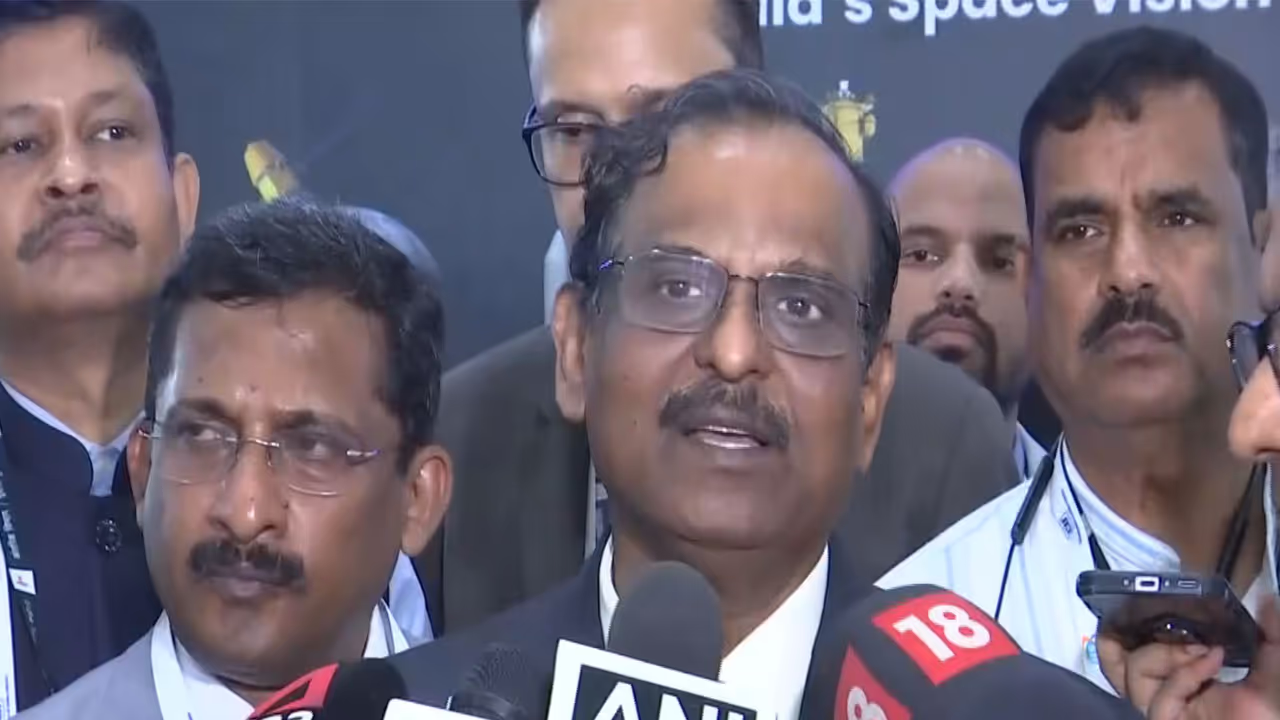
ISRO Chairman Dr V Narayanan clarified that the space agency is not being privatised and concerns from employees will be addressed. The reforms aim to expand India's space capacity with private participation, not replace ISRO's role.
ISRO not being privatised, employee concerns will be addressed
Indian Space Research Organisation (ISRO) Chairman Dr V Narayanan on Monday said ISRO is not being privatised and that concerns raised by some employees over the government's space sector reforms will be addressed. His comments came after some ISRO employees sought an official clarification on the government's policy regarding privatisation or transfer of ISRO's manufacturing and operational functions, the future role of the space agency and the impact of the changes on serving employees and future generations.
"The space sector reform was rolled out six years back. As per that, we are supposed to handhold the private sector and grow the space ecosystem," Narayanan told reporters on the sidelines of the Bengaluru Space Expo 2026. He said private industry has already been closely involved in India's space programme and contributes to ISRO's launch programmes.
"Whenever a PSLV or a GSLV is lifting off, don't think that everything is done by ISRO. Almost 80 per cent of the budget is invested by Indian industries. 450 industries are working for us," he said.
Acknowledging the concerns raised within the organisation, Narayanan said, "So surely my colleagues' concern is genuine... It is our responsibility to clarify." He, however, stressed that the reforms were aimed at expanding India's overall space capacity and not privatising ISRO.
"The country's requirement is around 50 launch vehicles per year... So ISRO is not privatised," he said. Narayanan said the future expansion in launch activity would involve the wider Indian space ecosystem and would not be limited to ISRO alone.
"Please understand, I didn't tell that it is only by ISRO. It is by the Indians in India. Fifty launches are going to be accomplished by Indians in India," he said.
On whether ISRO would formally respond to the letter, Narayanan said the organisation would engage with its employees. "If one or two people submit a letter, one cannot respond in writing. We are 20,000 employees. But we will address the employees," he said, adding that ISRO regularly communicates with its workforce on changes in the space sector.
Reforms consistent with Indian Space Policy: IN-SPACe
Separately, IN-SPACe Chairman Dr Pawan Kumar Goenka said the government's approach to expanding private participation remained fully aligned with the Indian Space Policy. "What we are doing is consistent with the Indian space policy, in which the role of ISRO, IN-SPACe, and the private sector is clearly defined, and there is not even an iota of digression from that," Goenka said.
He also said technology transfers being undertaken in the sector were in accordance with the policy. "All the technology transfer that we are doing is as per Indian Space Policy," Goenka said.
No shortage of government funding for ISRO
Narayanan also rejected concerns over any shortage of government funding for ISRO. "With respect to the budget, whatever ISRO needs per year, government is allotting. There is no shortage of budget," he said.
"Suppose if we spend more, government is ready to fund more. So in my capacity as the Secretary of the Department of Space, we only request the government to allot the budget. Whatever we request, government is allotting," he added.
Employee attrition rate 'marginal', says chairman
Responding to questions over scientists leaving ISRO for private space companies, Narayanan said employee attrition had not changed significantly, though there had been a marginal increase. "We are a 20,000 employees organisation, scientists are around 8,000 plus. Now, last five-six years if you take the statistics, around 150 people per year is the resignation. This is normal in any organisation," he said.
"The attrition has not increased... I will say marginal increase... So 150 is a normal number in my opinion," Narayanan added.
India's space sector reforms seek to increase private-sector participation in activities that were earlier largely undertaken by government entities, while ISRO focuses on research, advanced missions, technology development and other strategic areas. IN-SPACe acts as the interface for promoting and authorising private-sector space activities in the country. (ANI)
(Except for the headline, this story has not been edited by Asianetnews Editorial staff and is published from a syndicated feed.)