
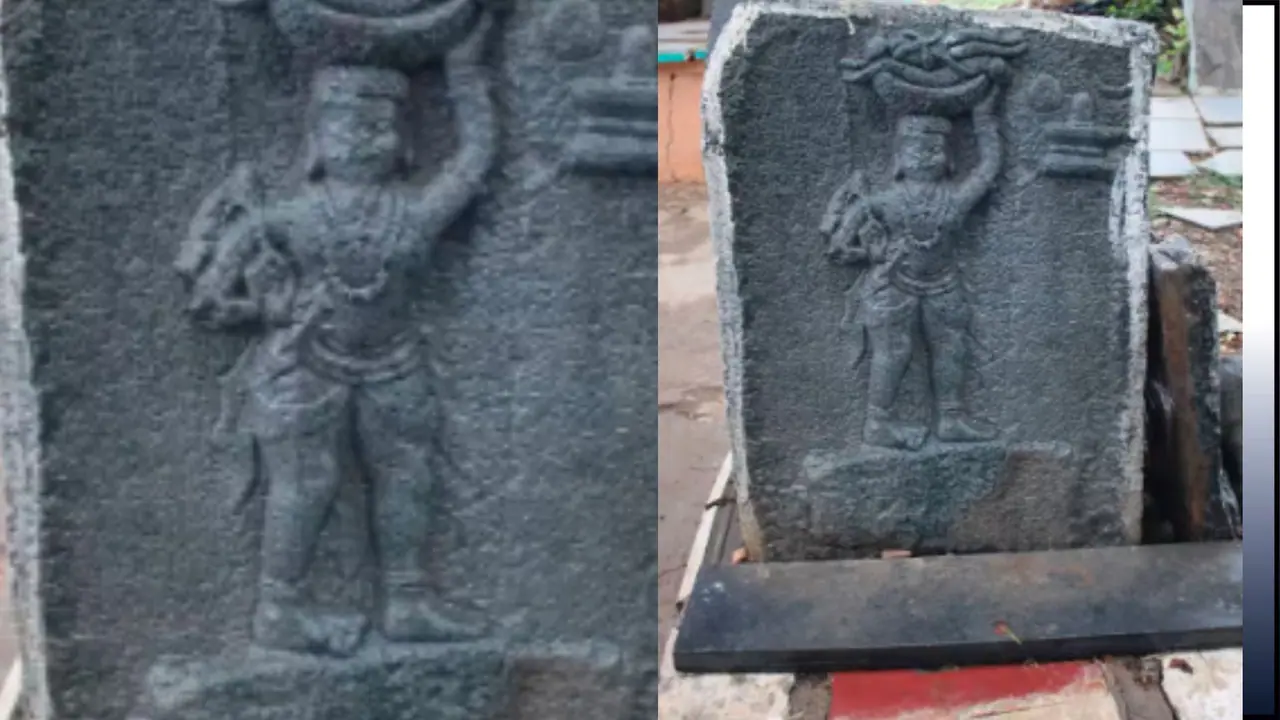
A rare 1539 inscription found in Guttala reveals Marulayya cremated 6,307 famine victims during a devastating crisis. This unique Kannada record highlights an extraordinary act of compassion during Vijayanagara ruler Achyutaraya’s reign.
Haveri: A rare sculpture and inscription have been discovered near the Chandrashekhara temple in Guttala, marking a significant addition to Kannada epigraphy and sculpture. Dr R Shejeshwara, Director of the Hampi Archaeological Museums and Heritage Department in Vijayanagara district, confirmed the finding during a recent field visit.
The sculpture depicts Puduvattu and Marulayya, with inscriptions on both sides, 20 lines on the right and 13 lines on the left. This inscription has not been previously documented or published, making it a valuable new discovery for historians and scholars.
Summary of the inscription
Related Articles

The right-side inscription records that Marulayya, son of Nannideva Odeya and a subordinate of the Guttala establishment, cremated 6,307 bodies, carrying them in baskets (referred to as 'zalli')—as a meritorious act dedicated to his ruler, Pattada Timmaswamy. The left-side inscription mentions that the sculpture was installed on Bhadrapada Shukla Panchami in Salivahana Saka 1462, corresponding to Monday, August 18, 1539, a year marked by devastating famine. The installation followed prayers to Basaveshwara. During this time, Vijayanagara was ruled by Achyutaraya.
Historical significance: In 1539, the Guttala region suffered a severe famine. The unclaimed bodies of victims lay scattered. In a remarkable act of compassion and courage, Marulayya cremated 6,307 of these bodies. This is believed to be the only known inscription worldwide that documents an individual cremating such a large number of bodies, highlighting both the scale of the disaster and the heroism involved.
The inscription also implies that an epidemic—possibly Davagi (dogi), cholera, or plague may have accompanied the famine, increasing the death toll in the region. The mention of the famine, mass cremation, and the associated sculpture is considered unique and historically invaluable.
The sculpture features carvings of the sun and moon, symbolising the enduring merit of Marulayya’s act, which is declared to last as long as the celestial bodies exist.
Dr Ravikumar Navalagund and Dr Chamaraja Kammar were also present during the fieldwork that led to the discovery. Though the sculpture is briefly mentioned in the Gazetteer of Dharwad District and a few doctoral theses, no detailed study had been undertaken until now. Dr Shejeshwara emphasised that cremating over 6,000 bodies is no ordinary feat, calling Marulayya’s actions both commendable and inspirational.

