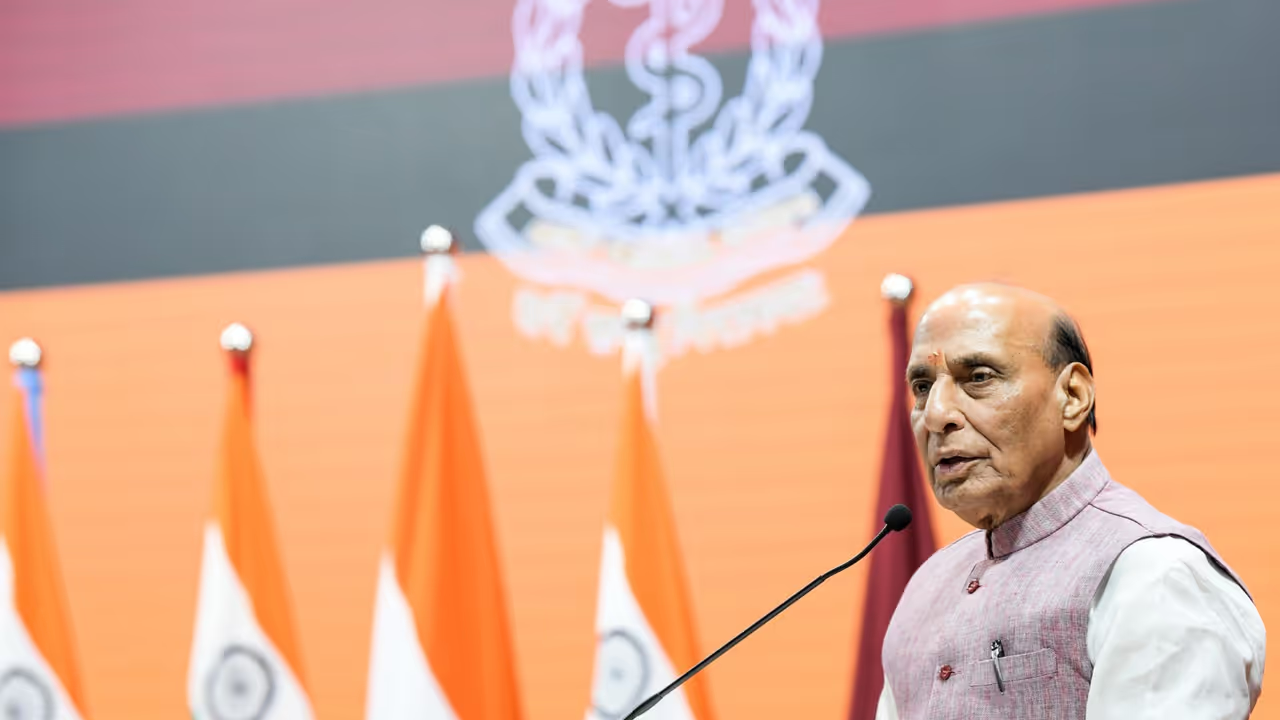
Defence Minister Rajnath Singh said Operation Sindoor reflects the success of 12 years of defence indigenisation under the Modi government. He highlighted indigenous military systems, record defence production, rising exports and India's growing defence manufacturing capabilities.
New Delhi: Operation Sindoor stands as proof of India’s growing defence capability, built on 12 years of indigenisation efforts under the Narendra Modi government, the defence minister, Rajnath Singh said at an event in New Delhi on Saturday.
Singh described the operation as evidence of the country's “up-to-date, up-to-the-mark, and up-to-the-standard” military preparedness, crediting the transformation of India's defence sector for its successful execution. He said the operation had sent a clear message to terrorists and those who shelter them, reiterating the government's “zero tolerance” policy on terrorism and its willingness to strike at targets regardless of where they are based.
The minister singled out indigenous platforms – including the Akashteer counter-drone system, the Akash missile system, and the BrahMos supersonic cruise missile – as having played a central role during the operation, calling their deployment a demonstration of both technological maturity and the government's confidence in Indian industry.
Related Articles

Indigenisation drive to expand further
Singh said five positive indigenisation lists, covering 509 items, had been issued by the armed forces to date, alongside five more lists comprising 5,012 items from defence public sector undertakings (DPSUs).
A further list is expected to be notified shortly, he added, as part of continuing efforts to reduce reliance on imported equipment.
Annual defence production touched a record Rs 1.78 lakh crore in the 2025-26 financial year, up from roughly Rs 40,000 crore in 2014, Singh said.
Defence exports, meanwhile, have risen to an all-time high of Rs 38,000 crore, compared with just Rs 686 crore in 2013–14.
The government is now targeting production worth over Rs 2 lakh crore this year, rising to Rs 3 lakh crore by 2029, with exports expected to reach Rs 50,000 crore in the same period.
Singh attributed the shift to a change in official thinking away from what he called a historic preference for imported weaponry, arguing that dependence on foreign suppliers for arms, radars, drones, and navigation systems limits a nation's strategic autonomy. Since 2014, he said, the emphasis has been on building a domestic defence industrial base capable of meeting both national and export requirements.
Corridors, exports and acquisition reform
The minister pointed to the defence industrial corridors in Uttar Pradesh and Tamil Nadu as central to this strategy, with roughly Rs 70,000 crore in investment proposed across the two corridors and around Rs 10,000 crore already committed. He said several companies operating within the corridors were now integrated into global supply chains, and singled out the Uttar Pradesh corridor as a particular success story for the government's Atmanirbhar Bharat (self-reliant India) programme.
On the export side, Singh cited reforms such as the Defence EXIM Portal, the Open General Export Licence, simplified quality-certification processes, and a self-certification mechanism as having eased the path for Indian manufacturers to sell abroad.
Start-ups and the innovation ecosystem
Singh highlighted the role of start-ups and small and medium enterprises (MSMEs) in the government's Innovations for Defence Excellence (iDEX) initiative, along with its iDEX Prime and ADITI (Acing Development of Innovative Technologies with iDEX) schemes.
Procurement worth more than Rs 2,400 crore has been approved from start-ups and MSMEs, he said, while projects worth over Rs 1,500 crore have been sanctioned for new technology development.
As of March 2026, 676 start-ups and innovators were engaged through iDEX, with 551 contracts signed. Singh noted that the number of defence-focused start-ups in India has grown from a handful in 2018 to more than 2,000 today, working across drones, artificial intelligence, quantum technology, cybersecurity, and robotics.
Regional diplomacy and outlook
Singh linked the defence sector's progress to India's expanding diplomatic footprint, describing the country as an emerging “credible global security partner” with interests stretching from the Indian Ocean to the Indo-Pacific.
The prime minister's tour of Indonesia, Australia and New Zealand, Singh said, had strengthened ties across strategic, industrial and cultural domains – citing cooperation on the BrahMos missile system and the restoration of the Prambanan Temple in Indonesia, uranium supplies from Australia, and a doubling of trade with New Zealand.
He said India's defence diplomacy today extended beyond strategic cooperation to include industrial collaboration and integration into global supply chains, crediting scientists, soldiers, engineers, and the country's youth for driving this shift.