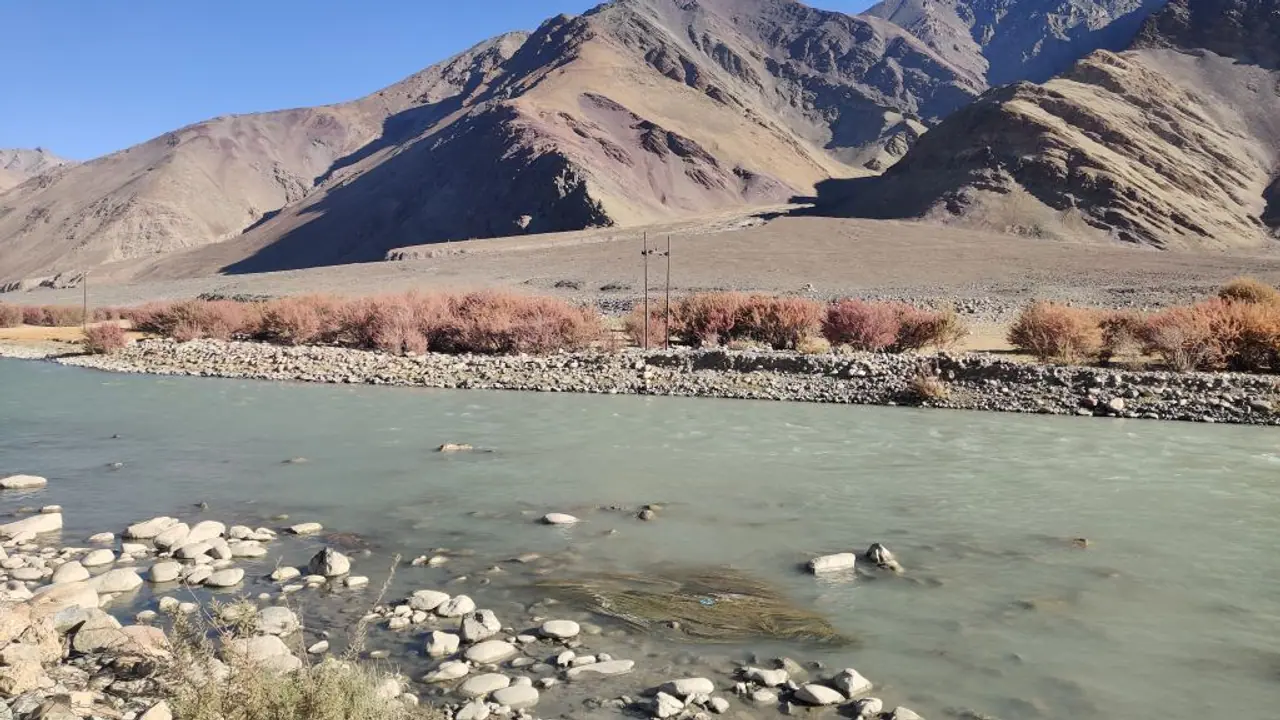
Amidst the reduction in diplomatic relations, cancelling of Visas, and closing of borders, India announced the suspension of the Indus Water Treaty.
By Aparajita Pandey: The attacks on Pahalgam in Jammu and Kashmir on the April 22 were a rude shock to the peace that has been maintained in the recent past. This act of terrorism has once again led to the flaring up of tensions between India and Pakistan, who have had a tense relationship since the inception of the two countries after end of the era of colonialism.
Amidst the reduction in diplomatic relations, cancelling of Visas, and closing of borders, India announced the suspension of the Indus Water Treaty, Vikram Misri, Foreign Secretary of India, announced that the Indus Water Treaty (IWT) would be “held in abeyance”. This suspension has shocked millions, because the Indus Water Treaty was signed in 1960, and this is the first time ever that such a suspension has taken place.
What is the Indus Water Treaty?
The Indus Water Treaty was signed between India and Pakistan and was brokered by the World Bank. It was signed by India and Pakistan on the 19th of September 1960 after a long, arduous, and almost failing negotiations that went on for 9 years. The treaty presides over the usage of the 6 rivers of the Indus water system. The Western Rivers – Indus, Jhelum, and Chenab belong to Pakistan, and the three Eastern Rivers – Ravi, Beas, and Sutlej belong to India.
Related Articles

All six rivers flow through India in their earlier stages, and then the western rivers flow through Pakistan. While the waters of the western and eastern rivers are specifically allocated to both countries, due to the nature of their flow, India is allowed to use the water of the western rivers as well for irrigation, electricity generation without water storage, and navigation. These activities are categorized as non-consumptive. Although these activities have caused disputes in the past.
The electricity generation that is allowed to India on the western river system is allowed under extremely strict conditions and can only be ‘run- of – the – river’ hydroelectric projects. However, these have caused disputes in the past. To resolve such disputes, a permanent Indus Commission is appointed with a commissioner. The Commission meets annually to attempt to resolve disputes that arise between India and Pakistan over the Indus in the presence of neutral expert.
The rivers of the Indus Water System other than their obvious importance also carry massive cultural significance across the borders of India and Pakistan.
Analyzing the Suspension
It is important to understand the larger significance of this suspension and its immediate and long-term implications. To begin with, there would be no immediate obstruction of water from the western rivers of Indus, since at the moment, India does not possess the infrastructure to stop, store, or divert such a large amount of water. Such an endeavour would take at least a few years to tangibly manifest.
However, India can start to use the water from the western rivers of the Indus without the restrictions that were put by the Treaty. At the same time, it can begin to build infrastructure that would eventually control or stop the flow of these rivers into Pakistan.
While India and Pakistan might be minimizing their diplomatic relations at the moment, they would eventually need to negotiate the future of the Indus Water Treaty. Since the Treaty by nature is perpetual and does not have an exit clause in its charter. Neither India nor Pakistan can effectively leave the Indus Water Treaty or nullify it unilaterally. All modifications to the treaty also require unanimous consensus of both parties, thereby at the moment bringing both parties to an impasse.
The treaty also has no end date, so both signatory parties would have to eventually sit in front of the Indus commission for grievance redressal in presence of a neutral expert. These negotiations would have to be arbitrated by a neutral forum as well.
The world still awaits an official response from Pakistan which has an extensive canal system that is founded on the Indus River system. While this canal system is extensive and has helped in growth of agriculture, the arbitrary redistribution and disruption of the natural flow of water by these canals has also been held responsible for the recent surge of droughts and floods across Pakistan. The reliance that Pakistan has on these rivers make it imperative for Pakistan to act fast for the reinstating of this Treaty.
However, that would be tricky. While there are grievance redressal mechanisms within the ambit of the Indus Water Treaty, there is no clarity on the way forward in case one party completely shuns the Treaty.
The suspension of the Indus Water Treaty by India would mean that India would no longer have to adhere to the conditions put on India by it which include grievance redressal and arbitration.
Pakistan on the other hand has a greater conundrum, since due to the Article 36(2) of the statute of the International Court of Justice (ICJ), India made a reservation that “no party can bring a case against India in the ICJ concerning a dispute with a commonwealth country or involving a treaty unless both parties agree”.
Since Pakistan was reinstated into the Commonwealth in 2008, the legal options that Pakistan has for the reinstatement of the treaty are next to none, if India continues to shun the treaty.
The way forward
It is important to note that the Indus Water Treaty has survived four wars in the past. It would not be too farfetched to believe that international players would get involved eventually and gradually there would be an updating of the Treaty mechanisms and parameters. There might be talks about delinking an essential source like water from geopolitical tensions, but these are just speculations for the future.
As of today, predicament for Pakistan would get worse with each day, and it should be expected that India would also face some international pressure as well, pushing both countries towards peaceful negotiations, it remains to be seen what path both countries would choose.
(The author is an Asst Professor at the Dept of Defence and Strategic Studies, Amity University, NOIDA).