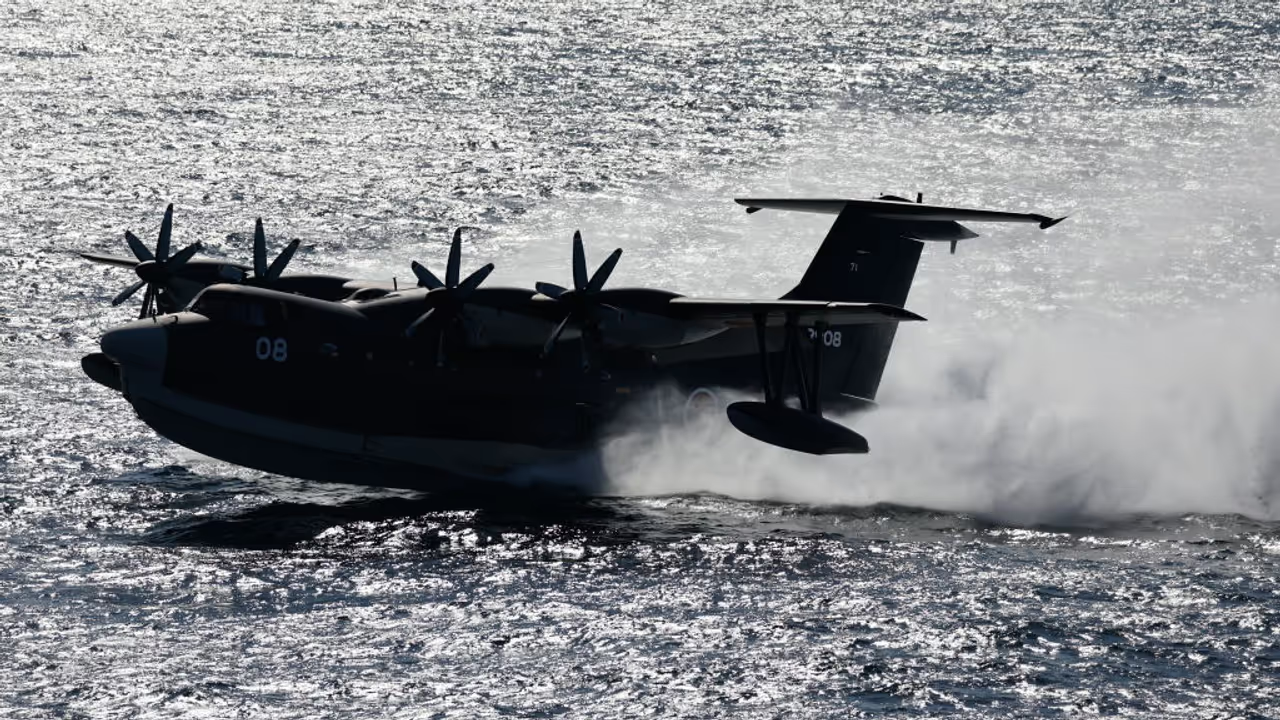
Indian Navy plans to lease four amphibious aircraft for coastal surveillance, SAR, and maritime security, enabling rapid response across island territories without long-term infrastructure delays.
New Delhi: The defence ministry has issued a Request for Information (RFI) to acquire four fixed-wing amphibious aircraft on a four-year wet lease to boost reconnaissance, surveillance, and search-and-rescue capabilities.
Under a wet lease, the lessor is responsible not only for providing the aircraft but also for supplying the full crew (flight deck and cabin), maintenance, and insurance. This will allow the Indian Navy to gain immediate operational capability without waiting for long-term infrastructure or training.
Given India’s vast coastline, island territories such as Andaman & Nicobar and Lakshadweep, and maritime threats like terrorism, piracy, and smuggling, amphibious aircraft that can take off and land on both water and conventional runways are expected to play a crucial role.
Related Articles

Why Amphibious Aircraft Are Needed
Amphibious fixed-wing aircraft are versatile and can operate from water bodies or conventional airstrips. They can directly deliver troops, medical teams, relief materials, or equipment during emergencies.
The primary roles of the amphibious aircraft would be to carry out operational logistics support, long-range search and rescue, special operations, humanitarian aid, and casualty evacuation. The secondary roles would include anti-piracy, anti-narcotics support, and maritime patrol.
In areas like Andaman, Nicobar, and Lakshadweep, these aircraft can deliver rapid assistance during maritime accidents, shipwrecks, or natural disasters.
RFI Timeline and Eligibility
The lessors are required to fill out a specified response form and submit it by March 05, 2026.
As per the RFI, the ministry has sought responses only from Original Equipment Manufacturers (OEMs) or authorised lessors.
Design Requirements and Equipment
As per the RFI, the aircraft must have a corrosion-resistant design to withstand the salty, humid maritime environment and should be equipped with advanced navigation, communication, and safety systems for long-range operations.
In addition, the aircraft should feature advanced avionics, secure communication, satellite-based navigation, survival equipment, sensors, and visual aids for long-range search-and-rescue missions.
Current Status of the Indian Navy
As of now, the Indian Navy does not have any fixed-wing amphibious aircraft in service.
India and Japan had earlier been discussing the acquisition of the ShinMaywa US-2 aircraft, but the proposal did not materialise due to cost and other conditions. This is the reason the Navy is opting for a leased option to gain immediate operational capability.