- Home
- India
- How Many Times Has India Used Essential Commodities Act? A Look At Key Decisions Since 2020
How Many Times Has India Used Essential Commodities Act? A Look At Key Decisions Since 2020
India has invoked Essential Commodities Act for steady LPG supply amid global tensions. The Act has been used several times, including during Covid-19 lockdown, to control wheat prices in 2023 and 2025, and to monitor rising tur dal prices in 2022.
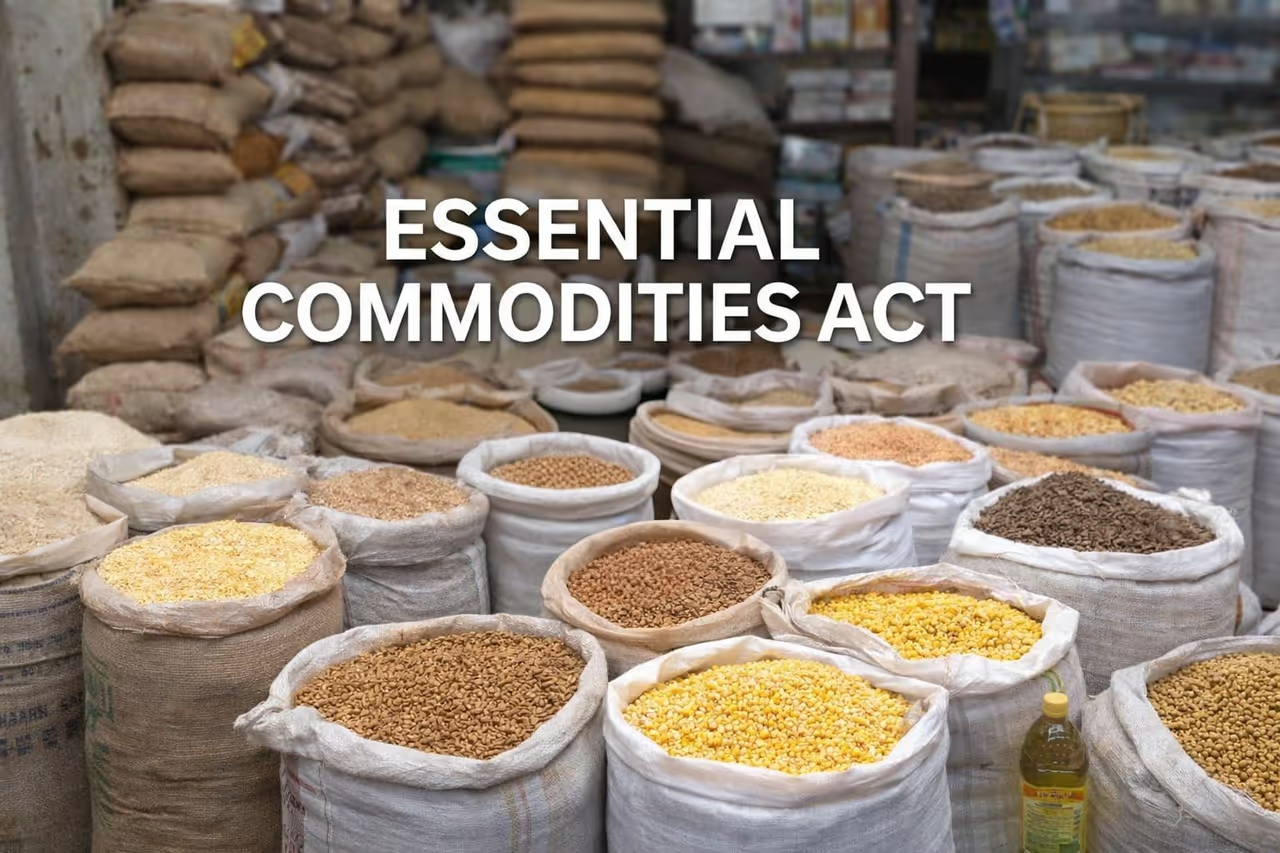
Essential Commodities Act: When and why the government applies it
The Indian government has invoked the Essential Commodities Act (ECA) to ensure the steady supply of domestic LPG in the country. The move comes amid tensions linked to the Iran war and Middle East crisis, which could affect global energy supplies.
The government said the decision aims to make sure LPG meant for Indian households remains available within the country and that traders do not hoard supplies.
This is not the first time the law has been used. Over the years, the central government has applied the Essential Commodities Act several times to control prices, prevent hoarding and protect food security.


What the Essential Commodities Act means
The Essential Commodities Act is a law that allows the government to control the production, supply and distribution of important goods. These goods include items such as food grains, pulses, edible oils, fuel and other daily necessities.
If the government believes that there could be a shortage, sudden price rise or hoarding of these items, it can use the law to impose restrictions such as stock limits.
This helps ensure that essential goods remain available to ordinary people at fair prices.
Recent use of the law to secure LPG supply
The government has now invoked the law to prioritise domestic LPG supply in India. Officials said the step was taken to avoid any shortage in the local market and to stop hoarding by traders.
Global conflicts, including tensions involving Iran, often affect energy supply chains. By using the Essential Commodities Act, the government can ensure that domestic consumers do not face sudden shortages.
August 2025: Wheat stock limits reduced
One of the most recent major uses of the law came on 26 August 2025. At that time, the government reduced stock limits for wheat traders and retailers to control rising prices.
The limit for traders and wholesalers was cut from 3,000 metric tonnes to 2,000 metric tonnes. Retailers were allowed to keep only 8 metric tonnes instead of 10 metric tonnes.
The government also placed limits on processors, allowing them to store wheat up to 60 per cent of their monthly installed capacity, down from 70 per cent earlier.
These restrictions were introduced as part of efforts to control wheat prices ahead of the festive season. The rules will remain in place until 31 March 2026.
April 2020: During the Covid-19 lockdown
The Essential Commodities Act was widely used during the Covid-19 pandemic in April 2020. When the nationwide lockdown was announced, the government applied the law and also asked states to do the same.
This helped ensure that essential items such as food and groceries were available at reasonable prices.
Due to labour shortages during the lockdown, production of many goods had slowed down. To prevent hoarding and black marketing, the government introduced stock limits and price controls.
Authorities also encouraged increased production to stabilise supply.
September 2020: Reforms to the law
Later in September 2020, the government introduced changes to the Essential Commodities Act through Parliament.
The changes were meant to support economic recovery after the lockdown.
Under the reforms, stock limits on items such as grains, pulses, potatoes, onions, edible oil seeds and edible oils were relaxed.
New conditions were also introduced, meaning stock limits could be imposed only under specific circumstances such as extreme price rises or emergencies.
August 2022: action on rising pulse prices
The government again used the law in August 2022 when retail inflation remained above seven per cent.
At that time, officials were concerned about rising prices of tur (pigeon pea) dal.
Heavy rainfall and waterlogging in major producing states such as Karnataka, Maharashtra and Madhya Pradesh had slowed sowing of the kharif crop.
Because of this, prices began to rise from mid-July.
The government applied the Essential Commodities Act and directed states to monitor and verify the stock of tur dal held by traders.
September 2023: steps to control wheat prices
In September 2023, the government once again imposed stock limits on wheat.
The move was taken to prevent a possible rise in wheat prices.
Stock limits for traders, wholesalers, retailers, large retail chains and processors were reduced from 3,000 metric tonnes to 2,000 metric tonnes.
Authorities also accused hoarders of creating artificial shortages in the market.
All wheat traders were asked to register on the government’s stock monitoring portal and update their stock levels every week.
December 2023: further tightening of wheat limits
The government tightened these restrictions further in December 2023.
Because prices of wheat and wheat flour were still high in several regions, stock limits were reduced again. The limit for traders and wholesalers was lowered to 1,000 metric tonnes.
Retailers were allowed to keep only 5 metric tonnes, down from 10 metric tonnes earlier.
Processors were allowed to store wheat up to 70 per cent of their monthly installed capacity.
Officials said the step was necessary to protect the country’s overall food security.
A tool used in times of economic stress
The Essential Commodities Act has repeatedly been used during difficult situations such as pandemics, inflation spikes or supply shortages.
Each time the government applies the law, the goal is similar: prevent hoarding, stabilise prices and make sure essential goods remain available.
While the law is not used constantly, it becomes an important policy tool when markets show signs of stress.
Stay updated with the Breaking News Today and Latest News from across India and around the world. Get real-time updates, in-depth analysis, and comprehensive coverage of India News, World News, Indian Defence News, Kerala News, and Karnataka News. From politics to current affairs, follow every major story as it unfolds. Get real-time updates from IMDon major cities weather forecasts, including Rain alerts, Cyclonewarnings, and temperature trends. Download the Asianet News Official App from the Android Play Store and iPhone App Store for accurate and timely news updates anytime, anywhere.