- Home
- India
- What Is Reservation Hatao Andolan? Inside The Instagram Campaign Against Caste-Based Quotas
What Is Reservation Hatao Andolan? Inside The Instagram Campaign Against Caste-Based Quotas
Reservation Hatao Andolan (RHA) has emerged as a growing Instagram-led campaign demanding an end to caste-based reservations in India. It says govt jobs/college admissions should be based on merit and support should reach economically weaker students
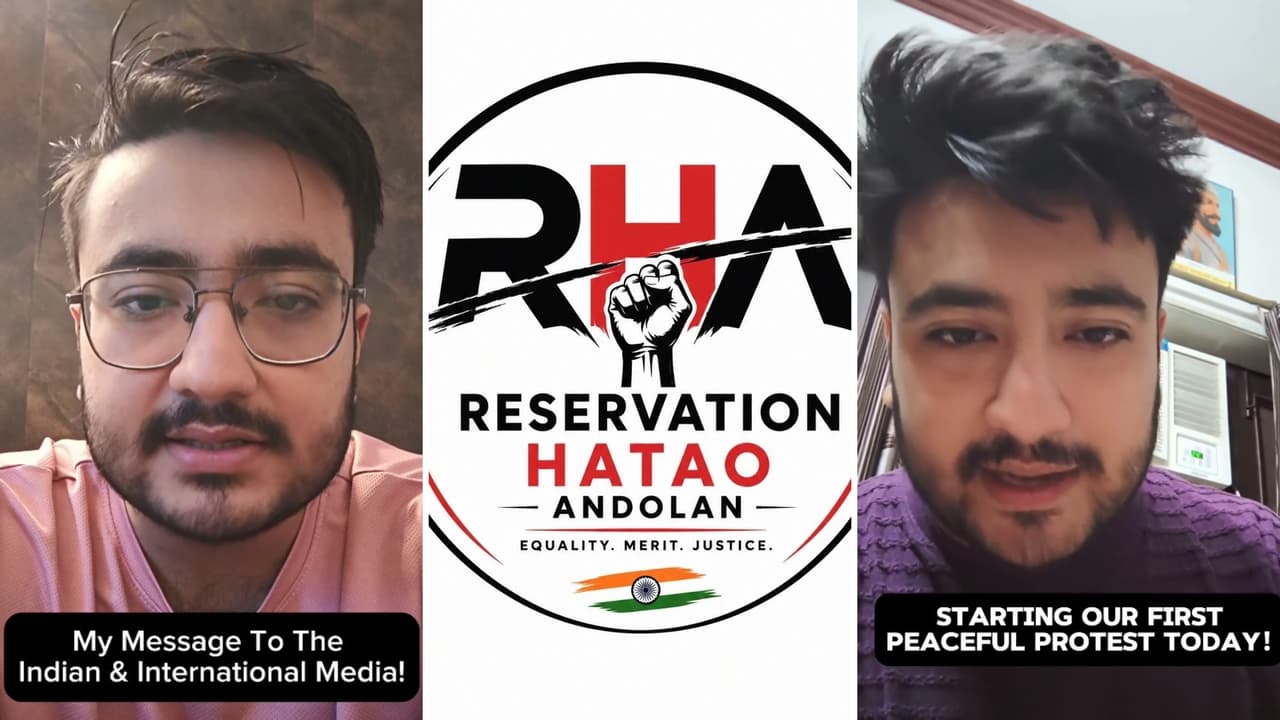
What is Reservation Hatao Andolan?
The success of the Cockroach Janata Party's social media campaign and its protest at Delhi's Jantar Mantar appears to have encouraged a new wave of online activism around other issues. One of the latest campaigns to attract attention is the Reservation Hatao Andolan (RHA), an Instagram-led movement that calls for an end to caste-based reservations in India.
The campaign has quickly built a large following on Instagram. Its account has reportedly reached nearly 5 million followers, putting it among the most visible new issue-based digital campaigns on the platform.
The campaign is not alone. Another account called Reservation Removal Sangh (RSS) has also emerged with a similar anti-reservation message, although its following is much smaller. At the same time, the E20 Janta Party, a separate social media campaign focused on ethanol-blended petrol, has also been gaining followers.
Together, these accounts point to a wider change in how young Indians are using social media to raise political and public issues.
But what exactly is the Reservation Hatao Andolan, what does it want and why has it attracted so much attention?


What is Reservation Hatao Andolan?
Reservation Hatao Andolan is a social media campaign that opposes caste-based reservation in India. The campaign's supporters argue that admission to colleges and recruitment for government jobs should be based on merit, marks and ability rather than caste.
The administrators and supporters of the campaign have also called for economic support for students and young people who come from financially weaker backgrounds. Their argument is that government assistance should be based on economic need so that people facing financial hardship can get opportunities to study and build careers.
The campaign uses slogans such as "Reservation is discrimination" to put forward its position.
Its supporters say they want to turn the Instagram campaign into a much larger public movement, similar in scale and reach to the recent Cockroach Janata Party-led agitation.
However, there is an important difference between the two campaigns.
The CJP's protest focused on examination reforms and the NEET-UG controversy, an issue that directly affected millions of students and their families. Reservation, on the other hand, is a deeply sensitive issue linked to India's social structure, history and Constitution.
Any campaign seeking major changes to the reservation system is therefore likely to trigger a much wider and more complex debate.
Why has RHA suddenly become so popular?
The rise of RHA comes at a time when social media is playing a bigger role in public campaigns.
Instagram, in particular, has become an important platform for young people to share political views, organise campaigns and build communities around specific issues.
The recent CJP movement showed how quickly a campaign that begins online can move into the real world.
The Cockroach Janata Party started as a satirical social media account but later became associated with a large protest at Jantar Mantar. The campaign attracted students, young people and public figures, and its activities received significant attention online.
The protest also gained momentum after activist Sonam Wangchuk joined the agitation and went on a hunger strike.
The movement eventually ended after the government held talks with its representatives and agreed to consider several demands linked to examination reforms. The resignation of then Education Minister Dharmendra Pradhan further fuelled discussions about the influence of youth-led digital campaigns.
The CJP's success appears to have created a new template for online activism.
Instead of waiting for traditional organisations to build a movement over months or years, young users can now create an Instagram account, post short videos and slogans, and quickly gather supporters around a particular demand.
RHA appears to be following this model.
Its rapid growth suggests that there is a sizeable group of social media users who want the reservation system to be debated and, in their view, changed.
What does RHA want?
At the heart of the campaign is a demand to remove caste-based reservations.
Supporters of the movement believe that government jobs and college admissions should be decided on the basis of marks, talent and qualifications.
They argue that a person's caste should not determine their access to educational opportunities or employment.
The campaign also puts forward the idea of economic support for those who need it.
According to this argument, students from poor families should receive financial help regardless of their caste. Supporters say this would allow economically weaker young people to compete for education and employment without relying on caste-based quotas.
This is the central idea behind the campaign's message: replace caste-based reservation with a system that gives financial assistance to people based on economic need.
RHA on why to reconsider the current reservation system:
1. Merit is overlooked
In many cases, students with lower marks benefit from reservation, while students with higher marks may miss out on opportunities.
2. Unfairness towards the general category
Students from the general category may not always get equal opportunities, even when they come from economically weaker families.
3. Competition is affected
When students with lower marks receive opportunities because of reservation, it can affect the overall quality and level of competition.
4. Economically weaker people are overlooked
Many economically weaker students from the general category are also deprived of opportunities, even though they may not receive any special support.
5. The system needs regular review
The reservation system should be reviewed and reconsidered from time to time, based on changing circumstances and needs.
6. It can encourage caste-based divisions
Caste-based reservation politics can contribute to divisions in society. The campaign calls for ending such politics and building a stronger nation.
Reservation Hatao Andolan (RHA) demands:
✓ Equal opportunities for everyone.
✓ Selection should be based on merit.
✓ Economically weaker sections should receive financial support.
✓ Reservation policies should be reviewed fairly from time to time.
✓ Caste-based politics should end; the nation should come first.
Reservation Hatao Andolan (RHA) claims they want to uplift and they believe that equal opportunity equals to strong India.
However, supporters of reservation argue that the system was created not simply to address poverty but also to tackle centuries of social discrimination, exclusion and unequal access to education and employment.
They say that economic hardship and social discrimination are not the same thing.
This is why the reservation debate cannot be reduced to a simple argument about who is rich or poor. It involves questions about social equality, representation, historical disadvantage and access to opportunities.
The constitutional debate around reservation
India's reservation system has a long and complex history.
Reservations were introduced to improve representation and opportunities for communities that faced social and educational disadvantage. Over the years, the system has expanded and changed through constitutional provisions, laws and court judgments.
Today, reservations exist in education, government employment and elected bodies in different forms.
The system has also been a subject of political debate for decades.
Supporters say reservations have helped historically disadvantaged communities gain access to education and government employment. They argue that removing them without addressing social inequality could make existing gaps even wider.
Critics, however, argue that the system should be changed because they believe it can affect opportunities for people who do not benefit from quotas, particularly those from economically weaker families outside reserved categories.
RHA's campaign is built around this criticism.
But any major change to India's reservation framework would require a serious legal and constitutional process. A social media campaign, regardless of how many followers it gains, cannot by itself change the country's reservation laws.
This is one of the biggest differences between online popularity and actual policy change.
Is RHA the new CJP?
The rapid rise of RHA has led to comparisons with the Cockroach Janata Party.
Both campaigns have used Instagram and social media to reach young audiences. Both have also built their messaging around a specific public issue and used short, easy-to-share content to attract attention.
However, their issues are very different.
The CJP movement was built around demands linked to NEET-UG, examination reforms and accountability following allegations of irregularities in the medical entrance examination.
The reservation debate is much broader.
It affects education, government employment, social justice and political representation. It also involves communities with very different experiences and opinions.
For that reason, it would be too early to say whether RHA can become a movement on the same scale as CJP.
Its follower count shows that the campaign has managed to attract significant online interest. But converting Instagram followers into sustained public support, organised protests and policy change would be a much bigger challenge.
Why Instagram is being called Gen Z's new Jantar Mantar
The growth of campaigns such as CJP and RHA has led to a wider discussion about Instagram's role in public life.
For decades, Jantar Mantar in New Delhi has been one of India's best-known locations for public protests.
Today, social media platforms are creating a kind of digital protest space.
A campaign can start with a single Instagram account. Supporters can share posts, create reels, use hashtags and encourage others to join. The message can reach people across the country without the organisers first having to arrange a physical gathering.
This is particularly important for Gen Z, a generation that spends a large part of its time online.
For young users, Instagram is not only a platform for entertainment. It is also a place where they discuss politics, education, jobs, social issues and public policy.
This does not mean that every online campaign will become a real-world movement. Many social media campaigns lose momentum after a few weeks.
But the CJP protest has shown that digital campaigns can, under the right circumstances, move beyond social media and enter the political conversation.
That may explain why new issue-based accounts are now appearing on Instagram.
The rise of other digital campaigns
RHA is part of a wider trend.
Another account, called Reservation Removal Sangh, has reportedly gained more than 1,500 followers while promoting a similar position against caste-based reservation.
The E20 Janta Party is another example of a social media campaign built around a specific public demand.
🚨 E20 is a serious issue affecting millions of vehicle owners. The govt must provide accountability and transparency on this matter.
— E20 JANTA PARTY (@E20Party) July 27, 2026
The E20 campaign is not a registered political party. It is an online movement focused on ethanol-blended petrol.
Its supporters say that while the government can make E20 petrol available, consumers should also have the option of buying petrol without ethanol. They argue that customers should be able to choose what fuel they want to use.
The campaign has also attracted a growing following on Instagram.
The emergence of these accounts suggests that social media users are increasingly adopting the language and style of political parties to promote single-issue campaigns.
The names may sound like political organisations, but many of these groups are not registered political parties. Their strength comes mainly from online engagement and public support.
Can RHA influence government policy?
That remains uncertain.
Having millions of followers can give a campaign visibility, but it does not automatically translate into political influence.
For RHA to become a major national movement, its organisers would have to answer several difficult questions.
How would they build support beyond Instagram?
Would they organise peaceful protests?
Would they seek legal changes?
How would they respond to groups that strongly support reservations?
And, most importantly, what alternative system would they propose for communities that currently depend on reservations for access to education and government employment?
These questions are likely to shape the future of the campaign.
The reservation debate is also expected to remain politically sensitive because different communities have different views on the issue.
Any attempt to change the existing system would need to consider constitutional provisions, court rulings and the concerns of communities that have historically faced discrimination.
A new phase of digital activism
The rise of Reservation Hatao Andolan shows how India's protest culture may be changing.
Young people are increasingly using social media not just to react to events but to create their own campaigns around issues they care about.
The success of the CJP movement appears to have shown that an online campaign can attract attention, move to the streets and force political parties and governments to respond.
Now, RHA is attempting to build its own movement around the reservation debate.
Whether it succeeds will depend on much more than its Instagram follower count.
For now, the campaign has succeeded in bringing the issue into the social media spotlight. It has also added a new chapter to the debate over reservation, merit and economic support in India.
The bigger question is whether Instagram can once again turn a fast-growing online campaign into a sustained movement in the real world.
For RHA, that journey has only just begun.
Stay updated with the Breaking News Today and Latest News from across India and around the world. Get real-time updates, in-depth analysis, and comprehensive coverage of India News, World News, Indian Defence News, Kerala News, and Karnataka News. From politics to current affairs, follow every major story as it unfolds. Get real-time updates from IMD on major cities weather forecasts, including Rain alerts, Cyclone warnings, and temperature trends. Download the Asianet News Official App from the Android Play Store and iPhone App Store for accurate and timely news updates anytime, anywhere.