
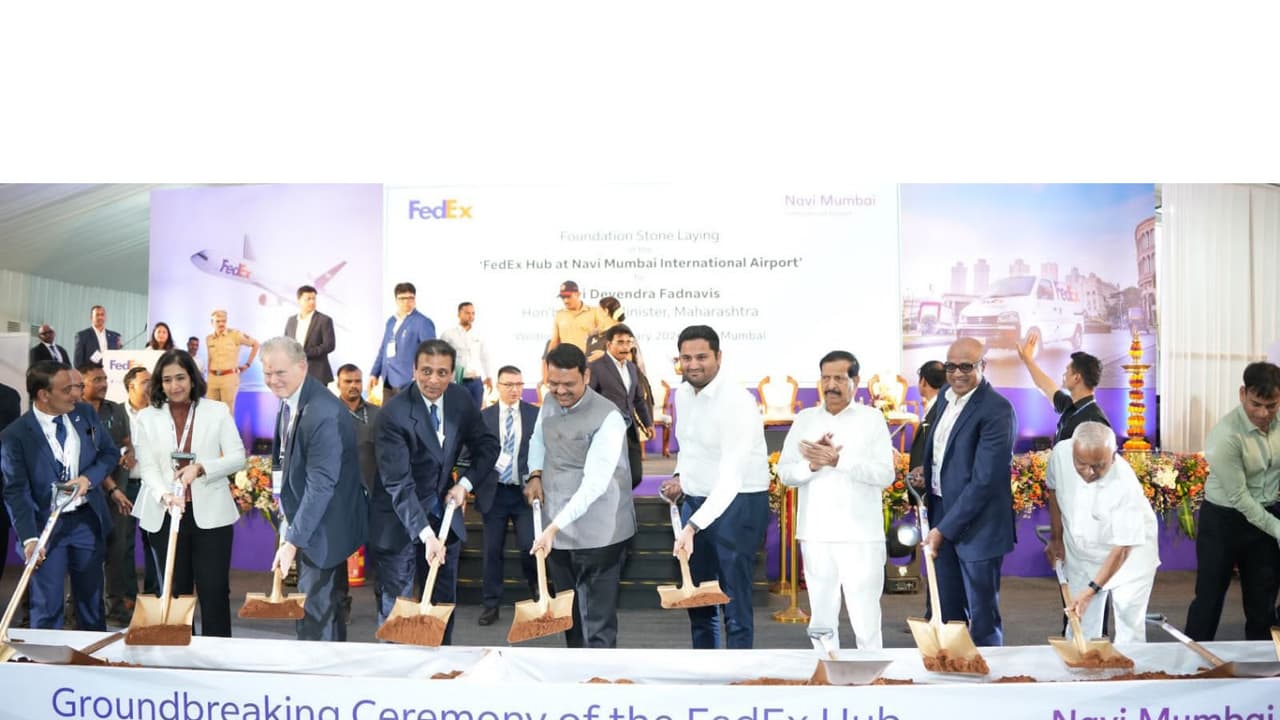
FedEx and NMIA broke ground on a Rs 2,500 crore automated air cargo hub. The 300,000 sq. ft. facility, a partnership with Adani, aims to boost Western India's trade corridor and is expected to create over 6,000 jobs.
FedEx's Major Investment in Indian Logistics
FedEx and Navi Mumbai International Airport (NMIA) on Wednesday broke ground on FedEx's fully automated air cargo hub, advancing capacity in India's largest international trade corridor and strengthening its role as an integrated logistics and trade gateway for Western India.
According to a joint statement, the Rs 2,500 crore long-term investment by FedEx will support the proposed 300,000 sq. ft. facility, designed as a regional consolidation and redistribution hub and developed in partnership with Adani Airport Holdings Ltd. (AAHL).
The hub leverages NMIA's multimodal infrastructure to strengthen Western India's international trade corridor. Once operational, the hub is expected to create more than 6,000 direct and indirect employment opportunities across logistics, warehousing, transportation and allied services.
The ceremony was held in the presence of Chief Minister of Maharashtra, Devendra Fadnavis; Raj Subramaniam, President and CEO, FedEx; Richard Smith, CEO, Airline and COO, International, FedEx; Kami Viswanathan, President, FedEx Middle East, Indian Subcontinent and Africa (MEISA); and Jeet Adani, Director, AAHL.
Strategic Vision and Impact
Jeet Adani, Director, AAHL, said: "This development reflects NMIA's long-term vision of building integrated infrastructure that strengthens India's trade competitiveness. With its proximity to Jawaharlal Nehru Port, industrial corridors and multimodal transport networks, NMIA is uniquely positioned to support high-growth export sectors and enhance Maharashtra's role as a global logistics gateway."
Kami Viswanathan, President, FedEx MEISA, said: "India's competitiveness in global trade will increasingly depend on the reliability and speed of its logistics infrastructure. Establishing this hub at NMIA allows us to integrate global network strength with India's fastest-growing trade corridor, providing greater certainty, speed and efficiency to customers."
Advanced Technology and Enhanced Capabilities
Equipped with advanced automated sorting systems, dimensional scanning, high-speed screening technology and dedicated aircraft parking bays, it will enable simultaneous processing of inbound and outbound shipments and enhance routing flexibility and transit time predictability, particularly for high-value and time-sensitive sectors such as electronics, engineering goods, pharmaceuticals and perishables. The improved reliability is also expected to strengthen export-import capabilities for micro, small and medium enterprises (MSMEs) while contributing to lower logistics costs and faster turnaround times.
NMIA's Long-Term Cargo Strategy
NMIA's cargo infrastructure is planned to commence with an initial handling capacity of approximately 0.5 million metric tonnes (MMT) annually, scaling in phases to around 3.25 MMT in its final development stage. This calibrated capacity expansion supports the airport's long-term strategy of positioning the Mumbai Metropolitan Region (MMR) as one of India's most advanced air freight and logistics gateways. (ANI)
(Except for the headline, this story has not been edited by Asianet Newsable English staff and is published from a syndicated feed.)