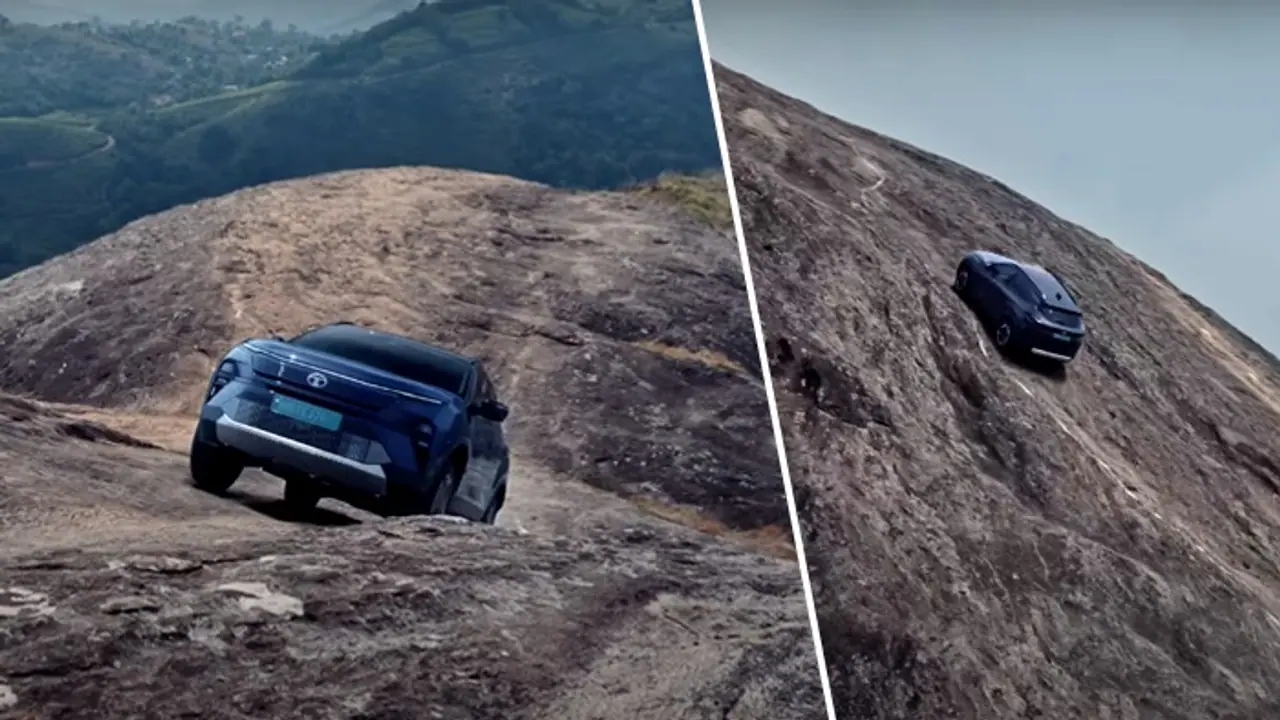
Tata Motors showcases the Harrier.ev's off-road capabilities in a video featuring the EV conquering Kerala's Elephant Rock. The video highlights features like 360-degree camera, off-road cruise control, and terrain-specific driving modes.
Tata Motors is preparing for the June 3 introduction of the Harrier.ev. The business has published a video demonstrating the electric SUV's off-road capabilities in advance of the big event. The Harrier.ev climbs the well-known rocky outcrop in the center of Kerala's verdant tea gardens in the video, Elephant Rock Challenge. Elephant Rock, which has a strong rise towards the finish, is 3937 feet high and may be climbed in three phases.

What can you expect from Tata Harrier.ev?
Some of the features available on the Harrier.ev are demonstrated in the movie, including the 360-degree camera, off-road cruise control, and a rotary driving mode selector with three terrain modes: rock crawl, snow, and sand. Additionally, the EV offers Eco and Boost modes.
Related Articles

The footage highlighted several features, including an off-road assist mode—which functions like an off-road creep setting with a fixed low speed—and a 360-degree camera system that offers a transparent bonnet view, typically seen in more premium SUVs.
With its dual-motor quad-wheel-drive (QWD) system and several high-end amenities, it positions itself as a formidable challenger in the electric SUV market, taking on competitors such as the Mahindra XUV.e9.
With headlights and DRLs that resemble those of the ICE version, the Harrier EV has the aggressive and muscular design of the original vehicle, but it has a new grille and bumper that give it a distinctive look. Sharp creases, smooth surfaces, and crisp lines characterize its appearance. Its aerodynamics and futuristic appearance are enhanced by a continuous LED DRL strip with stunning lighting effects and specially made turbine blade alloy wheels.
While detailed specifications and pricing are yet to be revealed, Tata Motors is already focusing on enhancing India’s EV infrastructure through its Open Collaboration 2.0 initiative.