Experts say Saudi Arabia’s top civilian honour for Field Marshal Asim Munir signals a security bargain, not prestige, exposing Pakistan’s de-facto military rule and Riyadh’s strategic dependence on Islamabad.
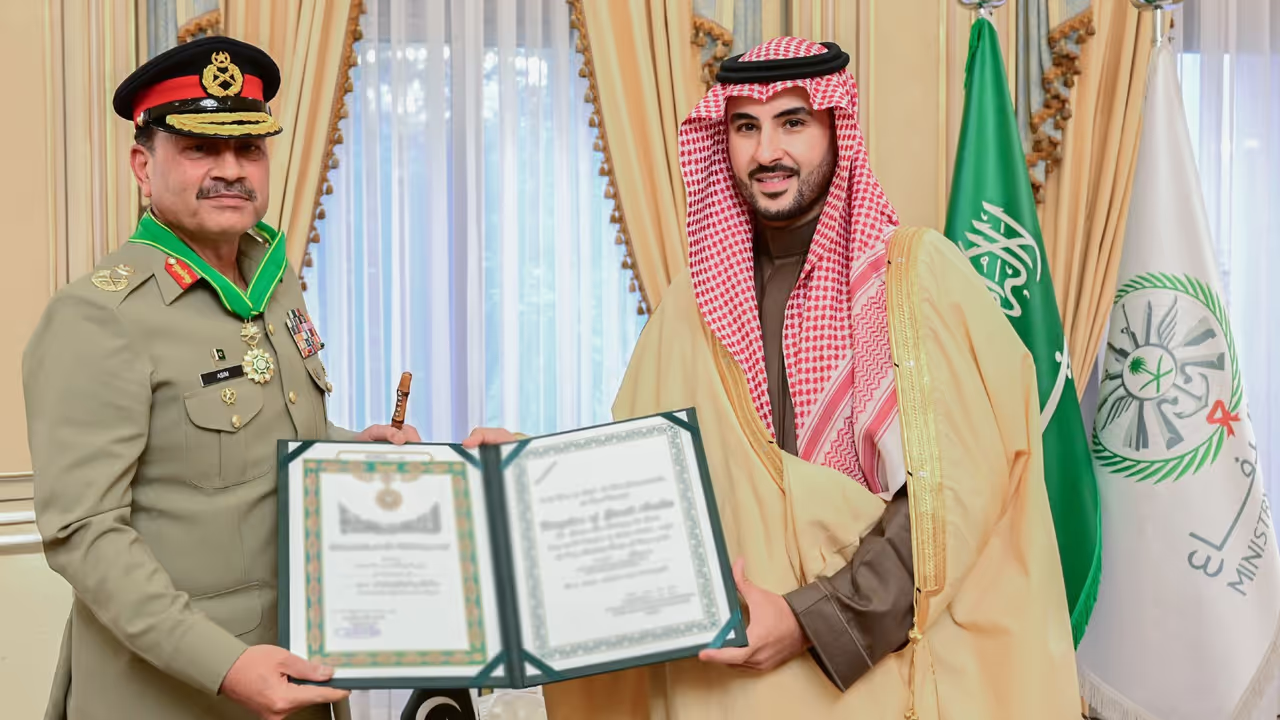
For Pakistan’s Field Marshal Syed Asim Munir, the conferral of Saudi Arabia’s highest civilian honour — the King Abdulaziz Medal of Excellence — was wrapped in ceremonial grandeur. Yet beyond the polished optics and royal decrees, the moment exposed a harsher reality: Pakistan’s military-first statecraft being quietly rewarded on the global stage.
Bestowed under a Royal Decree by King Salman bin Abdulaziz Al Saud, the honour arrives as Pakistan’s civilian institutions continue to hollow out, eclipsed by an all-powerful Chief of Defence Forces whose authority now stretches well beyond the barracks and into the heart of governance.
Related Articles

Not Just an Award, But an Endorsement
According to Pakistan Army’s statement, Saudi leadership praised Munir’s “professionalism and strategic outlook” and his role in strengthening “brotherly ties” between the two nations. Munir responded with gratitude, calling the honour a reflection of “enduring bonds” and reaffirming Pakistan’s commitment to the Kingdom’s “security, stability, and prosperity.”
Yet critics argue that the ceremony was less about symbolism and more about mutual dependence rooted in security bargains, not shared values.
“There Are No Free Lunches in the World”
Speaking to Asianet Newsable English, Major General Sudhakar Jee (Retd) offered a blunt assessment that cuts through diplomatic niceties.
“There are no free lunches in the world. One has to pay a price for everything in some form or another. The award is a strong sign of the mutual dependency between Saudi Arabia and Pakistan in terms of security and survivability. The bargaining chip for Saudi Arabia is extending recognition to the all-powerful and supreme Munir, strengthened and supported by Pakistan’s 27th constitutional amendment,” he said.
The message is unmistakable: the medal is not free — it is transactional. Saudi Arabia gains a security guarantor, while Munir gains international legitimacy.
Pakistan’s De-Facto Ruler in Uniform
Munir’s visit also included a meeting with Prince Khalid bin Salman bin Abdulaziz Al Saud, Saudi Arabia’s Defence Minister. Official statements spoke of discussions on regional security, defence cooperation and geopolitical challenges.
But beneath the scripted diplomacy lies a harder truth: Pakistan today functions under de-facto military rule, with Munir as its unquestioned centre of power.
That reality was highlighted by Alok Bansal, Executive Vice President of India Foundation and Secretary General of the Asian Eurasian Human Rights Forum (AEHRF).
“This is actually a manifestation of Saudi Arabia – Pakistan defence pact since the two countries signed a defence pact months back. Currently, Pakistan is being de-facto controlled by Field Marshal Asim Munir. This is just Saudi Arabia’s acknowledgement of Pakistan’s leadership," Bansal told Asianet Newsable English.
In essence, Riyadh is not honouring Pakistan’s democracy — it is perhaps recognising who truly runs the country.
Brotherhood or Strategic Convenience?
Pakistan’s leadership has long relied on Gulf patronage — economic bailouts, oil concessions, and diplomatic backing. In return, it has offered military manpower, intelligence cooperation and strategic alignment.
This medal fits neatly into that pattern. While Pakistan’s economy struggles and its political space shrinks, its military chief is rewarded abroad, reinforcing a system where external validation replaces internal accountability.
The Cost Paid at Home
As Munir is feted overseas, ordinary Pakistanis grapple with inflation, political repression, and a vanishing democratic voice. The contrast is stark: honours for the general, hardship for the people.
The King Abdulaziz Medal may glitter, but it also reflects Pakistan’s uncomfortable reality — a nation increasingly defined not by institutions or elections, but by the dominance of its military elite.
In that sense, the award is not just about Saudi Arabia’s trust in Munir. It is a quiet acknowledgment that Pakistan, once again, has chosen power over democracy — and the world is willing to play along.