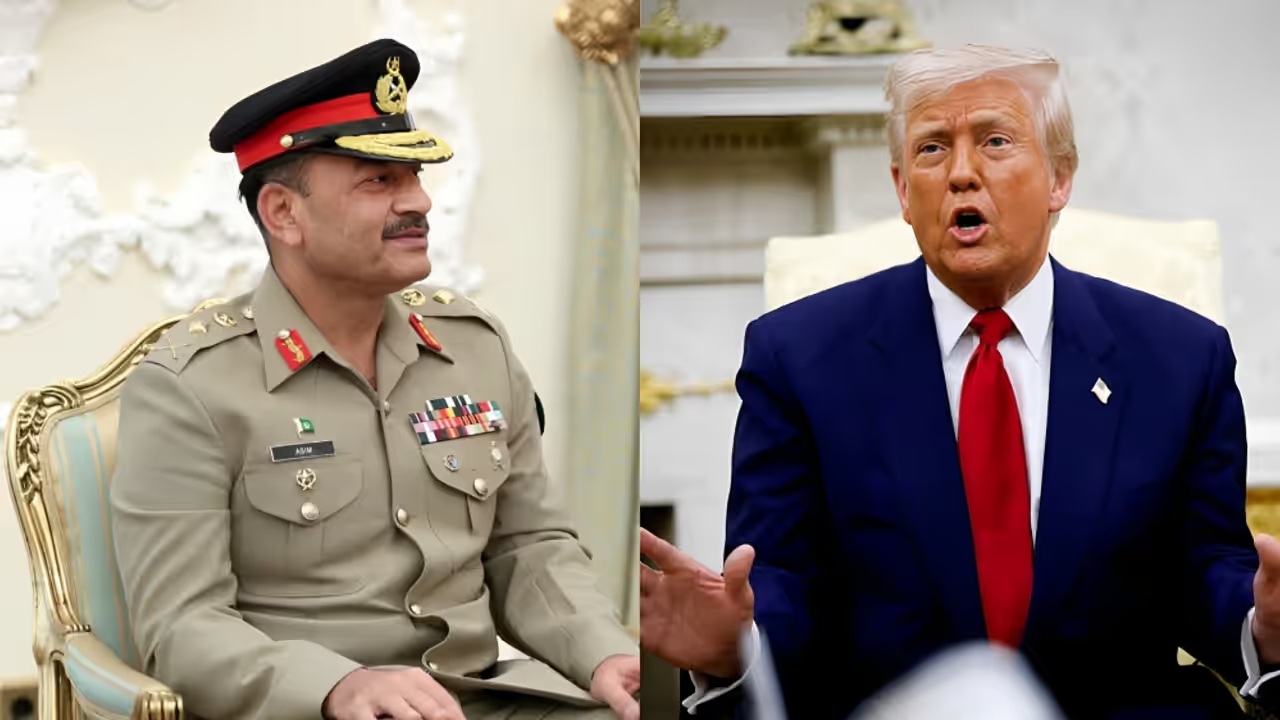
Pakistan's Chief of Defence Forces, Field Marshal Asim Munir’s claim of “divine help” during India’s Operation Sindoor has triggered online trolling, exposing Islamabad's attempt to mask its setback after India’s strikes on terror camps.
Pakistan’s Chief of Defence Forces, Field Marshal Asim Munir, is facing widespread trolling and criticism after claiming that Islamabad received “divine help” during its four-day military confrontation with India in May—triggered by India’s precision strikes on terror infrastructure under Operation Sindoor.
Munir’s remarks, delivered at the National Ulema Conference in Islamabad recently, have sparked ridicule across social media and strategic circles, with many sarcastically asking whether “divine intervention” was Pakistan’s only explanation for its performance after India’s decisive, precision strikes dismantled terror camps across the border.
Related Articles

‘We Felt It’: Munir’s Claim of Divine Intervention
Referring to the clashes that followed India’s May 7 strikes, Munir told the gathering that Pakistan’s armed forces experienced supernatural assistance during the conflict.
“We felt it,” he said, claiming that the military received “divine intervention” during Pakistan’s drubbing against India.
The statement has since become a flashpoint online, with one user stating, “Yes, that divine intervention was BrahMos!”
“They should keep feeding this churan to their masses. The more they stay in denial, the more they won't be prepared,” added another user.
A third user remarked, "Field Marshal Munir credits "divine intervention" for Pakistan’s survival in the May conflict — but even divine forces can’t fix strategic blunders. When airbases and terror camps are hit before a ceasefire plea, it’s not divine help — it’s a reality check."
Several social media users also ridiculed Munir’s remarks by sharing memes of US President Donald Trump, who has repeatedly claimed credit for ending the conflict.
Operation Sindoor: India’s Clear Message After Pahalgam
India launched Operation Sindoor on May 7 in retaliation for the Pahalgam terror attack, which killed 26 civilians. The Indian strikes were aimed at terror launchpads and infrastructure, sending an unambiguous message that cross-border terrorism would invite direct consequences.
The operation triggered four days of intense military exchanges, which ended with an understanding to stop military actions on May 10. Indian officials have maintained that the operation was calibrated, precise, and focused solely on terror targets—underscoring New Delhi’s zero-tolerance policy.
Religious Overtones and Political Messaging
Munir’s speech went well beyond military matters, leaning heavily into religious symbolism. Drawing parallels between Pakistan and the Islamic state established by the Prophet 1,400 years ago in the Arab region (modern-day Saudi Arabia), he made a sweeping claim about Pakistan’s place in the Islamic world.
There are 57 Islamic countries in the world, Munir said, and among them, “God gave us the honour of being the protectors of Haramain Sharifain.”
Observers have noted that such assertions ring hollow given Pakistan’s own struggles with internal extremism and global scrutiny over terror links.
Warning to Taliban: ‘Choose Between Pakistan and TTP’
In a message to Afghanistan’s Taliban regime, Munir also demanded that Kabul choose between Islamabad and the Tehrik-i-Taliban Pakistan (TTP), blaming Afghan nationals for a majority of cross-border terrorism.
“In the TTP formations coming [into Pakistan], 70 per cent are Afghans,” he said. “Is Afghanistan not spilling the blood of our Pakistani children?”
He reiterated that the Taliban must decide “between Pakistan and the TTP,” even as critics point out Pakistan’s own long history of nurturing militant groups as strategic assets.
‘No Jihad Without the State’: Munir’s Selective Doctrine
Attempting to assert control over religious narratives, Munir also said that only the state has the authority to declare jihad.
“No one can issue a fatwa for jihad without the order and permission and will of those vested with the authority,” he told the conference.
The comment has been met with scepticism, given Pakistan’s past tolerance—and at times promotion—of non-state actors invoking jihad beyond state control.