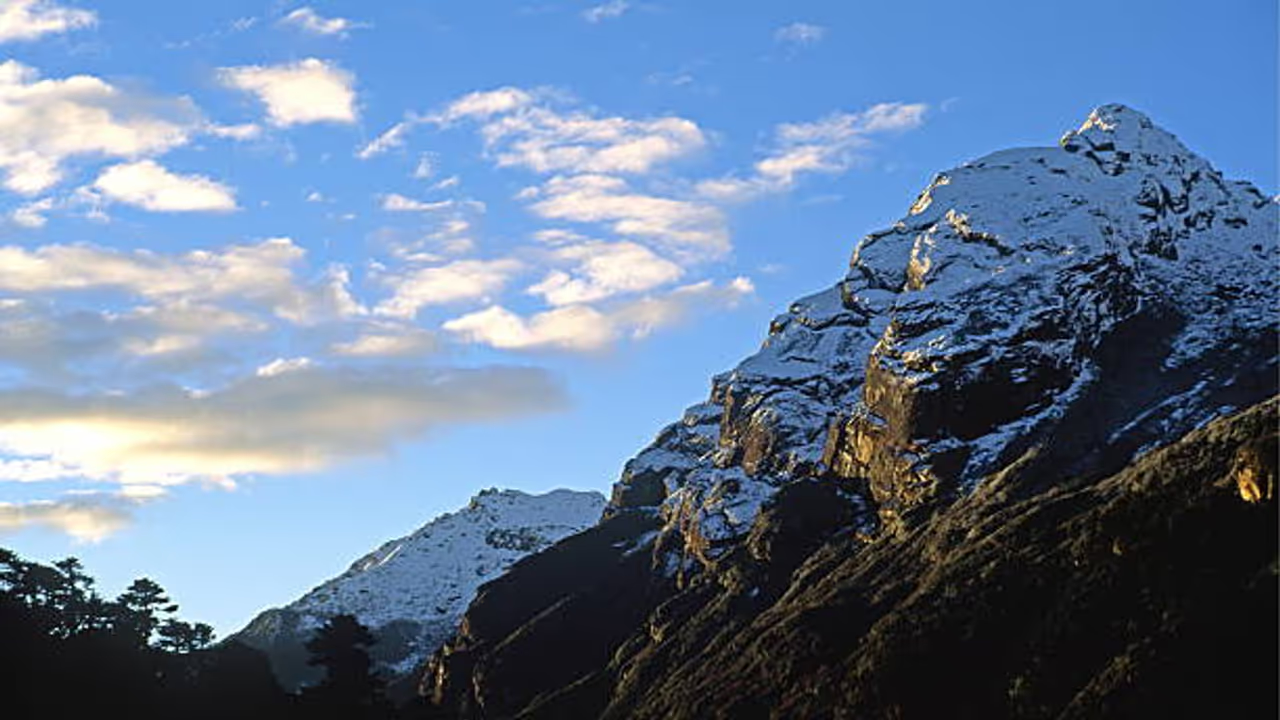
Tucked away at roughly 29°11′00″N, 94°13′06″E in the remote reaches of Arunachal Pradesh, the Puyong communities carry one of the Eastern Himalayas' oldest living tribal traditions.
Tucked away at roughly 29°11′00″N, 94°13′06″E in the remote reaches of Arunachal Pradesh, the Puyong communities carry one of the Eastern Himalayas' oldest living tribal traditions. Here, among dense forests, steep valleys, and rivers that never seem to slow down, the Puyong have built a way of life that's inseparable from the land around them – spiritually, practically, and everything in between. They sit close to the Bokar, Adi, and other Tani groups, acting almost like a cultural hinge point for these frontier regions, and their beliefs and accumulated knowledge still shape how India's northeastern borderlands understand themselves.
Survival here was never simple. Generations of Puyong people worked out how to live with the mountains rather than against them – through jhum, or shifting cultivation, along with hunting, forest gathering, and trade routes that snaked through the highlands.
Jhum farming rotates fields so the forest gets time to recover, which sounds straightforward on paper but actually took centuries of trial and error to get right. That patience shows: the community figured out how to ride out brutal weather, keep the biodiversity around them intact, and use what the land offered without stripping it bare.
Related Articles

Spiritually, everything circles back to Donyi-Polo – the worship of the Sun, Donyi, and the Moon, Polo. It's not unique to the Puyong; several other Tani tribes across Arunachal Pradesh, the Adi, Nyishi, Tagin, Galo, and Apatani among them, hold the same faith. The basic idea is that nature itself is alive with meaning – mountains, rivers, forests, the sky, all of it carries spiritual weight. The Sun stands for truth and protection, the Moon for peace and balance, and together they underpin how the community thinks about harmony, both social and environmental.
Shamans and village elders lead the rituals – chanting, offering sacrifices, running ceremonies for harvests, weddings, and other gatherings that matter to the community. Millet beer shows up often, as do animal offerings and sacred songs, all in service of asking for prosperity, fertility, or protection from sickness and disaster. It hasn't been an easy faith to hold onto as modernization creeps in, but Donyi-Polo institutions and cultural groups have worked hard to keep it alive, and today it still stands as a marker of indigenous identity across the state.
There's a warrior streak running through Puyong history too, tied closely to their sense of independence. Men once carried bows, arrows, and homemade weapons to guard mountain passes and forest land, and their clothing reflected that reality as much as the cold – sleeveless black wool jackets, helmets made from bamboo or animal skin. Women wore woven flax garments patterned in distinctly traditional styles. None of it was purely decorative; it was built for a hard climate and doubled as a statement of who they were.
Trade mattered just as much as farming or fighting. Long before any roads reached this part of Arunachal Pradesh, mountain paths connected the Eastern Himalayas to the Brahmaputra Valley and on into the Tibetan highlands. Traders moved forest products, medicinal herbs, musk, hides, and natural dyes out, and brought salt, wool, iron tools, and household goods back in. That barter economy did more than keep villages fed – it linked isolated mountain communities to a much wider regional world.
Zoom out a bit and the Puyong sit within the larger Tani cultural sphere, one of the most significant indigenous groupings in Arunachal Pradesh. Together, the Adi, Nyishi, Tagin, Galo, and Apatani number in the hundreds of thousands across the state, and despite being scattered across difficult terrain, they share language roots, myths, farming methods, and spiritual beliefs that trace back a long way.
History intervened here too. The region's strategic weight grew during the colonial era, especially after the McMahon Line was drawn up in the 1914 Simla Convention. Once India became independent in 1947, constitutional protections and tribal self-governance arrangements gave indigenous communities a real say over their land, customs, and cultural affairs, a structure that's helped keep things stable in what remains a sensitive border region.
Change is arriving now, though, and fairly quickly. The Vibrant Villages Programme is pushing roads, schools, healthcare, digital connectivity, and tourism infrastructure into these frontier areas. Some villages are getting 4G for the first time, along with better transport links and support for education. The goal is to loosen the isolation a bit and open up work for younger people through eco-tourism, handicrafts, and cultural preservation efforts – though how that balance plays out against tradition is still an open question.
Even so, the Puyong haven't let go of what makes them who they are. Festivals, oral storytelling, bamboo craft, weaving, and sacred ritual are all still very much part of daily life. Elders keep passing down what they know about the forests, rivers, farming, and spiritual practice, and in plenty of villages, traditional songs and dances still carry the community through its seasonal gatherings.
In the end, the Puyong people remain something like living custodians of a Himalayan heritage that's centuries in the making – shaped by resilience, ecological know-how, and a spiritual bond with the land that hasn't faded. In the forests and valleys they call home, they're still holding together a thread that connects ancient indigenous knowledge to the modern identity of India's northeastern frontier.