
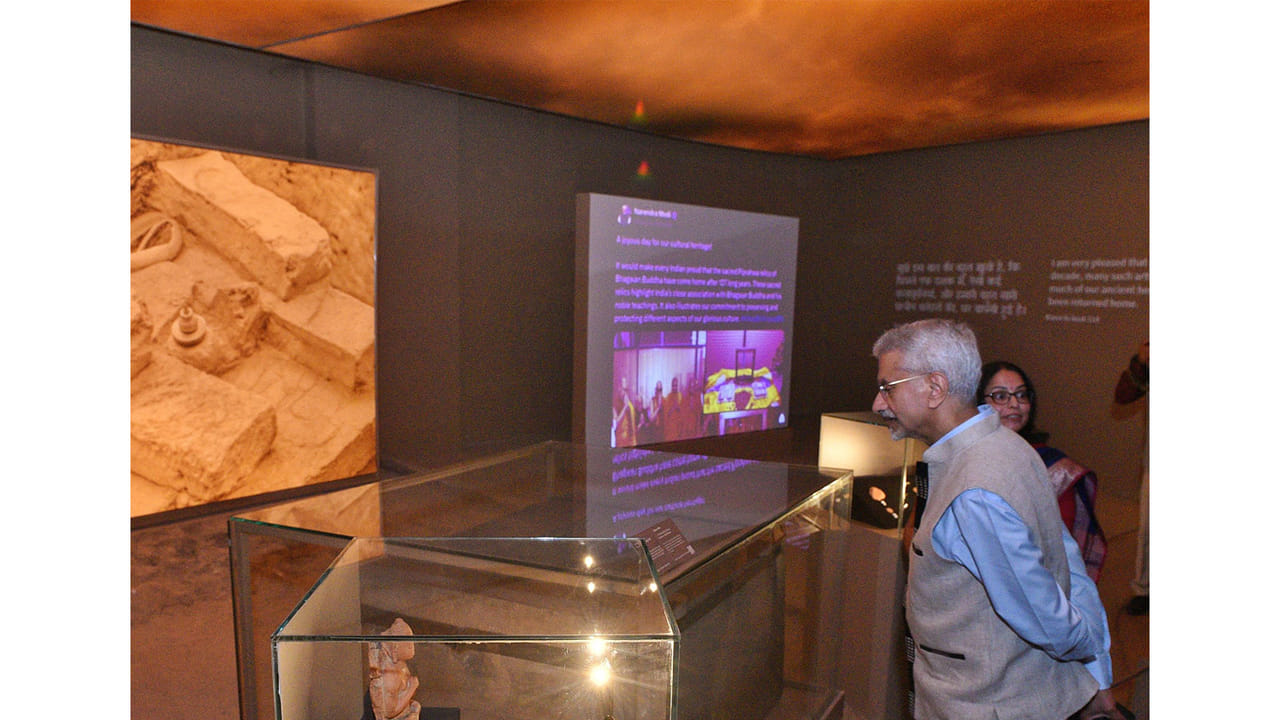
External Affairs Minister S Jaishankar visited the exhibition of Sacred Piprahwa relics of Lord Buddha, underscoring India's dedication to repatriating and honoring its lost cultural treasures after 127 years.
New Delhi [India], November 29 (ANI): External Affairs Minister S Jaishankar on Sunday witnessed the Grand International Exposition of the Sacred Piprahwa Relics of Bhagwan Buddha, reaffirming the government's commitment to bringing back India's lost treasures and reclaiming its cultural heritage. Sharing his experience in a post on X, Jaishankar said, "Blessed to witness the Grand International Exposition of the Sacred Piprahwa Relics associated with Bhagwan Buddha housed at the Raipithora Qila Cultural Complex. The Government of India is committed to bringing home India’s lost treasures and reclaiming our heritage."
The exposition, titled 'The Light and the Lotus: Relics of the Awakened One', was inaugurated by Prime Minister Narendra Modi earlier this year at the Raipithora Cultural Complex in the national capital. It showcases the sacred Piprahwa gem relics of Lord Buddha and commemorates their successful repatriation to India in July 2025. According to the Ministry of Culture, the exposition marks a historic moment with the reunification of the Piprahwa relics after 127 years, bringing together sacred relics and archaeological materials associated with the life of Lord Buddha. The repatriation followed the Ministry of Culture's intervention in May 2025 to halt the auction of a portion of the Piprahwa relics by Sotheby's in Hong Kong. The relics were subsequently brought back to India on July 30, 2025, through a public-private partnership involving the Government of India and the Godrej Industries Group.
Curated under the theme 'The Light and the Lotus: Relics of the Awakened One', the exhibition features more than 80 exceptional objects dating from the 6th century BCE to the present. These include sculptures, manuscripts, thangkas, ritual objects, reliquaries and jewelled treasures, alongside a monolithic stone coffer in which the sacred relics were originally discovered. For the first time since their discovery in 1898, the exhibition brings together the recently repatriated relics from the Peppé family collection with materials from the 1898 excavation and subsequent excavations at Piprahwa between 1971 and 1975. It also features relics and reliquaries preserved in the collections of the National Museum in New Delhi and the Indian Museum in Kolkata.
The sacred relics were discovered in 1898 by William Claxton Peppé at the ancient stupa of Kapilavastu. Following their discovery, portions of the relics were distributed to different locations, with one portion gifted to the King of Siam, another taken to England, and a third preserved at the Indian Museum in Kolkata. During the inauguration, Prime Minister Modi undertook a walkthrough of the exhibition and released its catalogue. "After a wait of 127 years, India's heritage has returned, and the nation's treasured legacy has come back home. From today, the people of India will be able to have darshan of these sacred relics of Lord Buddha and receive His blessings," the Prime Minister said. The exhibition area has been specially curated by the Archaeological Survey of India (ASI), incorporating elements inspired by Buddhist artistic and architectural traditions. It opened for public viewing on January 4. The exposition highlights the spiritual, archaeological and civilisational significance of the Piprahwa relics and India's historical association with Buddhism. According to the Ministry of Culture, India has so far facilitated the repatriation of 642 antiquities, with the return of the Piprahwa relics marking a significant milestone in the country's efforts to reclaim and preserve its cultural heritage. (ANI)
